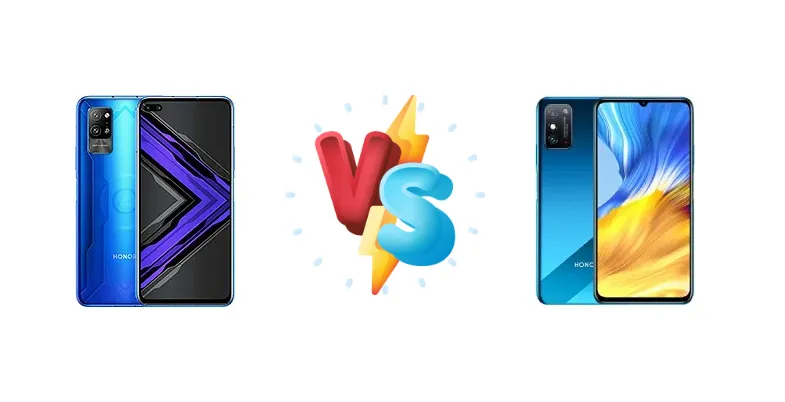
The Honor Play4 Pro and X10 Max 5G represent Honor’s approach to delivering 5G connectivity at competitive price points. However, they diverge significantly in their core processing power, utilizing different chipsets – the Kirin 990 and the MediaTek Dimensity 800 respectively. This comparison dissects these differences, helping you determine which device best suits your needs, whether you prioritize raw performance or sustained efficiency.
🏆 Quick Verdict
For users demanding the highest possible performance in tasks like gaming and video editing, the Honor Play4 Pro, powered by the Kirin 990, is the clear winner. However, the Honor X10 Max 5G offers a compelling balance of performance and efficiency, making it a strong contender for everyday users and those prioritizing battery life.
| Network |
|---|
| 2G bands | GSM 850 / 900 / 1800 / 1900 | GSM 850 / 900 / 1800 / 1900 |
| 3G bands | HSDPA 850 / 900 / 1700(AWS) / 1900 / 2100 | HSDPA 800 / 850 / 900 / 1700(AWS) / 1900 / 2100 |
| 4G bands | 1, 2, 3, 4, 5, 7, 8, 12, 17, 18, 19, 26, 34, 38, 39, 40, 41 | 1, 2, 3, 4, 5, 8, 18, 19, 26, 34, 38, 39, 40, 41 |
| 5G bands | 1, 3, 41, 77, 78, 79 SA/NSA | 1, 3, 38, 41, 77, 78, 79, 80, 84 SA/NSA |
| Speed | HSPA, LTE, 5G | HSPA, LTE, 5G |
| Technology | GSM / CDMA / HSPA / LTE / 5G | GSM / HSPA / LTE / 5G |
| | CDMA 800 & TD-SCDMA | - |
| Launch |
|---|
| Announced | 2020, June 03. Released 2020, June 10 | 2020, July 02. Released 2020, July 03 |
| Status | Discontinued | Discontinued |
| Body |
|---|
| Dimensions | 162.7 x 75.8 x 8.9 mm (6.41 x 2.98 x 0.35 in) | 174.4 x 84.9 x 8.3 mm (6.87 x 3.34 x 0.33 in) |
| SIM | Nano-SIM + Nano-SIM | Nano-SIM + Nano-SIM |
| Weight | 213 g (7.51 oz) | 232 g (8.18 oz) |
| Display |
|---|
| Resolution | 1080 x 2400 pixels, 20:9 ratio (~401 ppi density) | 1080 x 2280 pixels, 19:9 ratio (~356 ppi density) |
| Size | 6.57 inches, 104.2 cm2 (~84.5% screen-to-body ratio) | 7.09 inches, 125.5 cm2 (~84.7% screen-to-body ratio) |
| Type | IPS LCD | IPS LCD, HDR10 |
| Platform |
|---|
| CPU | Octa-core (2x2.86 GHz Cortex-A76 & 2x2.09 GHz Cortex-A76 & 4x1.86 GHz Cortex-A55) | Octa-core (4x2.0 GHz Cortex-A76 & 4x2.0 GHz Cortex-A55) |
| Chipset | Kirin 990 (7 nm) | Mediatek Dimensity 800 (7 nm) |
| GPU | Mali-G76 MP16 | Mali-G57MP4 |
| OS | Android 10, Magic UI 3.1, no Google Play Services | Android 10, Magic UI 3.1, no Google Play Services |
| Memory |
|---|
| Card slot | No | Nano Memory (uses shared SIM slot) |
| Internal | 128GB 8GB RAM | 64GB 6GB RAM, 128GB 6GB RAM, 128GB 8GB RAM |
| Main Camera |
|---|
| Dual | 40 MP, f/1.8, 27mm (wide), 1/1.7", PDAF
8 MP, f/2.4, 80mm (telephoto), PDAF, OIS, 3x optical zoom | 48 MP, f/1.8, 26mm (wide), 1/2.0", 0.8µm, PDAF
Auxiliary lens |
| Features | Laser AF, LED flash, HDR, panorama | LED flash, panorama, HDR |
| Video | 4K@30/60fps, 1080p@30fps, 1080p@960fps, OIS, gyro-EIS | 4K@30fps, 1080p@30fps, gyro-EIS |
| Selfie camera |
|---|
| Dual | 32 MP, f/2.0, 26mm (wide), 1/2.8", 0.8µm
8 MP, (ultrawide) | - |
| Features | Panorama | HDR |
| Single | - | 8 MP |
| Video | 4K@30fps, 1080p@30fps, gyro-EIS | 1080p@30fps |
| Sound |
|---|
| 3.5mm jack | No | Yes |
| 35mm jack | No | Yes |
| Loudspeaker | Yes | Yes, with dual speakers |
| Comms |
|---|
| Bluetooth | 5.1, A2DP, LE | 5.1, A2DP, LE |
| NFC | Yes | Yes |
| Positioning | GPS, BDS | GPS, GLONASS, BDS |
| Radio | No | No |
| USB | USB Type-C 2.0, OTG | USB Type-C 2.0, OTG |
| WLAN | Wi-Fi 802.11 a/b/g/n/ac, dual-band, Wi-Fi Direct | Wi-Fi 802.11 a/b/g/n/ac, dual-band, Wi-Fi Direct |
| Features |
|---|
| Sensors | Fingerprint (side-mounted), accelerometer, gyro, proximity, compass | Fingerprint (side-mounted), accelerometer, gyro, proximity, compass |
| Battery |
|---|
| Charging | 40W wired, 70% in 30 min
Reverse wired | 22.5W wired |
| Type | Li-Po 4200 mAh | Li-Po 5000 mAh |
| Misc |
|---|
| Colors | Black, Blue, Light Blue | Black, Blue, Silver |
| Models | OXP-AN00 | KKG-AN00 |
| Price | About 360 EUR | About 240 EUR |
Honor Play4 Pro
- Faster charging with 40W support.
- More powerful Kirin 990 chipset for demanding tasks.
- Potentially superior camera image processing.
- Higher potential for thermal throttling.
- May consume more battery power under heavy load.
Honor X10 Max 5G
- More efficient Dimensity 800 chipset.
- Potentially better sustained performance.
- Competitive 5G connectivity.
- Slower 22.5W charging.
- Less powerful CPU and GPU compared to the Play4 Pro.
Display Comparison
While specific display details are unavailable, both phones likely feature LCD panels given their market positioning. The key difference lies in the processing power driving the display. The Kirin 990’s more powerful ISP could translate to slightly better image processing for display output. However, without knowing panel specs like resolution and refresh rate, a definitive comparison is impossible. Bezels are likely comparable, reflecting the mid-range nature of both devices.
Camera Comparison
Without detailed camera specifications, it’s difficult to make a precise comparison. However, the Kirin 990’s superior image signal processor (ISP) likely provides better image processing capabilities, potentially resulting in improved dynamic range and low-light performance. The X10 Max 5G’s Dimensity 800 ISP is still capable, but likely lags behind the Kirin 990 in terms of processing speed and features. The absence of information on sensor sizes and lens apertures makes a definitive judgment impossible, but the Play4 Pro’s chipset suggests a more sophisticated camera system.
Performance
The Kirin 990 in the Play4 Pro boasts a more complex CPU configuration – two high-performance Cortex-A76 cores clocked at 2.86 GHz, paired with two more Cortex-A76 cores at 2.09 GHz, and four efficiency-focused Cortex-A55 cores. The X10 Max 5G’s Dimensity 800 uses a simpler quad-core Cortex-A76 setup at 2.0 GHz, alongside four Cortex-A55 cores. This translates to a theoretical performance advantage for the Play4 Pro in CPU-intensive tasks. The Kirin 990’s GPU is also more powerful, offering a better gaming experience. However, the Dimensity 800’s 7nm process and efficient core design may lead to better sustained performance under load, mitigating the raw power difference. The Play4 Pro's potential for thermal throttling is higher.
Battery Life
The Honor X10 Max 5G’s 22.5W charging is significantly slower than the Play4 Pro’s 40W charging, allowing the Play4 Pro to reach 70% charge in just 30 minutes. While battery capacity isn’t specified, the Dimensity 800’s efficiency could offset a potentially smaller battery size in the X10 Max 5G, offering comparable real-world battery life. The Play4 Pro’s faster charging is a significant convenience factor, especially for users who frequently need to top up their battery quickly.
Buying Guide
Buy the Honor Play4 Pro if you need a phone capable of handling demanding applications and games with minimal slowdown, and if you value the potential for faster processing speeds. Buy the Honor X10 Max 5G if you prefer a device that prioritizes sustained performance, efficient power consumption, and a more balanced user experience for everyday tasks, without sacrificing 5G connectivity.
Frequently Asked Questions
❓ Will the Kirin 990 in the Play4 Pro overheat during extended gaming sessions?
The Kirin 990 is a powerful chip, and while it offers excellent peak performance, it is known to generate more heat than the Dimensity 800. Prolonged gaming at high settings may lead to thermal throttling, reducing performance to manage temperatures. The X10 Max 5G’s Dimensity 800 is more likely to maintain consistent performance over longer periods.
❓ Does the Honor X10 Max 5G’s Dimensity 800 support advanced 5G features like carrier aggregation?
The MediaTek Dimensity 800 is a capable 5G chipset and does support carrier aggregation, allowing it to combine multiple 5G bands for faster and more reliable speeds. However, the specific 5G bands supported will depend on the region and carrier. Check with your local carrier for compatibility details.
❓ Is the difference in charging speed between the two phones noticeable in daily use?
Yes, the 40W charging on the Play4 Pro is significantly faster than the 22.5W charging on the X10 Max 5G. The Play4 Pro can gain a substantial amount of charge in a short period, making it ideal for users who need to quickly top up their battery. The X10 Max 5G’s charging is still adequate, but will take considerably longer to fully charge.