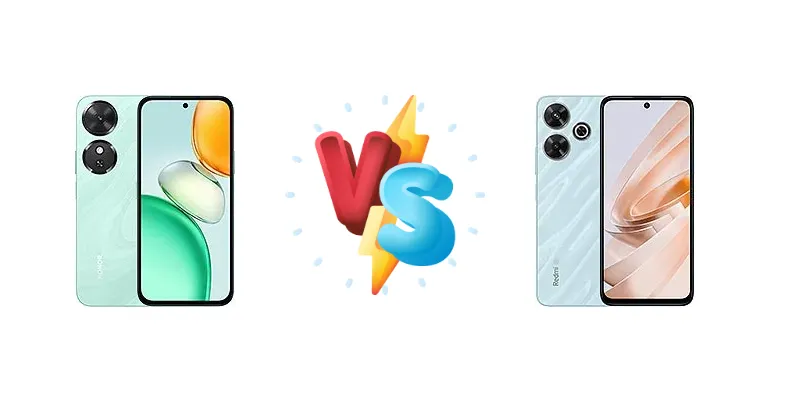
The sub-$200 smartphone market is fiercely competitive, and the Honor Play10C and Xiaomi Redmi Note 13R represent compelling options. While both aim to deliver essential features at an accessible price, they diverge significantly in their core hardware, particularly in their chipsets and charging capabilities. This comparison dissects these differences to determine which device offers the best value for your money.
🏆 Quick Verdict
For the average user prioritizing fast charging and potentially better long-term software support, the Xiaomi Redmi Note 13R is the stronger choice. Its Snapdragon 4+ Gen 2, built on a more efficient 4nm process, coupled with 33W charging, provides a noticeable advantage over the Honor Play10C's Dimensity 6300 and 15W charging.
| Network |
|---|
| 2G bands | GSM 850 / 900 / 1800 / 1900 | GSM 850 / 900 / 1800 / 1900 |
| 3G bands | HSDPA 850 / 900 / 1900 / 2100 | HSDPA 850 / 900 / 2100 |
| 4G bands | LTE | 1, 3, 5, 8, 34, 38, 39, 40, 41 |
| 5G bands | SA/NSA | 1, 5, 8, 28, 41, 78 SA/NSA |
| Speed | HSPA, LTE, 5G | HSPA, LTE, 5G |
| Technology | GSM / CDMA / HSPA / CDMA2000 / LTE / 5G | GSM / CDMA / HSPA / EVDO / LTE / 5G |
| Launch |
|---|
| Announced | 2025, August 08 | 2024, May 17 |
| Status | Available. Released Exp. release 2025, August 12 | Available. Released 2024, May 17 |
| Body |
|---|
| Build | - | Glass front, plastic frame, glass back |
| Dimensions | 164 x 75.6 x 8.4 mm (6.46 x 2.98 x 0.33 in) | 168.6 x 76.3 x 8.2 mm (6.64 x 3.00 x 0.32 in) |
| SIM | Nano-SIM + Nano-SIM | Nano-SIM + Nano-SIM |
| Weight | 197 g (6.95 oz) | 205 g (7.23 oz) |
| Display |
|---|
| Resolution | 720 x 1604 pixels, 20:9 ratio (~266 ppi density) | 1080 x 2460 pixels (~396 ppi density) |
| Size | 6.61 inches, 105.3 cm2 (~84.9% screen-to-body ratio) | 6.79 inches, 109.5 cm2 (~85.1% screen-to-body ratio) |
| Type | TFT LCD, 120Hz, 1010 nits (peak) | IPS LCD, 120Hz, 550 nits |
| Platform |
|---|
| CPU | Octa-core (2x2.4 GHz Cortex-A76 & 6x2.0 GHz Cortex-A55) | Octa-core (2x2.3 GHz Cortex-A78 & 6x1.95 GHz Cortex-A55) |
| Chipset | Mediatek Dimensity 6300 (6 nm) | Qualcomm SM4450 Snapdragon 4+ Gen 2 (4 nm) |
| GPU | Mali-G57 MC2 | Adreno 613 |
| OS | Android 15, MagicOS 9 | Android 14, HyperOS |
| Memory |
|---|
| Card slot | No | No |
| Internal | 128GB 4GB RAM, 128GB 6GB RAM, 256GB 8GB RAM | 128GB 6GB RAM, 128GB 8GB RAM, 256GB 8GB RAM, 256GB 12GB RAM, 512GB 12GB RAM |
| Main Camera |
|---|
| Dual | - | 50 MP, f/1.8, (wide), 1/2.76", 0.64µm, PDAF
2 MP (macro) |
| Features | LED flash, HDR | LED flash, HDR |
| Single | 13 MP, f/1.8, (wide) | - |
| Video | 1080p@30fps | 1080p@30fps |
| Selfie camera |
|---|
| Single | 5 MP, f/2.2, (wide) | 8 MP, (wide), 1/4.0", 1.12µm |
| Video | 1080p@30fps | 1080p@30fps |
| Sound |
|---|
| 35mm jack | Yes | Yes |
| Loudspeaker | Yes | Yes |
| Comms |
|---|
| Bluetooth | 5.3, A2DP, LE, aptX HD | 5.3, A2DP, LE |
| Infrared port | - | Yes |
| NFC | No | Yes |
| Positioning | GPS, GLONASS, GALILEO, BDS | GPS, GLONASS, GALILEO, BDS |
| Radio | No | No |
| USB | USB Type-C 2.0, OTG | USB Type-C |
| WLAN | Wi-Fi 802.11 a/b/g/n/ac, dual-band, Wi-Fi Direct | Wi-Fi 802.11 a/b/g/n/ac, dual-band |
| Features |
|---|
| Sensors | Fingerprint (side-mounted), accelerometer, proximity, compass | Fingerprint (side-mounted), accelerometer, compass |
| Battery |
|---|
| Charging | 15W wired
2.5W reverse wired | 33W wired |
| Type | Li-Po 6000 mAh | 5030 mAh |
| Misc |
|---|
| Colors | Black, White, Green | Black, Blue, Silver |
| Models | NIC-AN00 | 2406ERN9CC |
| Price | About 80 EUR | About 180 EUR |
Honor Play10C
- Potentially refined software experience (regional variations apply)
- Reverse wired charging capability
- Slightly higher CPU clock speeds on prime cores
- Less efficient 6nm chipset
- Significantly slower 15W charging
- Potentially lower sustained performance due to thermal throttling
Xiaomi Redmi Note 13R
- More efficient 4nm Snapdragon 4+ Gen 2 chipset
- Faster 33W wired charging
- Wider ecosystem and accessory availability
- Software experience can be heavily customized (MIUI)
- Potentially less optimized software compared to Honor (regional variations apply)
- May lack reverse wireless charging
Display Comparison
Neither device boasts a standout display. Both are likely to feature LCD panels, typical for this price bracket. However, detailed display specs (resolution, brightness, color gamut) are missing. The focus here is on internal components. We can assume both will offer adequate viewing experiences for everyday tasks, but neither will excel in outdoor visibility or color accuracy.
Camera Comparison
Without detailed camera specifications, a direct comparison is difficult. However, it’s safe to assume both phones will feature a multi-camera setup with a primary sensor and supporting lenses. The absence of information regarding sensor size and aperture makes it impossible to determine which phone will capture better images in low light. The Redmi Note 13R’s image signal processor (ISP) within the Snapdragon 4+ Gen 2 may offer slightly more advanced image processing capabilities, but this is speculative. We can expect both phones to perform adequately in well-lit conditions.
Performance
The core difference lies in the chipsets. The Xiaomi Redmi Note 13R utilizes the Qualcomm SM4450 Snapdragon 4+ Gen 2 (4nm), featuring a 2x2.3 GHz Cortex-A78 & 6x1.95 GHz Cortex-A55 configuration. This 4nm fabrication process is a significant advantage over the Honor Play10C’s Mediatek Dimensity 6300 (6nm). The smaller node generally translates to better power efficiency and potentially lower thermal throttling during sustained workloads. While the Dimensity 6300’s Cortex-A76 cores have a slightly higher peak clock speed (2.4 GHz vs 2.3 GHz), the architectural improvements and process node of the Snapdragon 4+ Gen 2 likely provide superior real-world performance, especially in gaming and multitasking. The Redmi Note 13R will likely handle graphically intensive tasks with more consistency.
Battery Life
The Redmi Note 13R’s 33W wired charging is a clear win over the Honor Play10C’s 15W charging. This translates to significantly faster top-up times. While battery capacity isn’t specified, the more efficient Snapdragon 4+ Gen 2 in the Redmi Note 13R could potentially offset a slightly smaller battery capacity, offering comparable or even better battery life in real-world usage. The 2.5W reverse wired charging on the Honor Play10C is a niche feature unlikely to be a deciding factor for most users.
Buying Guide
Buy the Honor Play10C if you prioritize a potentially more refined software experience (depending on regional Honor builds) and are comfortable with slower charging speeds. Buy the Xiaomi Redmi Note 13R if you value faster charging, a more modern chipset fabrication process for improved efficiency, and a wider ecosystem of accessories and support within the Xiaomi brand.
Frequently Asked Questions
❓ Will the Snapdragon 4+ Gen 2 in the Redmi Note 13R handle demanding games like PUBG Mobile?
The Snapdragon 4+ Gen 2 is capable of running PUBG Mobile, but expect to play at medium settings for a smooth experience. The 4nm process helps with thermal management, reducing the likelihood of significant frame drops during extended gaming sessions. However, it won't deliver the same performance as higher-end chipsets.
❓ How long will it take to fully charge the Redmi Note 13R with the 33W charger?
While a precise time requires testing, a 33W charger should fully charge the Redmi Note 13R from 0% to 100% in approximately 60-75 minutes, depending on battery capacity. This is considerably faster than the Honor Play10C's 15W charging, which could take over two hours.
❓ Does the Honor Play10C support widevine L1 for HD streaming on Netflix and other platforms?
This information is not readily available. Honor often includes Widevine L1 support in their devices, but it's crucial to verify this specification before purchasing if HD streaming is a priority. Check user forums or Honor's official documentation for confirmation.
❓ Is the software on the Xiaomi Redmi Note 13R heavily laden with bloatware?
Xiaomi's MIUI software is known for including pre-installed apps (bloatware). However, many of these can be uninstalled. Recent versions of MIUI have reduced the amount of bloatware, but it's still a consideration for users who prefer a cleaner software experience.