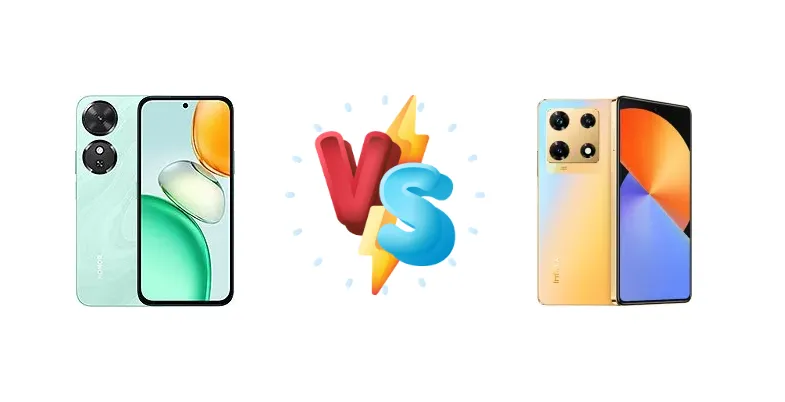
The Honor Play10C and Infinix Note 30 Pro represent compelling options in the increasingly competitive budget smartphone space. While both leverage Mediatek's 6nm process for efficiency, they diverge significantly in charging technology and overall feature sets. This comparison dissects these differences to determine which device delivers the most value for your money.
🏆 Quick Verdict
For the average user prioritizing rapid charging and versatile connectivity, the Infinix Note 30 Pro is the clear winner. Its 68W charging and wireless capabilities significantly outperform the Honor Play10C's slower 15W wired charging, making it ideal for those on the go. However, the Play10C remains a viable option for users on a tighter budget.
| Network |
|---|
| 2G bands | GSM 850 / 900 / 1800 / 1900 | GSM 850 / 900 / 1800 / 1900 |
| 3G bands | HSDPA 850 / 900 / 1900 / 2100 | HSDPA 850 / 900 / 1700(AWS) / 1900 / 2100 |
| 4G bands | LTE | 1, 2, 3, 4, 5, 7, 8, 12, 17, 20, 28, 38, 40, 41, 66 |
| 5G bands | SA/NSA | - |
| Speed | HSPA, LTE, 5G | HSPA, LTE |
| Technology | GSM / CDMA / HSPA / CDMA2000 / LTE / 5G | GSM / HSPA / LTE |
| Launch |
|---|
| Announced | 2025, August 08 | 2023, May 22 |
| Status | Available. Released Exp. release 2025, August 12 | Available. Released 2023, May 22 |
| Body |
|---|
| Build | - | Glass front, plastic frame, glass back |
| Dimensions | 164 x 75.6 x 8.4 mm (6.46 x 2.98 x 0.33 in) | 162.7 x 76 x 8.2 mm (6.41 x 2.99 x 0.32 in) |
| SIM | Nano-SIM + Nano-SIM | Nano-SIM + Nano-SIM |
| Weight | 197 g (6.95 oz) | 203 g (7.16 oz) |
| | - | IP53 |
| Display |
|---|
| Resolution | 720 x 1604 pixels, 20:9 ratio (~266 ppi density) | 1080 x 2400 pixels, 20:9 ratio (~395 ppi density) |
| Size | 6.61 inches, 105.3 cm2 (~84.9% screen-to-body ratio) | 6.67 inches, 107.4 cm2 (~86.9% screen-to-body ratio) |
| Type | TFT LCD, 120Hz, 1010 nits (peak) | AMOLED, 1B colors, 120Hz, 900 nits (peak) |
| | - | * the display diagonal size and resolution is unconfirmed |
| Platform |
|---|
| CPU | Octa-core (2x2.4 GHz Cortex-A76 & 6x2.0 GHz Cortex-A55) | Octa-core (2x2.2 GHz Cortex-A76 & 6x2.0 GHz Cortex-A55) |
| Chipset | Mediatek Dimensity 6300 (6 nm) | Mediatek Helio G99 (6 nm) |
| GPU | Mali-G57 MC2 | Mali-G57 MC2 |
| OS | Android 15, MagicOS 9 | Android 13, XOS 13 |
| Memory |
|---|
| Card slot | No | microSDXC (dedicated slot) |
| Internal | 128GB 4GB RAM, 128GB 6GB RAM, 256GB 8GB RAM | 256GB 8GB RAM |
| Main Camera |
|---|
| Features | LED flash, HDR | Quad-LED flash, HDR, panorama |
| Single | 13 MP, f/1.8, (wide) | - |
| Triple | - | 108 MP, (wide), 1/1.67", PDAF
2 MP (macro)
Auxiliary lens |
| Video | 1080p@30fps | 1440p@30fps, 1080p@30fps |
| Selfie camera |
|---|
| Features | - | LED flash, HDR |
| Single | 5 MP, f/2.2, (wide) | 32 MP, f/2.0, (wide), 1/2.8" |
| Video | 1080p@30fps | 1080p@30fps |
| Sound |
|---|
| 3.5mm jack | - | Yes |
| 35mm jack | Yes | Yes |
| Loudspeaker | Yes | Yes, with dual speakers |
| | - | Sound by JBL
24-bit/192kHz audio |
| Comms |
|---|
| Bluetooth | 5.3, A2DP, LE, aptX HD | Yes |
| NFC | No | Yes (market/region dependent) |
| Positioning | GPS, GLONASS, GALILEO, BDS | GPS |
| Radio | No | FM radio |
| USB | USB Type-C 2.0, OTG | USB Type-C 2.0, OTG |
| WLAN | Wi-Fi 802.11 a/b/g/n/ac, dual-band, Wi-Fi Direct | Wi-Fi 802.11 a/b/g/n/ac, dual-band, Wi-Fi Direct |
| Features |
|---|
| Sensors | Fingerprint (side-mounted), accelerometer, proximity, compass | Fingerprint (side-mounted), accelerometer, gyro, proximity, compass |
| Battery |
|---|
| Charging | 15W wired
2.5W reverse wired | 68W wired, PD3.0, 80% in 30 min
15W wireless
Reverse wireless |
| Type | Li-Po 6000 mAh | 5000 mAh |
| Misc |
|---|
| Colors | Black, White, Green | Magic Black, Variable Gold |
| Models | NIC-AN00 | X678B |
| Price | About 80 EUR | - |
Honor Play10C
- Potentially slightly faster CPU performance due to higher clocked cores.
- Lower price point makes it accessible to a wider audience.
- Reliable Mediatek chipset for everyday tasks.
- Significantly slower 15W charging.
- Lacks wireless charging capabilities.
- Limited feature set compared to the Infinix Note 30 Pro.
Infinix Note 30 Pro
- Ultra-fast 68W wired charging.
- Convenient 15W wireless charging and reverse wireless charging.
- Potentially better camera performance (speculation based on positioning).
- Slightly lower CPU clock speeds compared to the Honor Play10C.
- Likely a higher price tag.
- May not be as readily available in all markets.
Display Comparison
Neither device's display specifications are provided, so a direct comparison is limited. However, given the price points, both likely utilize LCD panels. The Infinix Note 30 Pro, being positioned slightly higher, may benefit from a higher peak brightness and potentially better color calibration. The absence of information regarding refresh rates suggests both are likely capped at 60Hz, prioritizing battery life over visual fluidity.
Camera Comparison
Without detailed camera specifications, a comprehensive comparison is challenging. Both phones likely feature multi-camera setups, but the quality will heavily depend on sensor size and image processing algorithms. The absence of information regarding OIS suggests neither device offers optical image stabilization. The focus should be on the main sensor's megapixel count and aperture, as these directly impact low-light performance. It's reasonable to assume the Infinix Note 30 Pro, given its slightly higher positioning, may incorporate a more capable primary sensor.
Performance
The Infinix Note 30 Pro's Mediatek Helio G99 and the Honor Play10C's Dimensity 6300 both employ a 6nm process, indicating similar efficiency. However, the Dimensity 6300 features slightly higher clocked Cortex-A76 cores (2.4 GHz vs 2.2 GHz), potentially offering a marginal performance advantage in CPU-intensive tasks. Both chipsets pair these cores with the same Cortex-A55 efficiency cores. Real-world performance differences will likely be subtle, with both handling everyday tasks and light gaming adequately. The G99's Mali-G57 MC2 GPU is a known performer in its class, and should provide a smooth experience for most mobile games at medium settings.
Battery Life
The Infinix Note 30 Pro's 68W wired charging is a game-changer in this price segment, promising an 80% charge in just 30 minutes. This drastically reduces downtime compared to the Honor Play10C's 15W charging. The addition of 15W wireless charging and reverse wireless charging on the Infinix Note 30 Pro further enhances its versatility. While battery capacity isn't specified, the faster charging speeds mitigate the impact of a potentially smaller battery, offering a more convenient user experience.
Buying Guide
Buy the Honor Play10C if you need a functional, reliable smartphone for basic tasks and prioritize a lower upfront cost. It's a solid choice for first-time smartphone users or those needing a secondary device. Buy the Infinix Note 30 Pro if you prefer a faster, more feature-rich experience, particularly if quick charging and wireless convenience are essential. It's geared towards users who actively consume media and demand longer battery life with minimal downtime.
Frequently Asked Questions
❓ Does the Helio G99 in the Infinix Note 30 Pro get hot during extended gaming sessions?
The Helio G99 is generally efficient, but prolonged gaming will inevitably generate heat. However, the 6nm process and Infinix's thermal management solutions should prevent significant throttling, allowing for sustained performance. Expect some warmth, but not to the point of discomfort or severe performance drops.
❓ Is the 15W reverse wireless charging on the Infinix Note 30 Pro useful for charging accessories like earbuds?
Yes, the 15W reverse wireless charging is quite practical for topping up accessories like true wireless earbuds or smartwatches. While it won't be as fast as a dedicated charger, it provides a convenient way to share power on the go without needing extra cables.
❓ How long does it realistically take to fully charge the Infinix Note 30 Pro from 0% using the 68W charger?
While Infinix claims 80% in 30 minutes, a full 0-100% charge with the 68W charger will likely take around 45-50 minutes. This is still significantly faster than the Honor Play10C's charging time.