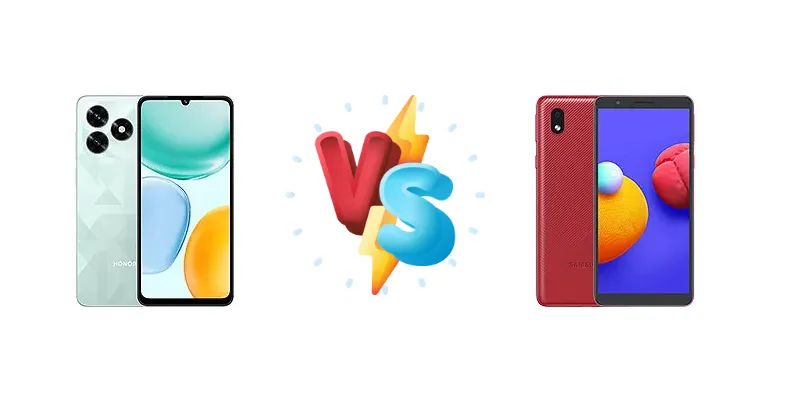
The Honor Play10A and Samsung Galaxy A01 Core represent the extreme end of the budget smartphone spectrum. While both aim to deliver essential smartphone functionality at a low price, they differ significantly in their internal hardware. This comparison dissects those differences, focusing on how the chipset choices impact real-world performance and usability.
🏆 Quick Verdict
For the average user needing a responsive experience beyond basic tasks, the Honor Play10A is the clear winner. Its Mediatek Helio G81 chipset offers a substantial performance advantage over the Galaxy A01 Core’s aging MT6739, making it better suited for multitasking and light gaming. However, the A01 Core remains a viable option for extremely basic use cases.
| Network |
|---|
| 2G bands | GSM 850 / 900 / 1800 / 1900 | GSM 850 / 900 / 1800 / 1900 |
| 3G bands | HSDPA 850 / 900 / 1900 / 2100 | HSDPA 850 / 900 / 2100 |
| 4G bands | LTE | 1, 3, 5, 7, 8, 20, 28, 38, 40, 41 |
| Speed | HSPA, LTE | HSPA 21.1/5.76 Mbps, LTE |
| Technology | GSM / HSPA / LTE | GSM / HSPA / LTE |
| Launch |
|---|
| Announced | 2025, October 23 | 2020, July 21. Released 2020, August 06 |
| Status | Available. Released 2025, October 23 | Discontinued |
| Body |
|---|
| Build | - | Plastic back, plastic frame |
| Dimensions | 167 x 77 x 7.9 mm (6.57 x 3.03 x 0.31 in) | 141.7 x 67.5 x 8.6 mm (5.58 x 2.66 x 0.34 in) |
| SIM | Nano-SIM + Nano-SIM | · Nano-SIM· Nano-SIM + Nano-SIM |
| Weight | 186 g (6.56 oz) | 150 g (5.29 oz) |
| Display |
|---|
| Resolution | 720 x 1600 pixels, 20:9 ratio (~260 ppi density) | 720 x 1480 pixels, 18.5:9 ratio (~311 ppi density) |
| Size | 6.74 inches, 109.7 cm2 (~85.3% screen-to-body ratio) | 5.3 inches, 71.3 cm2 (~74.5% screen-to-body ratio) |
| Type | TFT LCD, 90Hz | PLS LCD |
| Platform |
|---|
| CPU | Octa-core (2x2.0 GHz Cortex-A75 & 6x1.7 GHz Cortex-A55) | Quad-core 1.5 GHz Cortex-A53 |
| Chipset | Mediatek Helio G81 (12 nm) | Mediatek MT6739 (28 nm) |
| GPU | Mali-G52 MC2 | PowerVR GE8100 |
| OS | Android 15, MagicOS 9 | Android 10 (Go edition) |
| Memory |
|---|
| Card slot | microSDXC (uses shared SIM slot) | microSDXC (dedicated slot) |
| Internal | 128GB 4GB RAM | 16GB 1GB RAM, 16GB 2GB RAM, 32GB 2GB RAM |
| | - | eMMC 5.1 |
| Main Camera |
|---|
| Features | LED flash, HDR, panorama | LED flash |
| Single | 50 MP, f/1.8, (wide), PDAF
Auxiliary lens | 8 MP, f/2.2, AF |
| Video | 1080p@30fps | 1080p@30fps |
| Selfie camera |
|---|
| Single | 5 MP, f/2.2, (wide) | 5 MP, f/2.4 |
| Video | 1080p@30fps | - |
| Sound |
|---|
| 3.5mm jack | - | Yes |
| 35mm jack | Yes | Yes |
| Loudspeaker | Yes | Yes |
| Comms |
|---|
| Bluetooth | 5.1, A2DP, LE, aptX HD | 5.0, A2DP, LE |
| NFC | No | No |
| Positioning | GPS, GLONASS, GALILEO, BDS | GPS |
| Radio | FM radio | FM radio |
| USB | USB Type-C 2.0, OTG | microUSB 2.0 |
| WLAN | Wi-Fi 802.11 a/b/g/n/ac, dual-band, Wi-Fi Direct | Wi-Fi 802.11 b/g/n, Wi-Fi Direct |
| Features |
|---|
| Sensors | Fingerprint (side-mounted), accelerometer, proximity | Accelerometer |
| Battery |
|---|
| Charging | 15W wired | - |
| Type | Li-Po 5260 mAh | Li-Ion 3000 mAh |
| Misc |
|---|
| Colors | Ocean Cyan | Black, Blue, Red |
| Models | NLA-LX3 | SM-A013F, SM-A013F/DS, SM-A013G, SM-A013G/DS, SM-A013M |
| Price | About 80 EUR | About 150 EUR |
| SAR EU | - | 0.64 W/kg (head) 1.18 W/kg (body) |
Honor Play10A
- Significantly faster processor for smoother multitasking.
- More efficient chipset for longer battery life.
- Better image processing capabilities.
- May be slightly more expensive than the A01 Core.
- 15W charging is not particularly fast by modern standards.
Samsung Galaxy A01 Core
- Extremely affordable price point.
- Simple and easy-to-use interface.
- Acceptable for very basic communication tasks.
- Slow processor struggles with multitasking and demanding apps.
- Inefficient chipset leads to shorter battery life.
- Limited camera performance.
Display Comparison
Neither device boasts a standout display. While specific display specs (resolution, panel type) are not provided, the focus here is on the underlying processing power needed to drive a smooth visual experience. The Helio G81 in the Play10A has a dedicated image signal processor (ISP) and GPU capable of handling higher resolution displays and faster refresh rates, should the Play10A feature them. The MT6739 in the A01 Core is likely paired with a lower-resolution panel and will struggle with demanding graphical tasks.
Camera Comparison
Without detailed camera specifications, it’s difficult to make a direct comparison. However, the Helio G81’s ISP in the Play10A is more advanced, enabling better image processing and potentially supporting higher-resolution sensors. The MT6739’s ISP is comparatively limited. While both phones likely feature basic camera setups, the Play10A will likely produce sharper, more detailed images, especially in challenging lighting conditions. The A01 Core will likely rely heavily on software processing to compensate for its less capable hardware.
Performance
The core difference lies in the chipsets. The Honor Play10A’s Mediatek Helio G81, built on a 12nm process, features an octa-core CPU (2x2.0 GHz Cortex-A75 & 6x1.7 GHz Cortex-A55). This architecture provides a significant performance boost over the Samsung Galaxy A01 Core’s Mediatek MT6739, a quad-core 1.5 GHz Cortex-A53 processor fabricated on a much older 28nm process. The 28nm node of the MT6739 is less efficient, leading to higher power consumption for the same level of performance, and significantly lower peak performance. The Cortex-A75 cores in the G81 offer a substantial improvement in single-core performance, crucial for app launch times and general responsiveness. The G81’s GPU will also deliver a far superior gaming experience.
Battery Life
Both devices likely feature similar battery capacities, given their market segment. However, the Helio G81’s 12nm process is more power-efficient than the MT6739’s 28nm process. This means the Play10A will likely achieve longer battery life under similar usage conditions. While the Play10A features 15W wired charging, the A01 Core’s charging speed is likely lower, resulting in longer charge times. The efficiency gains of the G81 translate to more usable screen-on time.
Buying Guide
Buy the Honor Play10A if you need a phone capable of handling more than just calls and texts – social media, streaming video, and even some casual gaming will be noticeably smoother. Buy the Samsung Galaxy A01 Core if your primary needs are limited to essential communication and you prioritize absolute affordability above all else, and are willing to accept significant performance limitations.
Frequently Asked Questions
❓ Will the Honor Play10A handle popular games like PUBG Mobile?
The Helio G81 is capable of running PUBG Mobile, but likely at lower graphics settings and frame rates to maintain a playable experience. Expect medium settings to be the sweet spot for a balance between visual quality and performance. The A01 Core will struggle significantly with PUBG Mobile.
❓ Is the Samsung Galaxy A01 Core suitable for video streaming?
The A01 Core can technically stream video, but the experience will likely be choppy and laggy, especially with higher resolutions. The MT6739 processor is simply not powerful enough to decode and render video smoothly. The Play10A will provide a much more enjoyable streaming experience.
❓ How much faster is the Honor Play10A in everyday tasks like opening apps?
The Honor Play10A will feel noticeably faster in everyday tasks. The Helio G81's octa-core CPU and more efficient architecture result in significantly quicker app launch times and smoother multitasking compared to the A01 Core's quad-core processor.
❓ Does the Honor Play10A support fast charging beyond 15W?
No, the Honor Play10A supports a maximum of 15W wired charging. While not the fastest charging available, it's still faster than the likely charging speed of the Samsung Galaxy A01 Core.