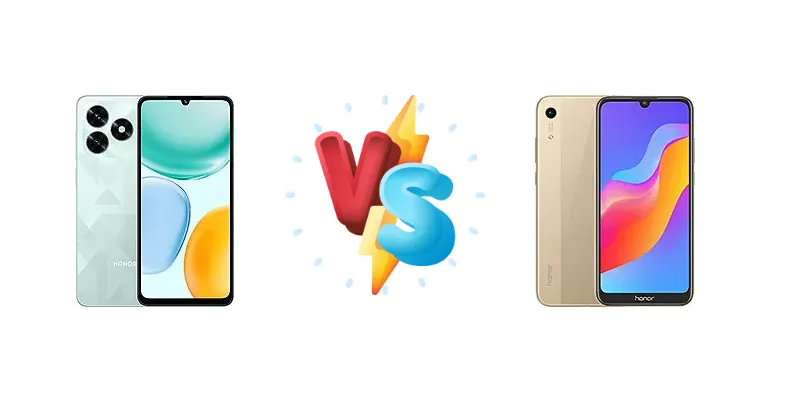
The Honor Play series consistently targets the value-conscious consumer, but the gap between the Play10A and the older Play 8A represents a significant generational leap in processing power. This comparison dissects the key differences between these two devices, focusing on how the newer Helio G81 chipset impacts real-world performance and whether the upgrade is worth considering for gamers and everyday users.
🏆 Quick Verdict
For most users, the Honor Play10A is the superior choice. Its Mediatek Helio G81 chipset offers a noticeable performance boost over the Play 8A’s Helio P35, translating to smoother multitasking and a better gaming experience. While both phones share a similar budget focus, the 10A provides a more future-proof platform.
| Network |
|---|
| 2G bands | GSM 850 / 900 / 1800 / 1900 | GSM 850 / 900 / 1800 / 1900 |
| 3G bands | HSDPA 850 / 900 / 1900 / 2100 | HSDPA 850 / 900 / 2100 |
| 4G bands | LTE | 1, 3, 5, 7, 8, 20, 40 |
| Speed | HSPA, LTE | HSPA 42.2/5.76 Mbps, LTE Cat4 150/50 Mbps |
| Technology | GSM / HSPA / LTE | GSM / HSPA / LTE |
| Launch |
|---|
| Announced | 2025, October 23 | 2019, January. Released 2019, January |
| Status | Available. Released 2025, October 23 | Discontinued |
| Body |
|---|
| Build | - | Glass front, plastic back, plastic frame |
| Dimensions | 167 x 77 x 7.9 mm (6.57 x 3.03 x 0.31 in) | 156.3 x 73.5 x 8 mm (6.15 x 2.89 x 0.31 in) |
| SIM | Nano-SIM + Nano-SIM | Nano-SIM + Nano-SIM |
| Weight | 186 g (6.56 oz) | 150 g (5.29 oz) |
| Display |
|---|
| Resolution | 720 x 1600 pixels, 20:9 ratio (~260 ppi density) | 720 x 1560 pixels, 19.5:9 ratio (~282 ppi density) |
| Size | 6.74 inches, 109.7 cm2 (~85.3% screen-to-body ratio) | 6.09 inches, 91.0 cm2 (~79.2% screen-to-body ratio) |
| Type | TFT LCD, 90Hz | IPS LCD |
| Platform |
|---|
| CPU | Octa-core (2x2.0 GHz Cortex-A75 & 6x1.7 GHz Cortex-A55) | Octa-core (4x2.3 GHz Cortex-A53 & 4x1.8 GHz Cortex-A53) |
| Chipset | Mediatek Helio G81 (12 nm) | Mediatek MT6765 Helio P35 (12 nm) |
| GPU | Mali-G52 MC2 | PowerVR GE8320 |
| OS | Android 15, MagicOS 9 | Android 9.0 (Pie), EMUI 9 |
| Memory |
|---|
| Card slot | microSDXC (uses shared SIM slot) | microSDXC (dedicated slot) |
| Internal | 128GB 4GB RAM | 32GB 3GB RAM, 64GB 3GB RAM |
| | - | eMMC 5.1 |
| Main Camera |
|---|
| Features | LED flash, HDR, panorama | LED flash, HDR, panorama |
| Single | 50 MP, f/1.8, (wide), PDAF
Auxiliary lens | 13 MP, f/1.8, PDAF |
| Video | 1080p@30fps | 1080p@30fps |
| Selfie camera |
|---|
| Features | - | HDR |
| Single | 5 MP, f/2.2, (wide) | 8 MP, f/2.0 |
| Video | 1080p@30fps | 1080p@30fps |
| Sound |
|---|
| 3.5mm jack | - | Yes |
| 35mm jack | Yes | Yes |
| Loudspeaker | Yes | Yes |
| Comms |
|---|
| Bluetooth | 5.1, A2DP, LE, aptX HD | 4.2, A2DP, LE |
| NFC | No | No |
| Positioning | GPS, GLONASS, GALILEO, BDS | GPS, GLONASS, BDS |
| Radio | FM radio | FM radio |
| USB | USB Type-C 2.0, OTG | microUSB 2.0 |
| WLAN | Wi-Fi 802.11 a/b/g/n/ac, dual-band, Wi-Fi Direct | Wi-Fi 802.11 b/g/n, Wi-Fi Direct |
| Features |
|---|
| Sensors | Fingerprint (side-mounted), accelerometer, proximity | Accelerometer, proximity |
| Battery |
|---|
| Charging | 15W wired | - |
| Type | Li-Po 5260 mAh | Li-Po 3020 mAh, non-removable |
| Misc |
|---|
| Colors | Ocean Cyan | Black, Blue, Gold, Red |
| Models | NLA-LX3 | JAT-L09, JAT-L29, JAT-AL00, JAT-TL00 |
| Price | About 80 EUR | About 100 EUR |
Honor Play10A
- Significantly faster processor for smoother performance.
- More efficient chipset for potentially longer battery life.
- Improved ISP for better image processing.
- May be slightly more expensive than the Play 8A.
- 15W charging is relatively slow compared to newer standards.
Honor Play 8A
- Lower price point makes it very accessible.
- Adequate for basic smartphone tasks.
- 15W charging is standard for its price range.
- Noticeably slower processor, impacting performance.
- Less efficient chipset, potentially leading to shorter battery life.
- Older architecture may limit future software updates.
Display Comparison
Both the Honor Play10A and Play 8A utilize 12nm chipsets, suggesting similar power efficiency considerations influenced display choices. While specific display specs (resolution, panel type) are not provided, the focus on processing power in the 10A suggests a potential for a slightly more responsive UI experience, even if the panels themselves are comparable. Bezels are likely similar given the budget nature of both devices, and color accuracy is expected to be standard for this price point.
Camera Comparison
Without detailed camera specifications, a direct comparison is limited. However, given the market segment, both phones likely feature similar primary camera sensors. The image signal processor (ISP) within the Helio G81 of the Play10A is likely more advanced, potentially resulting in better image processing, particularly in low-light conditions. The Play 8A’s ISP will be adequate for basic photography, but will likely exhibit more noise and less dynamic range. It's reasonable to assume both phones include auxiliary cameras (depth, macro) of limited utility.
Performance
The core difference lies in the chipsets. The Honor Play10A’s Mediatek Helio G81 features a more modern CPU architecture with its 2x2.0 GHz Cortex-A75 cores alongside 6x1.7 GHz Cortex-A55 cores. This contrasts with the Play 8A’s Helio P35, which uses 4x2.3 GHz Cortex-A53 cores and another 4x1.8 GHz Cortex-A53 cores. The Cortex-A75 cores in the G81 offer significantly improved single-core performance, crucial for app launch speeds and general responsiveness. The G81’s architecture also benefits from improved power efficiency, potentially leading to better sustained performance during gaming. The P35, while capable, will struggle with more demanding titles and multitasking scenarios.
Battery Life
Both devices feature 15W wired charging, indicating a similar charging experience. While battery capacity isn't specified, the more efficient Helio G81 in the Play10A will likely translate to slightly better battery life despite potentially having a similar capacity to the Play 8A. The G81’s improved power management allows it to deliver more performance per watt, extending usage time between charges.
Buying Guide
Buy the Honor Play10A if you prioritize smoother performance for gaming and demanding apps, and want a device that will feel responsive for longer. Buy the Honor Play 8A if you are on an extremely tight budget and primarily need a phone for basic tasks like calls, messaging, and light social media use, and are willing to accept slower performance.
Frequently Asked Questions
❓ Will the Honor Play10A handle popular games like PUBG Mobile smoothly?
The Helio G81 in the Play10A is specifically designed for gaming. While it won't deliver flagship-level performance, it should be capable of running PUBG Mobile at medium settings with a playable frame rate. The Play 8A’s Helio P35 will struggle with consistent performance in demanding games.
❓ Is the difference in performance between the Helio G81 and Helio P35 noticeable for everyday tasks like browsing and social media?
Yes, the difference is noticeable. The Play10A’s G81 chipset will result in faster app launch times, smoother scrolling, and a more responsive overall user experience. The Play 8A’s P35 may exhibit occasional lag or stuttering when multitasking or running multiple apps.
❓ Does the Honor Play10A support faster charging than the Play 8A?
No, both devices are limited to 15W wired charging. While not particularly fast by today's standards, it's consistent with the budget price point of both phones. Expect a full charge to take around 2-3 hours.