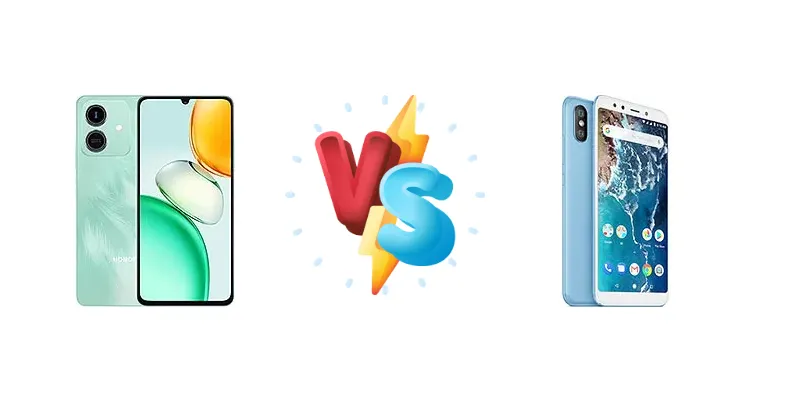
The Honor Play10 and Xiaomi Mi A2 (also known as the Mi 6X) represent compelling options in the budget smartphone space, but cater to different priorities. The Play10, with its newer Mediatek Helio G81 chipset, aims for sustained performance, while the Mi A2 leverages the Qualcomm Snapdragon 660 and a focus on quick charging. This comparison dissects their strengths and weaknesses to help you choose.
🏆 Quick Verdict
For the average user prioritizing sustained performance and potential for future software updates, the Honor Play10 is the better choice. While the Xiaomi Mi A2 boasts faster 18W charging, the Helio G81's architecture offers a more modern foundation, despite the slower 10W charging.
| Network |
|---|
| 2G bands | GSM 850 / 900 / 1800 / 1900 | GSM 850 / 900 / 1800 / 1900 |
| 3G bands | HSDPA 850 / 900 / 1700(AWS) / 1900 / 2100 | HSDPA 850 / 900 / 1700(AWS) / 1900 / 2100 - Global |
| 4G bands | 1, 2, 3, 4, 5, 7, 8, 13, 26, 28, 38, 40, 41, 66 | 1, 2, 3, 4, 5, 7, 8, 20, 38, 40 - Global |
| Speed | HSPA, LTE | HSPA 42.2/5.76 Mbps, LTE (3CA) Cat12 600/150 Mbps |
| Technology | GSM / HSPA / LTE | GSM / CDMA / HSPA / LTE |
| | - | 1, 3, 5, 7, 8, 34, 38, 39, 40, 41 - China |
| Launch |
|---|
| Announced | 2025, September 08 | 2018, July 24. Released 2018, July |
| Status | Available. Released 2025, September | Discontinued |
| Body |
|---|
| Build | - | Glass front, aluminum back, aluminum frame |
| Dimensions | 167.7 x 77.7 x 8.6 mm (6.60 x 3.06 x 0.34 in) | 158.7 x 75.4 x 7.3 mm (6.25 x 2.97 x 0.29 in) |
| SIM | Nano-SIM + Nano-SIM | Nano-SIM + Nano-SIM |
| Weight | 189 g (6.67 oz) | 166 g (5.86 oz) |
| Display |
|---|
| Resolution | 720 x 1600 pixels, 20:9 ratio (~260 ppi density) | 1080 x 2160 pixels, 18:9 ratio (~403 ppi density) |
| Size | 6.74 inches, 109.7 cm2 (~84.2% screen-to-body ratio) | 5.99 inches, 92.6 cm2 (~77.4% screen-to-body ratio) |
| Type | TFT LCD | IPS LCD |
| Platform |
|---|
| CPU | Octa-core (2x2.0 GHz Cortex-A75 & 6x1.7 GHz Cortex-A55) | Octa-core (4x2.2 GHz Kryo 260 Gold & 4x1.8 GHz Kryo 260 Silver) |
| Chipset | Mediatek Helio G81 (12 nm) | Qualcomm SDM660 Snapdragon 660 (14 nm) |
| GPU | Mali-G52 MC2 | Adreno 512 |
| OS | Android 15 (Go edition) | Android 8.1 (Oreo), upgradable to Android 9.0 (Pie), Android One |
| Memory |
|---|
| Card slot | microSDXC (uses shared SIM slot) | No |
| Internal | 64GB 3GB RAM, 128GB 4GB RAM | 32GB 4GB RAM, 64GB 4GB RAM, 128GB 6GB RAM |
| | - | eMMC 5.1 |
| Main Camera |
|---|
| Dual | - | 12 MP, f/1.8, 1/2.9", 1.25µm
20 MP, f/1.8, 1/2.8", 1.0µm, PDAF |
| Features | LED flash | Dual-LED flash, HDR, panorama |
| Single | 13 MP, f/2.2, (wide), AF | - |
| Video | 1080p@30fps | 4K@30fps, 1080p@30fps (gyro-EIS), 720p@120fps |
| Selfie camera |
|---|
| Features | - | LED flash, HDR |
| Single | 5 MP, f/2.2, (wide) | 20 MP, f/2.2, (wide), 1/3", 0.9µm |
| Video | 1080p@30fps | 1080p@30fps |
| Sound |
|---|
| 3.5mm jack | - | No |
| 35mm jack | Yes | No |
| Loudspeaker | Yes | Yes |
| Comms |
|---|
| Bluetooth | 5.1, A2DP, LE | 5.0, A2DP, LE |
| Infrared port | - | Yes |
| NFC | No | No |
| Positioning | GPS, GLONASS, GALILEO, BDS | GPS, GLONASS, BDS |
| Radio | FM radio | No |
| USB | USB Type-C 2.0, OTG | USB Type-C 2.0 |
| WLAN | Wi-Fi 802.11 a/b/g/n/ac, dual-band, Wi-Fi Direct | Wi-Fi 802.11 a/b/g/n/ac, dual-band, Wi-Fi Direct |
| Features |
|---|
| Sensors | Fingerprint (side-mounted), accelerometer, proximity | Fingerprint (rear-mounted), accelerometer, gyro, proximity, compass |
| Battery |
|---|
| Charging | 10W wired
Reverse wired | 18W wired, QC3 (Global)
18W wired, QC4 (India) |
| Type | Li-Po 5000 mAh | Li-Po 3000 mAh, non-removable |
| Misc |
|---|
| Colors | Ocean Cyan, Starry Purple, Midnight Black | Black, Gold, Blue, Red, Rose Gold |
| Models | ELA-LX3 | M1804D2SG, M1804D2SI, Mi A2, Mi 6X |
| Price | - | About 270 EUR |
| SAR | - | 0.96 W/kg (head) 0.64 W/kg (body) |
| SAR EU | - | 1.16 W/kg (head) 0.66 W/kg (body) |
| Tests |
|---|
| Battery life | - |
Endurance rating 73h
|
| Camera | - |
Photo / Video |
| Loudspeaker | - |
Voice 89dB / Noise 72dB / Ring 89dB
|
| Performance | - |
AnTuTu: 130927 (v7), 172886 (v8)
GeekBench: 4625 (v4.4), 1157 (v5.1)
GFXBench: 8.6fps (ES 3.1 onscreen) |
Honor Play10
- More modern chipset architecture (Helio G81)
- Potentially better thermal management due to 12nm process
- Likely better long-term software support
- Slower 10W charging
- Limited information on display quality
Xiaomi Mi A2 (Mi 6X)
- Faster 18W charging with Quick Charge support
- Established Snapdragon 660 platform
- Good battery endurance (73h)
- Older 14nm process
- Potentially less efficient power consumption
Display Comparison
Neither device's display specifications are provided, so a direct comparison is limited. However, given their market segments, both likely feature LCD panels. The Mi A2, being slightly older, may exhibit narrower color gamut coverage. The absence of high refresh rate technology on either device suggests a focus on battery conservation rather than visual fluidity.
Camera Comparison
Both devices are described as having 'Photo / Video' capabilities, but specific details are lacking. The absence of sensor size or aperture information makes a detailed comparison impossible. It's reasonable to assume the Mi A2, being a slightly more established model at launch, may have benefited from Qualcomm’s image processing optimizations. However, the Helio G81’s ISP could offer comparable results, particularly in well-lit conditions. The lack of detail suggests neither phone is a standout camera performer.
Performance
The core difference lies in the chipsets. The Xiaomi Mi A2’s Snapdragon 660 (14nm) utilizes a Kryo 260 core configuration with a peak clock speed of 2.2 GHz. This is contrasted by the Honor Play10’s Mediatek Helio G81 (12nm) featuring a combination of Cortex-A75 and A55 cores peaking at 2.0 GHz. While the Snapdragon 660 has a higher peak clock speed, the Helio G81 benefits from a more efficient 12nm process, potentially leading to better thermal management and sustained performance during prolonged tasks. The Helio G81’s architecture is also more modern, offering improvements in AI processing and image signal processing.
Battery Life
Both the Honor Play10 and Xiaomi Mi A2 achieve an endurance rating of 73 hours, suggesting similar real-world battery life despite differing charging capabilities. However, the Mi A2’s 18W wired charging (with QC3/QC4 support depending on region) offers a significant advantage over the Play10’s slower 10W charging. This means the Mi A2 can replenish its battery much faster, a crucial benefit for users who frequently need to top up their device. The 12nm process of the Helio G81 may partially offset the charging disadvantage by improving overall power efficiency.
Buying Guide
Buy the Honor Play10 if you need a phone for everyday tasks, light gaming, and value long-term software support. Its Helio G81 chipset provides a solid foundation for a smooth user experience. Buy the Xiaomi Mi A2 (Mi 6X) if you prioritize quick top-ups and are willing to trade some processing power for the convenience of 18W Quick Charge, especially if you frequently find yourself needing a fast boost throughout the day.
Frequently Asked Questions
❓ Does the Snapdragon 660 in the Mi A2 still hold up for modern app usage?
The Snapdragon 660 remains a capable chipset for everyday tasks like browsing, social media, and messaging. However, demanding applications and newer games may exhibit some slowdown or require reduced graphics settings. The Helio G81 in the Play10 offers a more modern architecture that handles these tasks more efficiently.
❓ How significant is the difference between 10W and 18W charging in real-world use?
The difference is substantial. 18W charging can significantly reduce the time it takes to replenish the battery, especially from low levels. While both phones have similar endurance ratings, the Mi A2 allows for quicker top-ups, which is beneficial for users who don't have time for lengthy charging sessions. Expect the Mi A2 to charge roughly 40-50% faster.
❓ Which phone is better for playing PUBG Mobile?
The Honor Play10, with its Helio G81, is likely the better choice for PUBG Mobile. The G81's GPU offers a performance edge, and the 12nm process should help mitigate thermal throttling during extended gaming sessions. While the Mi A2 can run PUBG, you may need to lower graphics settings for a smoother experience.