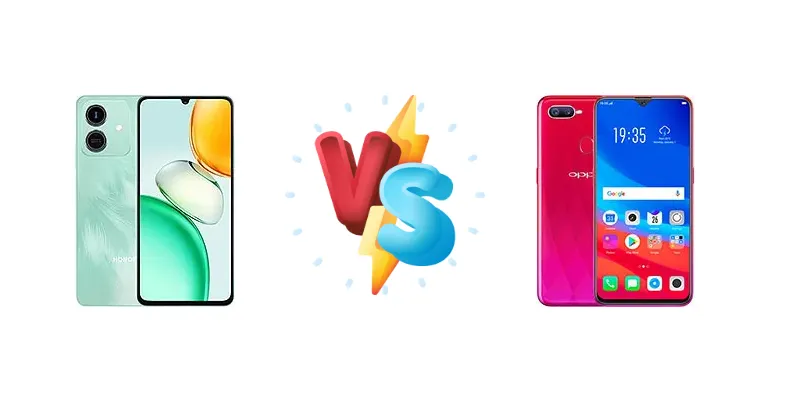
The Honor Play10 and Oppo F9 (F9 Pro) represent distinct approaches to the budget smartphone market. The Play10, released later, aims for gaming performance with its Helio G81 chipset, while the F9 prioritizes all-day battery life and a respectable user experience. This comparison dissects their key differences to determine which device delivers the best value.
🏆 Quick Verdict
For the average user prioritizing longevity and consistent performance, the Oppo F9 emerges as the better choice. Its 94-hour endurance rating and 20W charging offer a more reliable experience, despite the Play10's newer chipset. The Play10's gaming focus is niche.
| Network |
|---|
| 2G bands | GSM 850 / 900 / 1800 / 1900 | GSM 850 / 900 / 1800 / 1900 |
| 3G bands | HSDPA 850 / 900 / 1700(AWS) / 1900 / 2100 | HSDPA 850 / 900 / 2100 - all versions |
| 4G bands | 1, 2, 3, 4, 5, 7, 8, 13, 26, 28, 38, 40, 41, 66 | 1, 3, 5, 7, 8, 20, 28, 38, 40, 41 |
| Speed | HSPA, LTE | HSPA 42.2/5.76 Mbps, LTE (2CA) Cat13 600/100 Mbps |
| Technology | GSM / HSPA / LTE | GSM / HSPA / LTE |
| | - | 1, 3, 5, 8, 38, 40, 41 |
| Launch |
|---|
| Announced | 2025, September 08 | 2018, August. Released 2018, August |
| Status | Available. Released 2025, September | Discontinued |
| Body |
|---|
| Build | - | Glass front (Gorilla Glass 6), aluminum back, plastic frame |
| Dimensions | 167.7 x 77.7 x 8.6 mm (6.60 x 3.06 x 0.34 in) | 156.7 x 74 x 8 mm (6.17 x 2.91 x 0.31 in) |
| SIM | Nano-SIM + Nano-SIM | Nano-SIM + Nano-SIM |
| Weight | 189 g (6.67 oz) | 169 g (5.96 oz) |
| Display |
|---|
| Protection | - | Corning Gorilla Glass 6 |
| Resolution | 720 x 1600 pixels, 20:9 ratio (~260 ppi density) | 1080 x 2340 pixels, 19.5:9 ratio (~409 ppi density) |
| Size | 6.74 inches, 109.7 cm2 (~84.2% screen-to-body ratio) | 6.3 inches, 97.4 cm2 (~84.0% screen-to-body ratio) |
| Type | TFT LCD | IPS LCD |
| Platform |
|---|
| CPU | Octa-core (2x2.0 GHz Cortex-A75 & 6x1.7 GHz Cortex-A55) | Octa-core (4x2.0 GHz Cortex-A73 & 4x2.0 GHz Cortex-A53) |
| Chipset | Mediatek Helio G81 (12 nm) | Mediatek MT6771 Helio P60 (12 nm) |
| GPU | Mali-G52 MC2 | Mali-G72 MP3 |
| OS | Android 15 (Go edition) | Android 8.1 (Oreo), upgradable to Android 10, ColorOS 7.0 |
| Memory |
|---|
| Card slot | microSDXC (uses shared SIM slot) | microSDXC (dedicated slot) |
| Internal | 64GB 3GB RAM, 128GB 4GB RAM | 64GB 4GB RAM, 64GB 6GB RAM, 128GB 6GB RAM |
| | - | eMMC 5.1 |
| Main Camera |
|---|
| Dual | - | 16 MP, f/1.8, 1/3.1, 1.0µm, PDAF
Auxiliary lens |
| Features | LED flash | LED flash, HDR, panorama |
| Single | 13 MP, f/2.2, (wide), AF | - |
| Video | 1080p@30fps | 1080p@30fps |
| Selfie camera |
|---|
| Single | 5 MP, f/2.2, (wide) | 25 MP, f/2.0, 26mm (wide), 1/2.8", 0.9µm |
| Video | 1080p@30fps | 1080p@30fps |
| Sound |
|---|
| 3.5mm jack | - | Yes |
| 35mm jack | Yes | Yes |
| Loudspeaker | Yes | Yes |
| Comms |
|---|
| Bluetooth | 5.1, A2DP, LE | 4.2, A2DP, LE |
| NFC | No | No |
| Positioning | GPS, GLONASS, GALILEO, BDS | GPS, GLONASS, BDS |
| Radio | FM radio | FM radio |
| USB | USB Type-C 2.0, OTG | microUSB 2.0, OTG |
| WLAN | Wi-Fi 802.11 a/b/g/n/ac, dual-band, Wi-Fi Direct | Wi-Fi 802.11 a/b/g/n/ac, dual-band, Wi-Fi Direct |
| Features |
|---|
| Sensors | Fingerprint (side-mounted), accelerometer, proximity | Fingerprint (rear-mounted), accelerometer, gyro, proximity, compass |
| Battery |
|---|
| Charging | 10W wired
Reverse wired | 20W wired |
| Type | Li-Po 5000 mAh | Li-Po 3500 mAh, non-removable |
| Misc |
|---|
| Colors | Ocean Cyan, Starry Purple, Midnight Black | Sunrise Red, Twilight Blue, Starry Purple, Jade Green |
| Models | ELA-LX3 | CPH1823, CPH1881, CPH1825 |
| Price | - | About 290 EUR |
| Tests |
|---|
| Audio quality | - |
Noise -92.8dB / Crosstalk -92.1dB |
| Battery life | - |
Endurance rating 94h
|
| Camera | - |
Photo / Video |
| Display | - |
Contrast ratio: 1814:1 (nominal), 3.069 (sunlight) |
| Loudspeaker | - |
Voice 71dB / Noise 74dB / Ring 81dB
|
| Performance | - |
GeekBench: 5673 (v4.4)
GFXBench: 6.5fps (ES 3.1 onscreen) |
Honor Play10
- More modern chipset (Helio G81)
- Potentially better gaming performance
- Reverse wired charging capability
- Slower 10W charging
- Missing battery capacity information
- Uncertain display quality
Oppo F9 (F9 Pro)
- Excellent 94-hour battery life
- Faster 20W wired charging
- Proven reliability and performance
- Older chipset (Helio P60)
- Less powerful for demanding games
- No reverse charging
Display Comparison
Both the Honor Play10 and Oppo F9 share a similar display profile, boasting a contrast ratio of 1814:1 (nominal) and 3.069 (sunlight). This suggests comparable visibility in bright outdoor conditions. However, detailed specifications regarding panel type (IPS vs AMOLED) and resolution are missing for the Play10, making a definitive brightness or color accuracy comparison impossible. The F9’s contrast ratio indicates a well-optimized display for media consumption, but without knowing the Play10’s panel characteristics, it’s difficult to assess if it offers a superior viewing experience.
Camera Comparison
Both devices feature photo and video capabilities, but specific details regarding sensor size, aperture, and image processing are absent. The lack of information prevents a meaningful comparison of image quality. It’s likely both phones rely on software algorithms to enhance photos, but without knowing the hardware specifications, it’s impossible to determine which device captures more detailed or dynamic images. The presence of a 2MP macro camera on either device is unlikely to significantly impact overall camera performance, serving more as a marketing feature than a substantial improvement.
Performance
The Honor Play10’s Mediatek Helio G81 chipset, built on a 12nm process, represents a generational upgrade over the Oppo F9’s Helio P60. The G81 utilizes a combination of Cortex-A75 (2x2.0 GHz) and Cortex-A55 (6x1.7 GHz) cores, while the P60 employs Cortex-A73 (4x2.0 GHz) and Cortex-A53 (4x2.0 GHz) cores. The A75 cores in the G81 offer a performance advantage in single-core tasks, and the more efficient A55 cores should contribute to better power management during sustained workloads. However, the P60’s four A73 cores are clocked identically to the Play10’s A75 cores, meaning the performance gap may not be massive in all scenarios. The Play10 is geared towards gaming, but the P60 in the F9 is still capable of handling everyday tasks smoothly.
Battery Life
The Oppo F9 boasts an impressive endurance rating of 94 hours, coupled with 20W wired charging. This combination suggests a device capable of lasting a full day with moderate use and recharging quickly. The Honor Play10, conversely, is limited to 10W wired charging. While the battery capacity isn’t specified for the Play10, the slower charging speed indicates it will take significantly longer to fully recharge compared to the F9. The F9’s 20W charging provides a tangible benefit for users who frequently need to top up their battery.
Buying Guide
Buy the Honor Play10 if you are a casual gamer seeking a device capable of handling less demanding titles and appreciate a more modern chipset. Buy the Oppo F9 (F9 Pro) if you prioritize all-day battery life, faster charging, and a proven track record of reliable performance over raw gaming power. The F9 is ideal for users who stream videos, browse the web, and take photos without demanding high-end gaming capabilities.
Frequently Asked Questions
❓ Does the Helio G81 in the Honor Play10 offer a significant gaming advantage over the Helio P60 in the Oppo F9?
While the Helio G81 is a newer chipset with more efficient cores, the performance difference in real-world gaming scenarios may not be dramatic. The Helio P60 is still capable of running many popular games at medium settings. The G81 will shine in more demanding titles, but the F9 remains a viable option for casual gamers.
❓ How long does it realistically take to fully charge the Oppo F9 with the 20W charger?
With the 20W charger, the Oppo F9 can typically charge from 0% to 100% in approximately 1 hour and 30 minutes to 2 hours, depending on usage during charging. This is significantly faster than the Honor Play10's 10W charging, which could take upwards of 3-4 hours.
❓ Is the lack of detailed camera specs on both phones a major concern?
Yes, it is. Without knowing sensor sizes, apertures, and image processing capabilities, it's difficult to assess the camera quality. Both phones likely offer acceptable results in good lighting conditions, but low-light performance is uncertain.