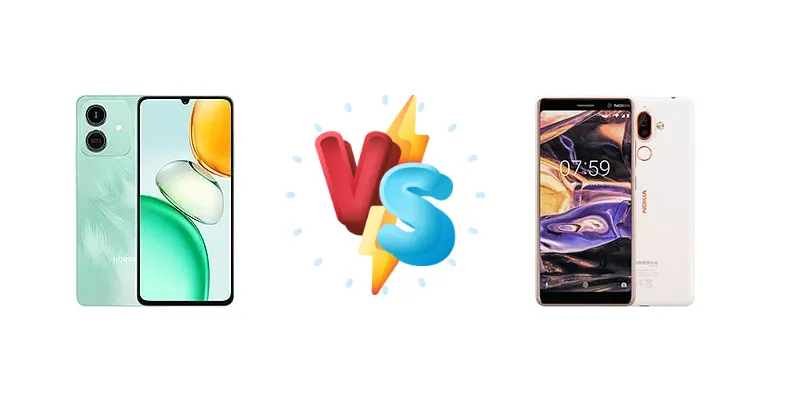
The Honor Play10 and Nokia 7 Plus represent different approaches to the mid-range smartphone market. The Play10, a more recent release, leverages a newer chipset for potentially improved performance, while the Nokia 7 Plus, though older, boasts a reputation for solid battery life and a well-regarded camera experience. This comparison dissects their key differences to determine which device best suits your needs.
🏆 Quick Verdict
For most users, the Nokia 7 Plus offers a more balanced experience. Its 18W charging and proven 87-hour endurance rating outweigh the Play10’s newer chipset, especially considering the Play10’s slow 10W charging. The Nokia 7 Plus provides a more reliable and convenient daily experience.
| Network |
|---|
| 2G bands | GSM 850 / 900 / 1800 / 1900 | GSM 850 / 900 / 1800 / 1900 |
| 3G bands | HSDPA 850 / 900 / 1700(AWS) / 1900 / 2100 | HSDPA 850 / 900 / 1900 / 2100 |
| 4G bands | 1, 2, 3, 4, 5, 7, 8, 13, 26, 28, 38, 40, 41, 66 | 1, 3, 5, 7, 8, 20, 28, 38, 40, 41 - Global |
| Speed | HSPA, LTE | HSPA 42.2/5.76 Mbps, LTE (2CA) Cat6 300/50 Mbps |
| Technology | GSM / HSPA / LTE | GSM / CDMA / HSPA / EVDO / LTE |
| | - | 1, 3, 4, 5, 7, 8, 20, 28, 34, 38, 39, 40, 41 - China |
| Launch |
|---|
| Announced | 2025, September 08 | 2018, February 25. Released 2018, April 30 |
| Status | Available. Released 2025, September | Discontinued |
| Body |
|---|
| Build | - | Glass front (Gorilla Glass 3), aluminum back, aluminum frame (6000 series) |
| Dimensions | 167.7 x 77.7 x 8.6 mm (6.60 x 3.06 x 0.34 in) | 158.4 x 75.6 x 8 mm (6.24 x 2.98 x 0.31 in) |
| SIM | Nano-SIM + Nano-SIM | Nano-SIM + Nano-SIM |
| Weight | 189 g (6.67 oz) | 183 g (6.46 oz) |
| Display |
|---|
| Protection | - | Corning Gorilla Glass 3 |
| Resolution | 720 x 1600 pixels, 20:9 ratio (~260 ppi density) | 1080 x 2160 pixels, 18:9 ratio (~403 ppi density) |
| Size | 6.74 inches, 109.7 cm2 (~84.2% screen-to-body ratio) | 6.0 inches, 92.4 cm2 (~77.2% screen-to-body ratio) |
| Type | TFT LCD | IPS LCD |
| Platform |
|---|
| CPU | Octa-core (2x2.0 GHz Cortex-A75 & 6x1.7 GHz Cortex-A55) | Octa-core (4x2.2 GHz Kryo 260 Gold & 4x1.8 GHz Kryo 260 Silver) |
| Chipset | Mediatek Helio G81 (12 nm) | Qualcomm SDM660 Snapdragon 660 (14 nm) |
| GPU | Mali-G52 MC2 | Adreno 512 |
| OS | Android 15 (Go edition) | Android 8.1 (Oreo), upgradable to Android 10, Android One |
| Memory |
|---|
| Card slot | microSDXC (uses shared SIM slot) | microSDXC (uses shared SIM slot) |
| Internal | 64GB 3GB RAM, 128GB 4GB RAM | 64GB 4GB RAM, 64GB 6GB RAM |
| | - | eMMC 5.1 |
| Main Camera |
|---|
| Dual | - | 12 MP, f/1.8, 25mm (wide), 1/2.55", 1.4µm, dual pixel PDAF
13 MP, f/2.6, (telephoto), 1/3.4", 1.0µm, AF, 2x optical zoom |
| Features | LED flash | Zeiss optics, dual-LED dual-tone flash, panorama, HDR |
| Single | 13 MP, f/2.2, (wide), AF | - |
| Video | 1080p@30fps | 4K@30fps, 1080p@30fps (gyro-EIS) |
| Selfie camera |
|---|
| Features | - | Zeiss optics |
| Single | 5 MP, f/2.2, (wide) | 16 MP, f/2.0, 1/3.06", 1.0µm |
| Video | 1080p@30fps | 1080p@30fps |
| Sound |
|---|
| 3.5mm jack | - | Yes |
| 35mm jack | Yes | Yes |
| Loudspeaker | Yes | Yes |
| Comms |
|---|
| Bluetooth | 5.1, A2DP, LE | 5.0, A2DP, LE |
| NFC | No | Yes |
| Positioning | GPS, GLONASS, GALILEO, BDS | GPS, GLONASS, BDS |
| Radio | FM radio | No |
| USB | USB Type-C 2.0, OTG | USB Type-C 2.0, OTG |
| WLAN | Wi-Fi 802.11 a/b/g/n/ac, dual-band, Wi-Fi Direct | Wi-Fi 802.11 a/b/g/n/ac, dual-band, Wi-Fi Direct |
| Features |
|---|
| Sensors | Fingerprint (side-mounted), accelerometer, proximity | Fingerprint (rear-mounted), accelerometer, gyro, proximity, compass |
| Battery |
|---|
| Charging | 10W wired
Reverse wired | 18W wired |
| Music play | - | Up to 126 h |
| Stand-by | - | Up to 723 h (3G) |
| Talk time | - | Up to 19 h (3G) |
| Type | Li-Po 5000 mAh | Li-Ion 3800 mAh, non-removable |
| Misc |
|---|
| Colors | Ocean Cyan, Starry Purple, Midnight Black | Black/Copper, White/Copper |
| Models | ELA-LX3 | TA-1041, TA-1062, TA-1046 |
| Price | - | About 490 EUR |
| SAR EU | - | 0.36 W/kg (head) 1.78 W/kg (body) |
| Tests |
|---|
| Audio quality | - |
Noise -38.8dB / Crosstalk -95.9dB |
| Battery life | - |
Endurance rating 87h
|
| Camera | - |
Photo / Video |
| Display | - |
Contrast ratio: 1701:1 (nominal), 3.479 (sunlight) |
| Loudspeaker | - |
Voice 67dB / Noise 71dB / Ring 79dB
|
| Performance | - |
AnTuTu: 140820 (v7)
GeekBench: 5893 (v4.4)
GFXBench: 8.6fps (ES 3.1 onscreen) |
Honor Play10
- More recent chipset (Helio G81)
- Potential for slightly better gaming performance
- Reverse wired charging capability
- Significantly slower 10W charging
- Limited battery information
- Uncertain camera performance
Nokia 7 plus
- Excellent 87-hour battery endurance
- Faster 18W wired charging
- Well-regarded camera (in its time)
- Older chipset (Snapdragon 660)
- May not support the latest software updates
- Larger physical size compared to some modern phones
Display Comparison
Both devices share a similar contrast ratio of 1701:1 (nominal) and 3.479 (sunlight), suggesting comparable outdoor visibility. However, detailed display specs like resolution and panel type are missing for the Honor Play10. The Nokia 7 Plus’s display benefits from its contrast ratio, ensuring clear visuals even in bright conditions. Without further information on the Play10’s panel, it’s difficult to assess its color accuracy or viewing angles relative to the Nokia.
Camera Comparison
Both phones feature photo and video capabilities, but detailed camera specifications are lacking. The Nokia 7 Plus’s camera was well-regarded in its time, offering good image quality in various lighting conditions. Without sensor size, aperture, or image processing details for the Honor Play10, it’s difficult to assess its camera performance. The absence of information suggests the Play10 likely doesn’t offer a significant camera upgrade over the Nokia 7 Plus.
Performance
The Nokia 7 Plus’s Qualcomm Snapdragon 660 (14nm) and the Honor Play10’s MediaTek Helio G81 (12nm) represent different architectural approaches. The Snapdragon 660 utilizes Kryo 260 cores with a 2.2 GHz peak clock speed, while the Helio G81 combines Cortex-A75 and A55 cores peaking at 2.0 GHz. While the G81 is newer, the Snapdragon 660’s Kryo cores are generally more efficient. The 14nm process of the Snapdragon 660, while older, doesn’t necessarily translate to worse performance, and may even offer better sustained performance due to thermal headroom. The Play10’s G81 aims for gaming performance, but the Snapdragon 660’s optimized architecture provides a smoother experience for everyday tasks.
Battery Life
The Nokia 7 Plus boasts an impressive endurance rating of 87 hours, a testament to its efficient chipset and optimized software. This is coupled with 18W wired charging, allowing for relatively quick top-ups. In contrast, the Honor Play10 is limited to 10W wired charging. This slower charging speed significantly impacts usability, requiring considerably longer to reach a full charge. While the Play10’s battery capacity is unknown, the Nokia 7 Plus’s superior charging speed and proven endurance make it the clear winner in this category.
Buying Guide
Buy the Honor Play10 if you prioritize a slightly newer processor and are comfortable with significantly slower charging speeds. This phone is best for users who primarily engage in light tasks and don't mind topping up their phone frequently. Buy the Nokia 7 Plus if you value battery life, faster charging, and a more established software experience. This is the better choice for users who need a phone that can reliably last a full day and offers quicker power-ups.
Frequently Asked Questions
❓ Is the Snapdragon 660 in the Nokia 7 Plus still capable of handling modern apps and games?
While not the latest chipset, the Snapdragon 660 remains surprisingly capable. It can handle most everyday apps and many popular games at medium settings. However, demanding titles may require lower graphics settings for smooth gameplay.
❓ How long does it realistically take to fully charge the Honor Play10 with its 10W charging?
With 10W charging, a full charge for the Honor Play10 will likely take over 3 hours, potentially even closer to 4 hours depending on the battery capacity. This is a significant drawback compared to the Nokia 7 Plus’s 18W charging.
❓ Does the Nokia 7 Plus still receive software updates?
Software update support for the Nokia 7 Plus is limited. While it initially received regular updates, it’s unlikely to receive major Android version updates at this point. However, it still benefits from security patches.
❓ Is the Helio G81 in the Honor Play10 a significant upgrade over the Snapdragon 660 for gaming?
The Helio G81 is designed with gaming in mind, but the Snapdragon 660’s optimized architecture and thermal management provide a surprisingly smooth gaming experience. The difference in gaming performance between the two is likely to be noticeable, but not dramatic.