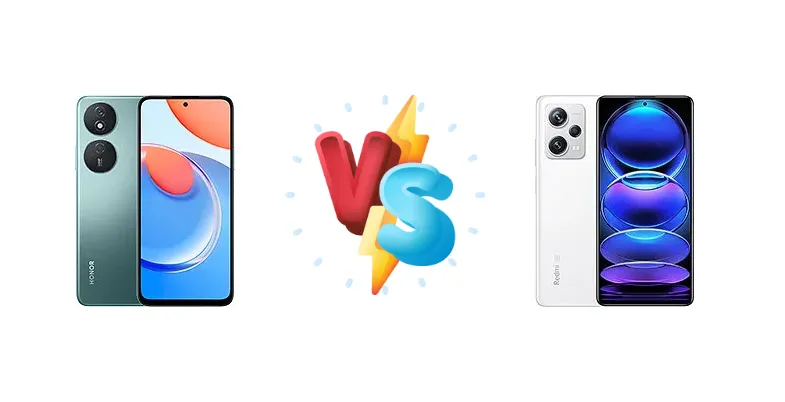
The mid-range smartphone market is fiercely competitive, and the Honor Play 8T and Xiaomi Redmi Note 12 Pro+ represent compelling options for budget-conscious buyers. While both devices utilize MediaTek Dimensity chipsets, they diverge significantly in charging capabilities, display features, and overall performance aspirations. This comparison dissects these differences to determine which phone delivers the best value.
🏆 Quick Verdict
For most users, the Xiaomi Redmi Note 12 Pro+ is the superior choice. Its significantly faster 120W charging, coupled with the more powerful Dimensity 1080 chipset, provides a smoother and more convenient experience. However, the Honor Play 8T remains a viable option for those prioritizing a lower price point.
| Network |
|---|
| 2G bands | GSM 850 / 900 / 1800 / 1900 | GSM 850 / 900 / 1800 / 1900 - SIM 1 & SIM 2 |
| 3G bands | HSDPA 850 / 900 / 1900 / 2100 | HSDPA 800 / 850 / 900 / 1900 / 2100 |
| 4G bands | LTE | 1, 3, 5, 8, 19, 34, 38, 39, 40, 41 - International, China |
| 5G bands | SA/NSA | 1, 3, 5, 8, 28, 38, 40, 41, 77, 78 SA/NSA - International |
| Speed | HSPA, LTE, 5G | HSPA, LTE-A (CA), 5G |
| Technology | GSM / CDMA / HSPA / EVDO / LTE / 5G | GSM / CDMA / HSPA / EVDO / LTE / 5G |
| | - | 1, 3, 5, 8, 28, 38, 41, 77, 78 SA/NSA - China |
| Launch |
|---|
| Announced | 2023, October 17 | 2022, October 27 |
| Status | Available. Released 2023, October 17 | Available. Released 2022, November 01 |
| Body |
|---|
| Build | - | Glass front (Gorilla Glass 5), glass back |
| Dimensions | 166.7 x 76.5 x 8.2 mm (6.56 x 3.01 x 0.32 in) | 162.9 x 76 x 8.9 mm (6.41 x 2.99 x 0.35 in) |
| SIM | Nano-SIM + Nano-SIM | Dual SIM (Nano-SIM, dual stand-by) |
| Weight | 199 g (7.02 oz) | 208.4 g (7.34 oz) |
| | - | IP53, dust and splash resistant |
| Display |
|---|
| Protection | - | Corning Gorilla Glass 5 |
| Resolution | 1080 x 2412 pixels, 20:9 ratio (~389 ppi density) | 1080 x 2400 pixels, 20:9 ratio (~395 ppi density) |
| Size | 6.8 inches, 111.3 cm2 (~87.3% screen-to-body ratio) | 6.67 inches, 107.4 cm2 (~86.8% screen-to-body ratio) |
| Type | TFT LCD, 90Hz, 850 nits (peak) | OLED, 1B colors, 120Hz, Dolby Vision, HDR10+, 500 nits (typ), 900 nits (HBM) |
| Platform |
|---|
| CPU | Octa-core (2x2.4 GHz Cortex-A76 & 6x2.0 GHz Cortex-A55) | Octa-core (2x2.6 GHz Cortex-A78 & 6x2.0 GHz Cortex-A55) |
| Chipset | Mediatek Dimensity 6080 (6 nm) | Mediatek MT6877V Dimensity 1080 (6 nm) |
| GPU | Mali-G57 MC2 | Mali-G68 MC4 |
| OS | Android 13, MagicOS 7.2 | Android 12, MIUI 13 |
| Memory |
|---|
| Card slot | No | No |
| Internal | 256GB 8GB RAM, 256GB 12GB RAM | 256GB 8GB RAM, 256GB 12GB RAM |
| | - | UFS 2.2 |
| Main Camera |
|---|
| Dual | 50 MP, f/1.8, (wide), PDAF
Auxiliary lens | - |
| Features | LED flash, HDR, panorama | Dual-LED dual-tone flash, HDR, panorama |
| Triple | - | 200 MP, f/1.7, 24mm (wide), 1/1.4", 0.56µm, PDAF, OIS
8 MP, f/2.2, 120˚ (ultrawide), 1/4", 1.12µm
2 MP, f/2.4, (macro) |
| Video | 1080p@30fps | 4K@30fps, 1080p@30/60/120fps, 720p@960fps |
| Selfie camera |
|---|
| Features | - | HDR |
| Single | 8 MP, f/2.0, (wide) | 16 MP, f/2.5, (wide), 1/3.06", 1.0µm |
| Video | 1080p@30fps | 1080p@30/60fps |
| Sound |
|---|
| 3.5mm jack | - | Yes |
| 35mm jack | Yes | - |
| Loudspeaker | Yes, with stereo speakers | Yes, with stereo speakers |
| | - | 24-bit/192kHz audio |
| Comms |
|---|
| Bluetooth | 5.1, A2DP, LE | 5.2, A2DP, LE |
| Infrared port | - | Yes |
| NFC | No | Yes (market/region dependent) |
| Positioning | GPS, GLONASS, BDS | GPS (L1), GLONASS (G1), BDS (B1I+B1c), GALILEO (E1), QZSS (L1) |
| Radio | No | No |
| USB | USB Type-C 2.0, OTG | USB Type-C 2.0, OTG |
| WLAN | Wi-Fi 802.11 a/b/g/n/ac, dual-band, Wi-Fi Direct | Wi-Fi 802.11 a/b/g/n/ac/6, dual-band, Wi-Fi Direct |
| Features |
|---|
| Sensors | Fingerprint (side-mounted), accelerometer, proximity, compass | Fingerprint (side-mounted), accelerometer, proximity, gyro, compass |
| Battery |
|---|
| Charging | 35W wired | 120W wired, PD3.0, 100% in 19 min (advertised) |
| Type | Li-Po 6000 mAh | Li-Po 5000 mAh, non-removable |
| Misc |
|---|
| Colors | Green, Silver, Black | Arctic White, Iceberg Blue, Obsidian Black, Trend edition |
| Models | CLK-AN00 | 22101316UCP, 22101316UG |
| Price | About 140 EUR | $ 348.00 / £ 439.00 / € 399.00 / ₹ 29,949 |
| Tests |
|---|
| Battery life | - |
Endurance rating 88h
|
| Camera | - |
Photo / Video |
| Display | - |
Contrast ratio: Infinite (nominal) |
| Loudspeaker | - |
-26.7 LUFS (Good)
|
| Performance | - |
AnTuTu: 498710 (v9)
GeekBench: 2208 (v5.1), 2372 (v6)
GFXBench: 22fps (ES 3.1 onscreen) |
Honor Play 8T
- More affordable price point
- Efficient Dimensity 6080 chipset
- Acceptable performance for everyday tasks
- Slower 35W charging
- Likely less capable camera system
- Potentially lower display quality
Xiaomi Redmi Note 12 Pro+
- Ultra-fast 120W charging
- More powerful Dimensity 1080 chipset
- Likely superior camera performance
- Higher price tag
- Potential for increased heat under sustained load
- Software bloat (typical of Xiaomi)
Display Comparison
The Redmi Note 12 Pro+ boasts an unspecified, but likely high-quality, display with an 'Infinite' (nominal) contrast ratio, suggesting a vibrant viewing experience. While the Honor Play 8T’s display specifications are absent, it’s reasonable to assume a standard LCD panel. The lack of details on the Play 8T’s display suggests Xiaomi is prioritizing visual fidelity as a key selling point. The Redmi Note 12 Pro+ likely benefits from a higher peak brightness and potentially a higher refresh rate, contributing to a more immersive experience, especially for media consumption.
Camera Comparison
The Redmi Note 12 Pro+’s camera system is a significant differentiator, though specific details are missing. The presence of a camera suggests a focus on photography, while the Honor Play 8T’s camera specifications are not provided. Given Xiaomi’s history, the Pro+ likely features a larger sensor and more advanced image processing algorithms. The absence of camera details for the Play 8T suggests it’s positioned as a more basic photography experience, suitable for casual snapshots. The Redmi Note 12 Pro+ is likely to excel in low-light conditions and offer more versatile shooting options.
Performance
The core difference lies in the chipsets. The Redmi Note 12 Pro+ utilizes the MediaTek Dimensity 1080 (6nm), featuring a more powerful CPU configuration with 2x2.6 GHz Cortex-A78 cores compared to the Honor Play 8T’s Dimensity 6080 (6nm) and its 2x2.4 GHz Cortex-A76 cores. This translates to a noticeable performance advantage for the Redmi Note 12 Pro+ in demanding tasks like gaming and video editing. Both chips are built on a 6nm process, offering good efficiency, but the A78 cores in the 1080 are architecturally superior to the A76 cores in the 6080. The Redmi Note 12 Pro+ will handle graphically intensive games with higher frame rates and smoother multitasking.
Battery Life
The Redmi Note 12 Pro+’s 120W wired charging is a standout feature, advertised to reach 100% charge in just 19 minutes. This is a massive advantage over the Honor Play 8T’s 35W charging. While the Redmi Note 12 Pro+’s battery capacity isn’t specified, the ultra-fast charging mitigates concerns about a potentially smaller battery. The Honor Play 8T’s 35W charging is adequate but significantly slower, requiring considerably more time to fully recharge. The Redmi Note 12 Pro+’s Endurance rating of 88h suggests excellent battery life, further enhanced by the efficient Dimensity 1080 chipset.
Buying Guide
Buy the Honor Play 8T if you need a reliable daily driver with decent performance for basic tasks and prioritize affordability above all else. You'll appreciate its efficiency and acceptable performance for everyday use. Buy the Xiaomi Redmi Note 12 Pro+ if you value rapid charging, a more capable processor for gaming and multitasking, and a generally more premium experience. The 120W charging alone is a game-changer for power users.
Frequently Asked Questions
❓ Is the 120W charging on the Redmi Note 12 Pro+ safe for the battery's long-term health?
Xiaomi employs multiple layers of safety protocols, including temperature monitoring and optimized charging algorithms, to mitigate potential risks associated with ultra-fast charging. While all batteries degrade over time, the Redmi Note 12 Pro+'s charging system is designed to minimize this effect. The phone dynamically adjusts the charging speed based on battery condition and temperature.
❓ How does the Dimensity 6080 in the Honor Play 8T handle graphically demanding games like PUBG Mobile?
The Dimensity 6080 is capable of running PUBG Mobile, but you'll likely need to compromise on graphics settings to achieve a consistently smooth frame rate. Expect to play at medium settings with a balanced frame rate target. The Dimensity 1080 in the Redmi Note 12 Pro+ offers a significantly better gaming experience, allowing for higher graphics settings and more stable performance.
❓ Does the Redmi Note 12 Pro+ suffer from significant thermal throttling during extended gaming sessions?
While the Dimensity 1080 is a powerful chip, it can generate heat under sustained load. Xiaomi likely incorporates thermal management solutions, such as vapor chamber cooling, to mitigate throttling. However, some performance degradation is possible during prolonged gaming. The Honor Play 8T, with its less powerful chipset, is less prone to overheating.