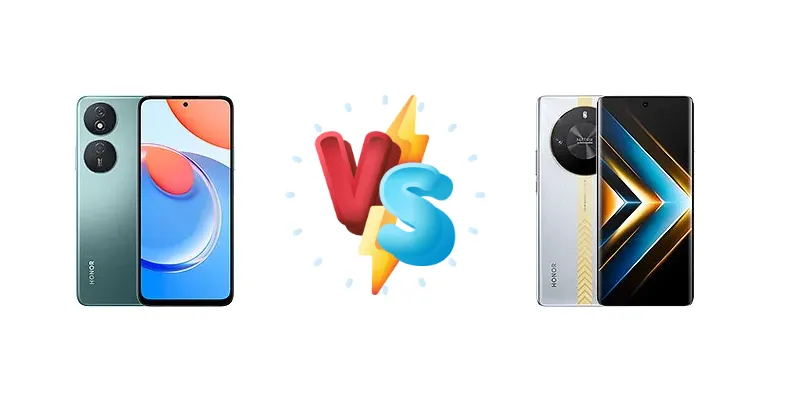
Honor has been aggressively targeting the mid-range and upper-mid-range segments with compelling devices. The Play 8T offers a solid foundation for everyday tasks, while the X50 GT aims for a more premium experience with flagship-level processing power. This comparison dissects the core differences between these two phones, helping you determine which aligns best with your needs and budget.
🏆 Quick Verdict
For the average user prioritizing affordability and daily usability, the Honor Play 8T provides a balanced experience. However, the Honor X50 GT is the clear winner for gamers and power users, thanks to the significantly more powerful Snapdragon 8+ Gen 1 chipset, despite sharing the same 35W charging.
| Network |
|---|
| 2G bands | GSM 850 / 900 / 1800 / 1900 | GSM 850 / 900 / 1800 / 1900 |
| 3G bands | HSDPA 850 / 900 / 1900 / 2100 | HSDPA 850 / 900 / 1700(AWS) / 1900 / 2100 |
| 4G bands | LTE | LTE |
| 5G bands | SA/NSA | SA/NSA |
| Speed | HSPA, LTE, 5G | HSPA, LTE, 5G |
| Technology | GSM / CDMA / HSPA / EVDO / LTE / 5G | GSM / CDMA / HSPA / CDMA2000 / LTE / 5G |
| Launch |
|---|
| Announced | 2023, October 17 | 2024, January 04 |
| Status | Available. Released 2023, October 17 | Available. Released 2024, January 09 |
| Body |
|---|
| Dimensions | 166.7 x 76.5 x 8.2 mm (6.56 x 3.01 x 0.32 in) | 163.6 x 75.5 x 8 mm (6.44 x 2.97 x 0.31 in) |
| SIM | Nano-SIM + Nano-SIM | Nano-SIM + Nano-SIM |
| Weight | 199 g (7.02 oz) | 192 g (6.77 oz) |
| Display |
|---|
| Resolution | 1080 x 2412 pixels, 20:9 ratio (~389 ppi density) | 1220 x 2652 pixels, 19.5:9 ratio (~431 ppi density) |
| Size | 6.8 inches, 111.3 cm2 (~87.3% screen-to-body ratio) | 6.78 inches, 112.6 cm2 (~91.2% screen-to-body ratio) |
| Type | TFT LCD, 90Hz, 850 nits (peak) | AMOLED, 1B colors, 120Hz |
| Platform |
|---|
| CPU | Octa-core (2x2.4 GHz Cortex-A76 & 6x2.0 GHz Cortex-A55) | Octa-core (1x3.0 GHz Cortex-X2 & 3x2.5 GHz Cortex-A710 & 4x1.80 GHz Cortex-A510) |
| Chipset | Mediatek Dimensity 6080 (6 nm) | Qualcomm SM8475 Snapdragon 8+ Gen 1 (4 nm) |
| GPU | Mali-G57 MC2 | Adreno 730 |
| OS | Android 13, MagicOS 7.2 | Android 13, MagicOS 7.2 |
| Memory |
|---|
| Card slot | No | No |
| Internal | 256GB 8GB RAM, 256GB 12GB RAM | 256GB 12GB RAM, 256GB 16GB RAM, 512GB 16GB RAM, 1TB 16GB RAM |
| Main Camera |
|---|
| Dual | 50 MP, f/1.8, (wide), PDAF
Auxiliary lens | 108 MP, f/1.8, (wide), 1/1.67", PDAF
Auxiliary lens |
| Features | LED flash, HDR, panorama | LED flash, panorama, HDR |
| Video | 1080p@30fps | 4K@30fps, 1080p@30fps |
| Selfie camera |
|---|
| Single | 8 MP, f/2.0, (wide) | 8 MP, f/2.0, (wide) |
| Video | 1080p@30fps | 1080p@30fps |
| Sound |
|---|
| 35mm jack | Yes | No |
| Loudspeaker | Yes, with stereo speakers | Yes |
| Comms |
|---|
| Bluetooth | 5.1, A2DP, LE | 5.2, A2DP, LE, aptX HD |
| NFC | No | Yes |
| Positioning | GPS, GLONASS, BDS | GPS, GLONASS, GALILEO, BDS |
| Radio | No | No |
| USB | USB Type-C 2.0, OTG | USB Type-C 2.0, OTG |
| WLAN | Wi-Fi 802.11 a/b/g/n/ac, dual-band, Wi-Fi Direct | Wi-Fi 802.11 a/b/g/n/ac/6, dual-band, Wi-Fi Direct |
| Features |
|---|
| Sensors | Fingerprint (side-mounted), accelerometer, proximity, compass | Fingerprint (under display, optical), accelerometer, gyro, ultrasound proximity, compass |
| Battery |
|---|
| Charging | 35W wired | 35W wired
7.5W reverse wired |
| Type | Li-Po 6000 mAh | Li-Po 5800 mAh |
| Misc |
|---|
| Colors | Green, Silver, Black | Black, Silver |
| Models | CLK-AN00 | ALP-AN00 |
| Price | About 140 EUR | About 260 EUR |
Honor Play 8T
- More affordable price point
- Sufficient performance for everyday tasks
- 35W fast charging
- Less powerful processor compared to the X50 GT
- Potential for throttling during demanding games
- Likely lacks advanced camera features
Honor X50 GT
- Flagship-level Snapdragon 8+ Gen 1 performance
- Superior gaming capabilities
- 7.5W reverse wired charging
- Higher price tag
- Potentially higher power consumption
- May require more frequent charging if heavily used
Display Comparison
While both phones likely feature LCD panels (based on market positioning), specific details like resolution and refresh rate are missing. The focus here is on performance. The absence of LTPO technology on either device suggests standard refresh rate control, impacting battery life during dynamic content. Bezels are likely comparable given the similar target market, and color accuracy will depend on software calibration, a detail not provided.
Camera Comparison
Without detailed camera specifications, a direct comparison is limited. However, the X50 GT, positioned as a more premium device, likely features a more capable main sensor and potentially better image processing algorithms. The Dimensity 6080 in the Play 8T is paired with a capable ISP, but it won’t match the Snapdragon 8+ Gen 1’s processing power. The presence of OIS (Optical Image Stabilization) on the X50 GT would be a significant advantage for low-light photography and video recording. We can assume both phones will include standard auxiliary lenses, but their quality is likely to be secondary to the main sensor.
Performance
The core difference lies in the chipsets. The Honor X50 GT’s Qualcomm Snapdragon 8+ Gen 1 (4nm) is a substantial upgrade over the Play 8T’s MediaTek Dimensity 6080 (6nm). The Snapdragon 8+ Gen 1 boasts a Cortex-X2 prime core clocked at 3.0 GHz, alongside three Cortex-A710 performance cores and four Cortex-A510 efficiency cores. This contrasts with the Play 8T’s two Cortex-A76 and six Cortex-A55 cores. The 4nm process node of the Snapdragon 8+ Gen 1 delivers superior power efficiency and thermal performance, meaning sustained performance will be significantly higher on the X50 GT, especially during graphically intensive tasks. The X50 GT will handle demanding games and multitasking with ease, while the Play 8T may exhibit throttling under prolonged load.
Battery Life
Both devices share the same 35W wired charging capability, suggesting similar charging speeds from 0-100%. The actual battery capacity is unknown, but the Snapdragon 8+ Gen 1’s superior efficiency in the X50 GT could offset a potentially smaller battery size, resulting in comparable or even better real-world battery life despite the higher performance demands. The X50 GT also features 7.5W reverse wired charging, a convenience feature absent on the Play 8T.
Buying Guide
Buy the Honor Play 8T if you need a reliable daily driver for social media, browsing, and light gaming, and value a lower price point. It’s ideal for users who don’t push their phones to the limit. Buy the Honor X50 GT if you prioritize demanding mobile gaming, content creation, and future-proofing, and are willing to invest in a more capable processor and potentially better thermal performance.
Frequently Asked Questions
❓ Will the Dimensity 6080 in the Play 8T struggle with graphically intensive games like Genshin Impact?
The Dimensity 6080 is capable of running Genshin Impact, but you'll likely need to lower the graphics settings to medium or low to maintain a stable frame rate. Prolonged gaming sessions may also result in noticeable throttling due to the 6nm process node and less sophisticated cooling solutions compared to the X50 GT.
❓ Does the Snapdragon 8+ Gen 1 in the X50 GT get excessively hot during extended gaming?
The Snapdragon 8+ Gen 1 is known for its efficiency, but it can still generate heat under heavy load. Honor likely implemented thermal management solutions (heat pipes, graphite sheets) to mitigate overheating. While some warmth is expected, the X50 GT should maintain stable performance for longer periods than the Play 8T.
❓ Is the 7.5W reverse wired charging on the X50 GT useful for topping up accessories like earbuds?
Yes, the 7.5W reverse wired charging is a convenient feature for charging small accessories like wireless earbuds or a smartwatch. While it's not a fast charging solution, it can provide a useful boost when you're away from a power outlet.
❓ What kind of RAM does the X50 GT use, and does it impact performance?
While not explicitly stated, the X50 GT, being a higher-end device, likely utilizes LPDDR5X RAM. This faster RAM standard provides increased bandwidth and improved performance compared to older RAM types, contributing to smoother multitasking and faster app loading times.