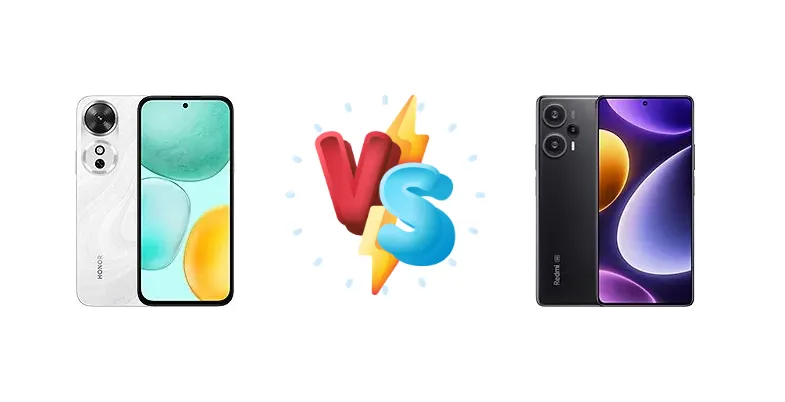
The mid-range smartphone market is fiercely competitive, and the Honor Play 60 and Xiaomi Redmi Note 12 Turbo represent compelling options for budget-conscious buyers. While both aim to deliver a solid experience, they take distinctly different approaches to performance and charging speed, making the choice less straightforward than it appears. This comparison dissects the key differences to help you determine which device best suits your needs.
🏆 Quick Verdict
For the average user prioritizing performance and fast charging, the Xiaomi Redmi Note 12 Turbo is the clear winner. Its Snapdragon 7+ Gen 2 chipset offers a significant performance advantage over the Dimensity 6300 in the Honor Play 60, and the 67W charging dramatically reduces downtime. However, the Honor Play 60 remains a viable option for those on a tighter budget who prioritize efficiency.
| Network |
|---|
| 2G bands | GSM 850 / 900 / 1800 / 1900 | GSM 850 / 900 / 1800 / 1900 |
| 3G bands | HSDPA 850 / 900 / 1900 / 2100 | HSDPA 800 / 850 / 900 / 2100 |
| 4G bands | LTE | 1, 3, 5, 8, 19, 34, 38, 39, 40, 41, 42 |
| 5G bands | SA/NSA | 1, 3, 5, 8, 28, 38, 41, 77, 78 SA/NSA |
| Speed | HSPA, LTE, 5G | HSPA, LTE, 5G |
| Technology | GSM / CDMA / HSPA / CDMA2000 / LTE / 5G | GSM / HSPA / CDMA2000 / LTE / 5G |
| | - | CDMA2000 1x |
| Launch |
|---|
| Announced | 2025, April 03 | 2023, March 28 |
| Status | Available. Released 2025, April 03 | Available. Released 2023, March 28 |
| Body |
|---|
| Build | - | Glass front, plastic frame, plastic back |
| Dimensions | 164 x 75.6 x 8.4 mm (6.46 x 2.98 x 0.33 in) | 161.1 x 75 x 7.9 mm (6.34 x 2.95 x 0.31 in) |
| SIM | Nano-SIM + Nano-SIM | Nano-SIM + Nano-SIM |
| Weight | 197 g (6.95 oz) | 181 g (6.38 oz) |
| Display |
|---|
| Resolution | 720 x 1604 pixels, 20:9 ratio (~266 ppi density) | 1080 x 2400 pixels, 20:9 ratio (~395 ppi density) |
| Size | 6.61 inches, 105.3 cm2 (~84.9% screen-to-body ratio) | 6.67 inches, 107.4 cm2 (~88.9% screen-to-body ratio) |
| Type | TFT LCD, 120Hz, 1010 nits (peak) | OLED, 68B colors, 120Hz, Dolby Vision, HDR10+, 1000 nits (HBM) |
| Platform |
|---|
| CPU | Octa-core (2x2.4 GHz Cortex-A76 & 6x2.0 GHz Cortex-A55) | Octa-core (1x2.91 GHz Cortex-X2 & 3x2.49 GHz Cortex-A710 & 4x1.8 GHz Cortex-A510) |
| Chipset | Mediatek Dimensity 6300 (6 nm) | Qualcomm SM7475-AB Snapdragon 7+ Gen 2 (4 nm) |
| GPU | Mali-G57 MC2 | Adreno 725 |
| OS | Android 15, MagicOS 9 | Android 13, MIUI 14 |
| Memory |
|---|
| Card slot | No | No |
| Internal | 128GB 6GB RAM, 256GB 8GB RAM, 256GB 12GB RAM | 256GB 8GB RAM, 256GB 12GB RAM, 256GB 16GB RAM, 512GB 12GB RAM, 1TB 16GB RAM |
| | - | UFS 3.1 |
| Main Camera |
|---|
| Features | LED flash, HDR | LED flash, HDR, panorama |
| Single | 13 MP, f/1.8, (wide) | - |
| Triple | - | 64 MP, f/1.8, (wide), 1/2.0", 0.7µm, PDAF, OIS
8 MP, f/2.2, 120˚ (ultrawide), 1/4.0", 1.12µm
2 MP (macro) |
| Video | 1080p@30fps | 4K@30fps, 1080p@30/60/120/240fps |
| Selfie camera |
|---|
| Single | 5 MP, f/2.2, (wide) | 16 MP, f/2.5, (wide) |
| Video | 1080p@30fps | 1080p@30/60fps |
| Sound |
|---|
| 3.5mm jack | - | Yes |
| 35mm jack | Yes | Yes |
| Loudspeaker | Yes | Yes, with stereo speakers |
| | - | 24-bit/192kHz audio |
| Comms |
|---|
| Bluetooth | 5.3, A2DP, LE, aptX HD | 5.3, A2DP, LE |
| Infrared port | - | Yes |
| NFC | No | Yes |
| Positioning | GPS, GLONASS, GALILEO, BDS | GPS (L1), GLONASS (G1), BDS (B1I+B1c), GALILEO (E1), QZSS (L1) |
| Radio | No | No |
| USB | USB Type-C 2.0, OTG | USB Type-C 2.0, OTG |
| WLAN | Wi-Fi 802.11 a/b/g/n/ac, dual-band, Wi-Fi Direct | Wi-Fi 802.11 a/b/g/n/ac/6e, dual-band |
| Features |
|---|
| Sensors | Fingerprint (side-mounted), accelerometer, proximity, compass | Fingerprint (side-mounted), accelerometer, gyro, proximity, compass |
| Battery |
|---|
| Charging | 15W wired
2.5W reverse wired | 67W wired, PD3.0, QC4 |
| Type | Li-Po 6000 mAh | Li-Po 5000 mAh |
| Misc |
|---|
| Colors | Black, White, Green, Gold | Black, Blue, White, Harry Potter Edition |
| Models | NIC-AN00 | 23049RAD8C |
| Price | About 140 EUR | About 270 EUR |
Honor Play 60
- Potentially better battery life due to the Dimensity 6300's efficiency.
- More affordable price point.
- Reverse wired charging for accessories.
- Significantly slower charging speed (15W).
- Lower performance compared to the Snapdragon 7+ Gen 2.
- Likely less capable camera system.
Xiaomi Redmi Note 12 Turbo
- Much faster 67W charging.
- Superior performance with the Snapdragon 7+ Gen 2.
- Likely better camera quality and features.
- Potentially slightly shorter battery life.
- Higher price compared to the Honor Play 60.
- May run slightly warmer under heavy load.
Display Comparison
Neither device's display specifications are provided, so a direct comparison is limited. However, given the Redmi Note 12 Turbo's positioning, it likely features a higher refresh rate panel (potentially 120Hz) compared to the Honor Play 60, which may stick to a standard 60Hz refresh rate. This would translate to smoother scrolling and animations on the Redmi. Bezels are likely comparable given the price points, and color accuracy will depend on panel calibration, a detail not specified.
Camera Comparison
Without detailed camera specs, analysis is limited. However, the Redmi Note 12 Turbo, positioned as a more performance-focused device, likely features a larger main sensor and potentially optical image stabilization (OIS). The Honor Play 60 will likely prioritize cost-effectiveness, potentially resulting in a smaller sensor and a lack of OIS. Image processing algorithms will also differ, with Xiaomi typically favoring vibrant, saturated colors, while Honor often aims for a more natural look. The presence of a 2MP macro camera on either device is largely irrelevant due to its limited image quality.
Performance
The core difference lies in the chipsets. The Xiaomi Redmi Note 12 Turbo’s Qualcomm Snapdragon 7+ Gen 2 (4nm) is a substantial upgrade over the Honor Play 60’s MediaTek Dimensity 6300 (6nm). The Snapdragon 7+ Gen 2 boasts a prime Cortex-X2 core clocked at 2.91 GHz, alongside Cortex-A710 performance cores, offering significantly higher peak performance and improved efficiency. The Dimensity 6300, while capable, relies on older Cortex-A76 cores and a less efficient 6nm process. This translates to faster app loading, smoother multitasking, and a better gaming experience on the Redmi Note 12 Turbo. The Redmi also benefits from potentially faster RAM (LPDDR5x is common in this tier) which further enhances performance.
Battery Life
The Redmi Note 12 Turbo’s 67W wired charging is a game-changer, allowing for a full charge in under 45 minutes. The Honor Play 60’s 15W charging is considerably slower, requiring over two hours for a complete charge. While battery capacity isn't specified, the Snapdragon 7+ Gen 2’s 4nm efficiency partially offsets the faster charging, meaning the Redmi Note 12 Turbo won’t necessarily drain significantly faster despite its higher performance. The 2.5W reverse wired charging on the Honor Play 60 is a niche feature, useful for topping up accessories but not a primary selling point.
Buying Guide
Buy the Honor Play 60 if you need a reliable daily driver with decent performance for basic tasks and value long-term battery life over raw speed. It's ideal for users who primarily browse, use social media, and make calls. Buy the Xiaomi Redmi Note 12 Turbo if you prefer a smoother, more responsive experience, especially for gaming or demanding applications, and if you value the convenience of incredibly fast charging. This phone is geared towards users who push their devices harder.
Frequently Asked Questions
❓ Will the Snapdragon 7+ Gen 2 in the Redmi Note 12 Turbo handle demanding games like Genshin Impact at high settings?
Yes, the Snapdragon 7+ Gen 2 is capable of running Genshin Impact and other graphically intensive games at high settings with playable frame rates. While it won't match a flagship Snapdragon 8 Gen 2, it provides a significantly smoother gaming experience than the Dimensity 6300 in the Honor Play 60.
❓ How much faster is the 67W charging on the Redmi Note 12 Turbo compared to the 15W charging on the Honor Play 60 in real-world use?
The 67W charging on the Redmi Note 12 Turbo can take a phone from 0% to 100% in approximately 40-45 minutes, while the 15W charging on the Honor Play 60 will take over two hours. This means you can quickly top up your Redmi Note 12 Turbo during a short break, whereas the Honor Play 60 requires overnight charging for a full refill.
❓ Does the Dimensity 6300 in the Honor Play 60 get noticeably hot during extended gaming sessions?
The Dimensity 6300 is a relatively efficient chip, but it's likely to get warmer than the Snapdragon 7+ Gen 2 under sustained load. While it shouldn't reach critical temperatures, you may experience some performance throttling after prolonged gaming sessions to manage heat.