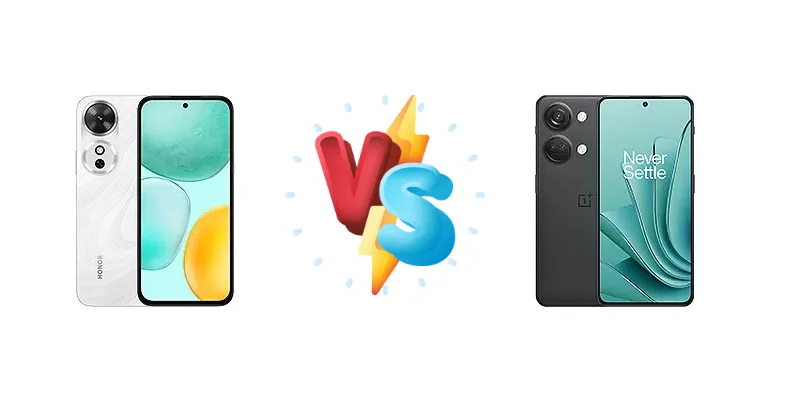
The mid-range smartphone market is fiercely competitive, and the Honor Play 60 and OnePlus Ace 2V represent compelling options for budget-conscious buyers. While both leverage Mediatek's Dimensity series, they target slightly different priorities: the Play 60 emphasizes value, while the Ace 2V aims for a more premium experience with faster performance and charging. This comparison dissects their key differences to determine which device best suits your needs.
🏆 Quick Verdict
For most users, the OnePlus Ace 2V is the superior choice. Its Dimensity 9000 chipset delivers significantly faster processing power, and the 80W charging is a game-changer, fully charging the device in just 32 minutes. While the Honor Play 60 offers a lower price point, the performance gap is substantial.
| Network |
|---|
| 2G bands | GSM 850 / 900 / 1800 / 1900 | GSM 850 / 900 / 1800 / 1900 |
| 3G bands | HSDPA 850 / 900 / 1900 / 2100 | HSDPA 850 / 900 / 1700(AWS) / 2100 |
| 4G bands | LTE | 1, 3, 4, 5, 8, 28, 34, 38, 39, 40, 41 |
| 5G bands | SA/NSA | 1, 3, 8, 28, 40, 41, 77, 78 SA/NSA |
| Speed | HSPA, LTE, 5G | HSPA, LTE, 5G |
| Technology | GSM / CDMA / HSPA / CDMA2000 / LTE / 5G | GSM / CDMA / HSPA / LTE / 5G |
| | - | CDMA 800 |
| Launch |
|---|
| Announced | 2025, April 03 | 2023, March 07 |
| Status | Available. Released 2025, April 03 | Available. Released 2023, March 15 |
| Body |
|---|
| Build | - | Glass front (Asahi Glass), aluminum frame, glass back (Gorilla Glass 5) |
| Dimensions | 164 x 75.6 x 8.4 mm (6.46 x 2.98 x 0.33 in) | 162.6 x 75.1 x 8.2 mm (6.40 x 2.96 x 0.32 in) |
| SIM | Nano-SIM + Nano-SIM | Nano-SIM + Nano-SIM |
| Weight | 197 g (6.95 oz) | 191.5 g (6.77 oz) |
| Display |
|---|
| Protection | - | Asahi Glass |
| Resolution | 720 x 1604 pixels, 20:9 ratio (~266 ppi density) | 1240 x 2772 pixels, 20:9 ratio (~451 ppi density) |
| Size | 6.61 inches, 105.3 cm2 (~84.9% screen-to-body ratio) | 6.74 inches, 109.2 cm2 (~89.5% screen-to-body ratio) |
| Type | TFT LCD, 120Hz, 1010 nits (peak) | AMOLED, 1B colors, 120Hz, HDR10+, 500 nits (typ), 1100 nits (HBM), 1450 nits (peak) |
| Platform |
|---|
| CPU | Octa-core (2x2.4 GHz Cortex-A76 & 6x2.0 GHz Cortex-A55) | Octa-core (1x3.05 GHz Cortex-X2 & 3x2.85 GHz Cortex-A710 & 4x1.80 GHz Cortex-A510) |
| Chipset | Mediatek Dimensity 6300 (6 nm) | Mediatek Dimensity 9000 (4 nm) |
| GPU | Mali-G57 MC2 | Mali-G710 MC10 |
| OS | Android 15, MagicOS 9 | Android 13, ColorOS 13 |
| Memory |
|---|
| Card slot | No | No |
| Internal | 128GB 6GB RAM, 256GB 8GB RAM, 256GB 12GB RAM | 256GB 12GB RAM, 256GB 16GB RAM, 512GB 16GB RAM, 1TB 16GB RAM |
| | - | UFS 3.1 |
| Main Camera |
|---|
| Features | LED flash, HDR | Color spectrum sensor, LED flash, HDR, panorama |
| Single | 13 MP, f/1.8, (wide) | 16 MP, f/2.4, 26mm (wide), 1/3.09", 1.0µm |
| Triple | - | 64 MP, f/1.7, 25mm (wide), PDAF
8 MP, f/2.2, 16mm, 112˚ (ultrawide), 1/4.0", 1.12µm
2 MP (macro) |
| Video | 1080p@30fps | 4K@30/60fps, 1080p@30/60/120fps, gyro-EIS |
| Selfie camera |
|---|
| Features | - | HDR |
| Single | 5 MP, f/2.2, (wide) | 16 MP, f/2.4, 26mm (wide), 1/3.09", 1.0µm |
| Video | 1080p@30fps | 1080p@30fps |
| Sound |
|---|
| 3.5mm jack | - | No |
| 35mm jack | Yes | No |
| Loudspeaker | Yes | Yes, with stereo speakers |
| | - | 24-bit/192kHz audio |
| Comms |
|---|
| Bluetooth | 5.3, A2DP, LE, aptX HD | 5.3, A2DP, LE, aptX HD |
| Infrared port | - | Yes |
| NFC | No | Yes |
| Positioning | GPS, GLONASS, GALILEO, BDS | GPS (L1+L5), GLONASS (G1), BDS (B1I+B1c+B2a), GALILEO (E1+E5a), QZSS (L1+L5) |
| Radio | No | No |
| USB | USB Type-C 2.0, OTG | USB Type-C 2.0 |
| WLAN | Wi-Fi 802.11 a/b/g/n/ac, dual-band, Wi-Fi Direct | Wi-Fi 802.11 a/b/g/n/ac/6, dual-band |
| Features |
|---|
| Sensors | Fingerprint (side-mounted), accelerometer, proximity, compass | Fingerprint (under display, optical), accelerometer, gyro, proximity, compass |
| Battery |
|---|
| Charging | 15W wired
2.5W reverse wired | 80W wired, 100% in 32 min |
| Type | Li-Po 6000 mAh | Li-Po 5000 mAh |
| Misc |
|---|
| Colors | Black, White, Green, Gold | Black, Blue/Green |
| Models | NIC-AN00 | PHP110 |
| Price | About 140 EUR | About 310 EUR |
Honor Play 60
- More affordable price point
- Potentially longer software support (Honor's recent track record)
- Reverse wired charging capability
- Significantly slower processor
- Slow 15W charging
- Likely lower quality display
OnePlus Ace 2V
- Much faster Dimensity 9000 chipset
- Ultra-fast 80W charging (32 minutes to full)
- Likely superior camera performance
- Higher price tag
- Potential for more aggressive software customization (OnePlus)
- No reverse wired charging
Display Comparison
Neither device's display specifications are provided, so a direct comparison is limited. However, given the Ace 2V's positioning, it likely features a higher quality panel with a faster refresh rate. The Play 60, aiming for cost savings, likely utilizes a standard 60Hz LCD. The absence of LTPO technology in either device suggests neither will offer adaptive refresh rates for optimal battery efficiency. Bezels are likely comparable, but the Ace 2V may benefit from slightly slimmer borders due to its higher price bracket.
Camera Comparison
Without detailed camera specs, analysis is limited. However, the Ace 2V, being a higher-tier device, likely features a larger main sensor and more sophisticated image processing algorithms. The Dimensity 9000’s ISP (Image Signal Processor) is also more capable than the 6300’s. While both phones may include multiple lenses, the quality of those additional lenses (ultrawide, macro) is likely to be significantly better on the Ace 2V. We can assume the Ace 2V will offer better low-light performance and more detailed images overall.
Performance
The core difference lies in the chipsets. The OnePlus Ace 2V’s Dimensity 9000, built on a 4nm process, is a significant leap ahead of the Honor Play 60’s Dimensity 6300 (6nm). The 9000’s Cortex-X2 prime core (3.05 GHz) provides a substantial performance boost over the Play 60’s Cortex-A76 cores (2.4 GHz). This translates to faster app loading times, smoother multitasking, and a more enjoyable gaming experience. The Ace 2V also benefits from a more modern CPU architecture (A710 vs A55), further enhancing its performance. While both likely feature ample RAM, the Ace 2V’s superior chipset will better utilize it. Thermal management is also likely superior on the Ace 2V due to the more efficient 4nm node.
Battery Life
The Honor Play 60’s 15W charging is a major drawback compared to the OnePlus Ace 2V’s 80W SuperVOOC charging, which promises a full charge in just 32 minutes. While battery capacity isn’t specified, the Ace 2V’s faster charging effectively mitigates any potential capacity disadvantage. The 15W charging on the Play 60 will require significantly longer to reach 100%, impacting usability for power users. The Ace 2V’s charging speed is a clear convenience advantage.
Buying Guide
Buy the Honor Play 60 if you prioritize extreme affordability and are primarily focused on basic smartphone tasks like calling, texting, and light social media use. You'll need to accept compromises in performance and charging speed. Buy the OnePlus Ace 2V if you value a smoother, more responsive experience, enjoy mobile gaming, and appreciate the convenience of incredibly fast charging. It's a worthwhile investment for those who demand more from their smartphone.
Frequently Asked Questions
❓ Is the Dimensity 6300 in the Honor Play 60 powerful enough for demanding games like Genshin Impact?
While the Dimensity 6300 can run Genshin Impact, you'll likely need to lower the graphics settings to medium or low to achieve a playable frame rate. The OnePlus Ace 2V’s Dimensity 9000 will provide a much smoother experience at higher settings.
❓ How much faster is the 80W charging on the OnePlus Ace 2V compared to the 15W charging on the Honor Play 60 in real-world use?
The difference is substantial. The Ace 2V can go from 0% to 100% in approximately 32 minutes. The Play 60 will likely take over two hours to achieve the same result, making it inconvenient for users who need a quick top-up.
❓ Does the OnePlus Ace 2V overheat during extended gaming sessions?
The Dimensity 9000 is generally efficient, and OnePlus typically implements effective thermal management solutions. While some heat is expected during prolonged gaming, the Ace 2V is unlikely to experience significant throttling due to its 4nm process and cooling system.
❓ What kind of storage and RAM options are available on each device?
Specific storage and RAM configurations aren't provided. However, the Ace 2V, being a higher-end model, is likely to offer more RAM and storage options, potentially including configurations with 12GB or 16GB of RAM and 256GB or 512GB of storage. The Play 60 will likely be limited to more basic configurations.