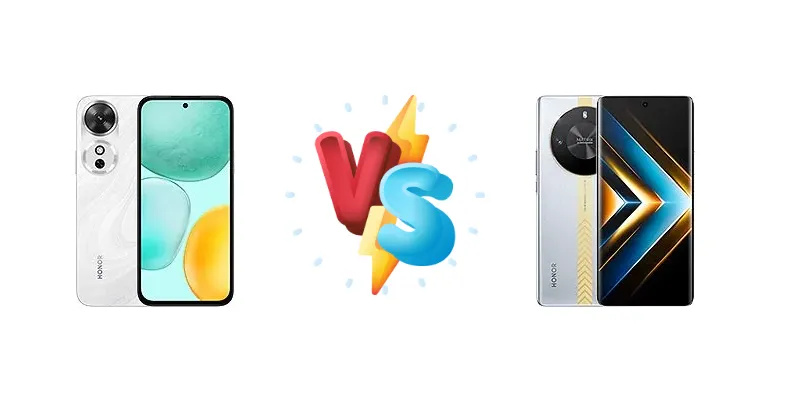
Honor's Play and X series represent distinct approaches to the mid-range smartphone market. The Play 60 focuses on delivering a solid everyday experience at an accessible price, while the X50 GT aims to bridge the gap between mid-range affordability and flagship-level performance. This comparison dissects the core differences between these two devices, focusing on their chipsets, charging capabilities, and overall user experience.
🏆 Quick Verdict
For the average user prioritizing daily tasks and moderate gaming, the Honor Play 60 offers a compelling value. However, the Honor X50 GT is the clear winner for power users and gamers, thanks to its significantly more potent Snapdragon 8+ Gen 1 chipset and faster 35W charging, justifying its higher price point.
| Network |
|---|
| 2G bands | GSM 850 / 900 / 1800 / 1900 | GSM 850 / 900 / 1800 / 1900 |
| 3G bands | HSDPA 850 / 900 / 1900 / 2100 | HSDPA 850 / 900 / 1700(AWS) / 1900 / 2100 |
| 4G bands | LTE | LTE |
| 5G bands | SA/NSA | SA/NSA |
| Speed | HSPA, LTE, 5G | HSPA, LTE, 5G |
| Technology | GSM / CDMA / HSPA / CDMA2000 / LTE / 5G | GSM / CDMA / HSPA / CDMA2000 / LTE / 5G |
| Launch |
|---|
| Announced | 2025, April 03 | 2024, January 04 |
| Status | Available. Released 2025, April 03 | Available. Released 2024, January 09 |
| Body |
|---|
| Dimensions | 164 x 75.6 x 8.4 mm (6.46 x 2.98 x 0.33 in) | 163.6 x 75.5 x 8 mm (6.44 x 2.97 x 0.31 in) |
| SIM | Nano-SIM + Nano-SIM | Nano-SIM + Nano-SIM |
| Weight | 197 g (6.95 oz) | 192 g (6.77 oz) |
| Display |
|---|
| Resolution | 720 x 1604 pixels, 20:9 ratio (~266 ppi density) | 1220 x 2652 pixels, 19.5:9 ratio (~431 ppi density) |
| Size | 6.61 inches, 105.3 cm2 (~84.9% screen-to-body ratio) | 6.78 inches, 112.6 cm2 (~91.2% screen-to-body ratio) |
| Type | TFT LCD, 120Hz, 1010 nits (peak) | AMOLED, 1B colors, 120Hz |
| Platform |
|---|
| CPU | Octa-core (2x2.4 GHz Cortex-A76 & 6x2.0 GHz Cortex-A55) | Octa-core (1x3.0 GHz Cortex-X2 & 3x2.5 GHz Cortex-A710 & 4x1.80 GHz Cortex-A510) |
| Chipset | Mediatek Dimensity 6300 (6 nm) | Qualcomm SM8475 Snapdragon 8+ Gen 1 (4 nm) |
| GPU | Mali-G57 MC2 | Adreno 730 |
| OS | Android 15, MagicOS 9 | Android 13, MagicOS 7.2 |
| Memory |
|---|
| Card slot | No | No |
| Internal | 128GB 6GB RAM, 256GB 8GB RAM, 256GB 12GB RAM | 256GB 12GB RAM, 256GB 16GB RAM, 512GB 16GB RAM, 1TB 16GB RAM |
| Main Camera |
|---|
| Dual | - | 108 MP, f/1.8, (wide), 1/1.67", PDAF
Auxiliary lens |
| Features | LED flash, HDR | LED flash, panorama, HDR |
| Single | 13 MP, f/1.8, (wide) | - |
| Video | 1080p@30fps | 4K@30fps, 1080p@30fps |
| Selfie camera |
|---|
| Single | 5 MP, f/2.2, (wide) | 8 MP, f/2.0, (wide) |
| Video | 1080p@30fps | 1080p@30fps |
| Sound |
|---|
| 35mm jack | Yes | No |
| Loudspeaker | Yes | Yes |
| Comms |
|---|
| Bluetooth | 5.3, A2DP, LE, aptX HD | 5.2, A2DP, LE, aptX HD |
| NFC | No | Yes |
| Positioning | GPS, GLONASS, GALILEO, BDS | GPS, GLONASS, GALILEO, BDS |
| Radio | No | No |
| USB | USB Type-C 2.0, OTG | USB Type-C 2.0, OTG |
| WLAN | Wi-Fi 802.11 a/b/g/n/ac, dual-band, Wi-Fi Direct | Wi-Fi 802.11 a/b/g/n/ac/6, dual-band, Wi-Fi Direct |
| Features |
|---|
| Sensors | Fingerprint (side-mounted), accelerometer, proximity, compass | Fingerprint (under display, optical), accelerometer, gyro, ultrasound proximity, compass |
| Battery |
|---|
| Charging | 15W wired
2.5W reverse wired | 35W wired
7.5W reverse wired |
| Type | Li-Po 6000 mAh | Li-Po 5800 mAh |
| Misc |
|---|
| Colors | Black, White, Green, Gold | Black, Silver |
| Models | NIC-AN00 | ALP-AN00 |
| Price | About 140 EUR | About 260 EUR |
Honor Play 60
- More affordable price point
- Good efficiency for everyday tasks
- Acceptable performance for casual users
- Significantly slower charging speed
- Less powerful chipset for demanding games
Honor X50 GT
- Flagship-level Snapdragon 8+ Gen 1 performance
- Much faster 35W wired charging
- Potentially better camera system
- Higher price tag
- May generate more heat under sustained load
Display Comparison
While display specifications aren't provided, it's reasonable to assume both phones utilize LCD panels given their price points. The X50 GT, positioned as a more premium device, likely benefits from a higher peak brightness and potentially a slightly more refined color calibration. However, without specific data, it's difficult to quantify the difference. Both will likely target a 60Hz refresh rate, prioritizing battery life over ultra-smooth scrolling.
Camera Comparison
Without detailed camera specifications, a direct comparison is limited. However, the X50 GT, being the more premium model, likely features a larger main sensor and potentially optical image stabilization (OIS). While both phones may include multiple lenses, the quality of the primary sensor dictates the overall image quality. The X50 GT’s image signal processor (ISP), integrated within the Snapdragon 8+ Gen 1, also benefits from advanced processing algorithms, resulting in better dynamic range and low-light performance. Expect the Play 60 to offer acceptable image quality for casual use, but the X50 GT will deliver a more refined and versatile camera experience.
Performance
The core differentiator lies in the chipsets. The Honor X50 GT’s Qualcomm Snapdragon 8+ Gen 1 (4nm) is a significant leap over the Play 60’s Mediatek Dimensity 6300 (6nm). The Snapdragon 8+ Gen 1 features a Cortex-X2 prime core clocked at 3.0 GHz, alongside Cortex-A710 performance cores, offering substantially higher CPU and GPU performance. The 4nm process node also contributes to improved thermal efficiency, meaning the X50 GT will likely sustain peak performance for longer periods under heavy load. The Dimensity 6300, while capable, is geared towards efficiency and everyday tasks, with its Cortex-A76 cores operating at a lower 2.4 GHz clock speed. This translates to noticeable differences in gaming frame rates and app loading times.
Battery Life
The Honor X50 GT’s 35W wired charging is a significant advantage over the Play 60’s 15W charging. This faster charging speed translates to a considerably quicker 0-100% charge time, minimizing downtime. While battery capacity isn't specified, the X50 GT’s more efficient chipset and optimized power management could offset any potential capacity difference. The 7.5W reverse wired charging on both devices is a convenient feature for topping up accessories, but it's relatively slow compared to dedicated charging solutions.
Buying Guide
Buy the Honor Play 60 if you need a reliable smartphone for everyday communication, social media, and light gaming, and value affordability above all else. Its Mediatek Dimensity 6300 provides sufficient power for these tasks without breaking the bank. Buy the Honor X50 GT if you prioritize demanding mobile gaming, content creation, and faster charging speeds. The Snapdragon 8+ Gen 1 delivers a substantial performance boost, making it ideal for users who push their phones to the limit.
Frequently Asked Questions
❓ Will the Snapdragon 8+ Gen 1 in the X50 GT get noticeably hot during extended gaming sessions?
While the Snapdragon 8+ Gen 1 is efficient, it's still a high-performance chip. Expect some heat generation during prolonged gaming. However, the 4nm process and Honor's thermal management system should prevent significant throttling, maintaining consistent frame rates for a reasonable duration. The Play 60's Dimensity 6300 will run cooler, but at the cost of performance.
❓ Is the 15W charging on the Play 60 slow enough to be a major inconvenience?
For casual users who charge their phones overnight, 15W charging is likely sufficient. However, if you frequently need a quick top-up during the day, the X50 GT’s 35W charging is a game-changer, reducing charge times by a significant margin. Consider your charging habits when making your decision.
❓ Can the Honor Play 60 handle popular games like PUBG Mobile or Call of Duty Mobile?
The Play 60 can run PUBG Mobile and Call of Duty Mobile, but you'll likely need to lower the graphics settings to achieve smooth frame rates. The Dimensity 6300 isn't designed for maximum graphical fidelity in demanding titles. The X50 GT, with its Snapdragon 8+ Gen 1, will provide a much smoother and more visually impressive gaming experience.