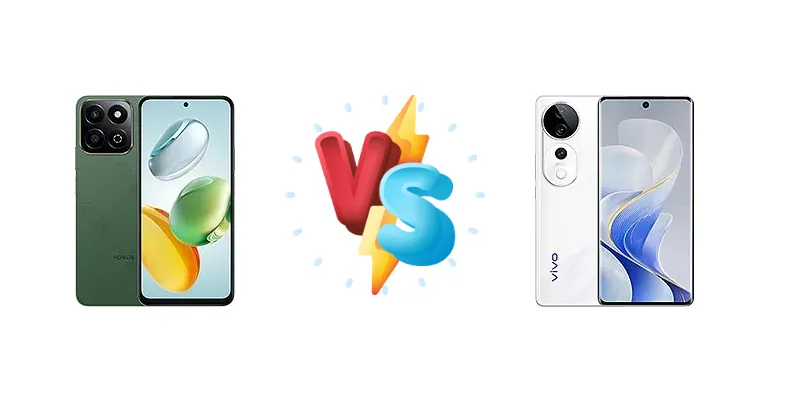
The Honor Play 60 Plus and vivo S19 Pro represent distinct approaches to the mid-range smartphone market. The Honor focuses on efficiency and affordability with a Snapdragon 4 Gen 2, while the vivo S19 Pro aims for a more premium experience with the powerful Dimensity 9200+ chipset and significantly faster charging. This comparison dissects their key differences to help you choose the right device.
🏆 Quick Verdict
For the average user prioritizing a smooth daily experience and long battery life, the vivo S19 Pro is the clear winner. Its Dimensity 9200+ chipset delivers substantially higher performance, and the 80W charging drastically reduces downtime. However, the Honor Play 60 Plus remains a compelling option for budget-conscious buyers.
| Network |
|---|
| 2G bands | GSM 850 / 900 / 1800 / 1900 | GSM 850 / 900 / 1800 / 1900 |
| 3G bands | HSDPA 850 / 900 / 1900 / 2100 | HSDPA 800 / 850 / 900 / 1700(AWS) / 1900 / 2100 |
| 4G bands | LTE | 1, 3, 4, 5, 7, 8, 18, 19, 26, 28, 34, 38, 39, 40, 41 |
| 5G bands | SA/NSA | 1, 3, 5, 8, 28, 38, 40, 41, 77, 78 SA/NSA |
| Speed | HSPA, LTE, 5G | HSPA, LTE, 5G |
| Technology | GSM / HSPA / LTE / 5G | GSM / CDMA / HSPA / LTE / 5G |
| Launch |
|---|
| Announced | 2024, June 24 | 2024, May 30 |
| Status | Available. Released 2024, June 28 | Available. Released 2024, May 30 |
| Body |
|---|
| Build | - | Glass front, plastic frame, glass back |
| Dimensions | 167 x 76.8 x 8.1 mm (6.57 x 3.02 x 0.32 in) | 164.1 x 75 x 7.6 mm (6.46 x 2.95 x 0.30 in) |
| SIM | Nano-SIM + Nano-SIM | Nano-SIM + Nano-SIM |
| Weight | 197 g or 199 g (6.95 oz) | 192 g (6.77 oz) |
| Display |
|---|
| Resolution | 720 x 1610 pixels, 20:9 ratio (~261 ppi density) | 1260 x 2800 pixels, 20:9 ratio (~453 ppi density) |
| Size | 6.77 inches, 110.2 cm2 (~85.9% screen-to-body ratio) | 6.78 inches, 111.0 cm2 (~90.2% screen-to-body ratio) |
| Type | TFT LCD, 120Hz | AMOLED, 1B colors, 120Hz, 4500 nits (peak) |
| Platform |
|---|
| CPU | Octa-core (2x2.2 GHz Cortex-A78 & 6x1.95 GHz Cortex-A55) | Octa-core (1x3.35 GHz Cortex-X3 & 3x3.0 GHz Cortex-A715 & 4x2.0 GHz Cortex-A510) |
| Chipset | Qualcomm SM4450 Snapdragon 4 Gen 2 (4 nm) | Mediatek Dimensity 9200+ (4 nm) |
| GPU | Adreno 613 | Immortalis-G715 MC11 |
| OS | Android 14, Magic OS 8 | Android 14, OriginOS 4 |
| Memory |
|---|
| Card slot | Unspecified | No |
| Internal | 256GB 8GB RAM, 256GB 12GB RAM, 512GB 12GB RAM | 256GB 8GB RAM, 256GB 12GB RAM, 256GB 16GB RAM, 512GB 12GB RAM, 512GB 16GB RAM |
| Main Camera |
|---|
| Dual | 50 MP, f/1.8, (wide), PDAF
Auxiliary lens | - |
| Features | LED flash, HDR, panorama | Ring-LED flash, panorama, HDR |
| Triple | - | 50 MP, f/1.9, (wide), 1/1.56", PDAF, OIS
50 MP, f/1.9, (telephoto), PDAF, OIS, 2x optical zoom
8 MP, f/2.2, 106˚ (ultrawide) |
| Video | 1080p@30fps | 4K@30fps, 1080p@30fps, gyro-EIS, OIS |
| Selfie camera |
|---|
| Features | - | Dual-LED flash, HDR |
| Single | 5 MP, f/2.2, (wide) | 50 MP, f/2.0, 22mm (wide), AF |
| Video | 1080p@30fps | 4K@30fps, 1080p@30fps |
| Sound |
|---|
| 35mm jack | Yes | No |
| Loudspeaker | Yes, with stereo speakers | Yes, with stereo speakers |
| Comms |
|---|
| Bluetooth | 5.0, A2DP, LE | 5.3, A2DP, LE, aptX HD |
| Infrared port | - | Yes |
| NFC | No | Yes |
| Positioning | GPS, GLONASS, GALILEO, BDS | GPS (L1+L5), GLONASS, BDS (B1I+B1c+B2a), GALILEO (E1+E5a), QZSS (L1+L5), NavIC (L5) |
| Radio | No | No |
| USB | USB Type-C 2.0, OTG | USB Type-C 2.0, OTG |
| WLAN | Wi-Fi 802.11 a/b/g/n/ac, dual-band, Wi-Fi Direct | Wi-Fi 802.11 a/b/g/n/ac/6/7, dual-band, Wi-Fi Direct |
| Features |
|---|
| Sensors | Fingerprint (side-mounted), accelerometer, compass, proximity (ultrasonic) | Fingerprint (under display, optical), accelerometer, gyro, proximity, compass |
| Battery |
|---|
| Charging | 35W wired | 80W wired, PD
Reverse wired |
| Type | Li-Po 6000 mAh | Si/C Li-Ion 5500 mAh |
| Misc |
|---|
| Colors | Green, Black, White | Gray, Green, Light Blue |
| Models | ALT-AN00 | V2362A |
| Price | About 200 EUR | About 420 EUR |
Honor Play 60 Plus
- More affordable price point
- Potentially longer battery life due to efficient chipset
- Reliable performance for basic tasks
- Significantly slower charging speed
- Less powerful processor for demanding apps
- Likely lower quality display
vivo S19 Pro
- Flagship-level performance with Dimensity 9200+
- Ultra-fast 80W charging with PD
- Likely superior display quality (AMOLED, higher refresh rate)
- Higher price tag
- Potentially shorter battery life under heavy load
- May run hotter during intensive tasks
Display Comparison
Neither device's display specifications are provided, so we must infer. Given the price point of the Honor Play 60 Plus, it likely features a 60Hz LCD panel. The vivo S19 Pro, positioned as a more premium device, likely boasts a higher refresh rate AMOLED display, potentially with LTPO technology for adaptive refresh rates. This would translate to smoother scrolling and animations on the vivo, and potentially better color accuracy and contrast. Bezels are also likely thinner on the vivo S19 Pro, contributing to a more immersive viewing experience.
Camera Comparison
Without specific camera sensor details, analysis is limited. However, the vivo S19 Pro, being a more premium offering, likely features a larger main sensor with optical image stabilization (OIS). This would result in better low-light performance and sharper images. The Honor Play 60 Plus likely employs a more basic camera setup, prioritizing affordability over advanced features. Lens apertures are also crucial; a wider aperture (lower f-number) on the vivo would allow more light to reach the sensor, further enhancing low-light capabilities. We can expect the vivo to offer more sophisticated image processing algorithms, resulting in more vibrant and detailed photos.
Performance
The performance gap between these two devices is significant. The vivo S19 Pro’s Mediatek Dimensity 9200+ (4nm) is a flagship-level chipset featuring a Cortex-X3 prime core clocked at 3.35 GHz, designed for peak performance. This contrasts sharply with the Honor Play 60 Plus’s Qualcomm SM4450 Snapdragon 4 Gen 2 (4nm), which utilizes a more power-efficient Cortex-A78 architecture at 2.2 GHz. The Dimensity 9200+ will excel in demanding tasks like gaming and video editing, while the Snapdragon 4 Gen 2 is optimized for everyday use. The Dimensity 9200+ also benefits from a more powerful GPU, ensuring superior graphics performance. While both are built on a 4nm process, the architectural differences favor the vivo in terms of raw processing power.
Battery Life
The Honor Play 60 Plus’s 35W wired charging is adequate but slow compared to the vivo S19 Pro’s 80W wired charging with PD and reverse wired charging. The 80W charging will significantly reduce charging times, potentially going from 0-100% in under 40 minutes, while the Honor will likely take over an hour. While battery capacity isn't specified, the faster charging of the vivo S19 Pro mitigates the impact of a potentially smaller battery, offering more usable uptime throughout the day. The reverse wired charging on the vivo is a convenient feature for topping up accessories like earbuds.
Buying Guide
Buy the Honor Play 60 Plus if you need a reliable, affordable smartphone for basic tasks like calling, texting, social media, and light web browsing, and value extended battery life over raw power. Buy the vivo S19 Pro if you prioritize performance for gaming and demanding apps, require incredibly fast charging, and are willing to spend a bit more for a more refined user experience.
Frequently Asked Questions
❓ Will the Dimensity 9200+ in the vivo S19 Pro overheat during prolonged gaming sessions?
While the Dimensity 9200+ is a powerful chip, vivo typically employs effective thermal management solutions. The 4nm process also contributes to better efficiency. However, sustained gaming at maximum settings will inevitably generate heat. Expect some throttling, but the vivo S19 Pro should maintain playable frame rates for extended periods.
❓ Is the 35W charging on the Honor Play 60 Plus slow enough to be a major inconvenience?
For casual users, 35W charging is acceptable. However, compared to the 80W charging on the vivo S19 Pro, it's considerably slower. Expect to spend over an hour to fully charge the Honor Play 60 Plus, whereas the vivo can achieve a full charge in under 40 minutes. If you frequently find yourself needing to quickly top up your phone, the slower charging speed could be a drawback.
❓ Does the Snapdragon 4 Gen 2 in the Honor Play 60 Plus support 5G connectivity?
Yes, the Qualcomm Snapdragon 4 Gen 2 does support 5G connectivity, allowing for faster download and streaming speeds where 5G networks are available. This is a key feature for future-proofing the device.
❓ What kind of gaming performance can I expect from the Honor Play 60 Plus?
The Honor Play 60 Plus is capable of running most popular mobile games, but you'll likely need to lower graphics settings for a smooth experience in demanding titles. It's best suited for casual gaming rather than hardcore mobile gamers.