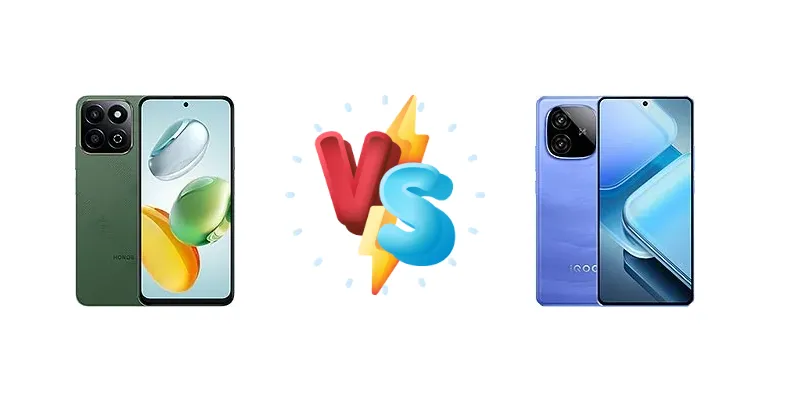
The Honor Play 60 Plus and vivo iQOO Z9 Turbo Endurance represent distinct approaches to the mid-range smartphone market. The Honor focuses on a balance of efficiency with its Snapdragon 4 Gen 2, while the iQOO aggressively targets performance with the more powerful Snapdragon 8s Gen 3. This comparison dissects their key differences to determine which device best suits your needs.
🏆 Quick Verdict
For the average user prioritizing raw performance and fast charging, the iQOO Z9 Turbo Endurance is the clear winner. Its Snapdragon 8s Gen 3 offers a significant leap in processing power. However, the Honor Play 60 Plus provides a compelling alternative for those seeking a more efficient device with respectable performance at a potentially lower price point.
| Network |
|---|
| 2G bands | GSM 850 / 900 / 1800 / 1900 | GSM 850 / 900 / 1800 / 1900 |
| 3G bands | HSDPA 850 / 900 / 1900 / 2100 | HSDPA 850 / 900 / 2100 |
| 4G bands | LTE | 1, 3, 5, 8, 28, 34, 38, 39, 40, 41 |
| 5G bands | SA/NSA | 1, 5, 8, 28, 41, 77, 78 SA/NSA |
| Speed | HSPA, LTE, 5G | HSPA, LTE, 5G |
| Technology | GSM / HSPA / LTE / 5G | GSM / CDMA / HSPA / LTE / 5G |
| Launch |
|---|
| Announced | 2024, June 24 | 2025, January 03 |
| Status | Available. Released 2024, June 28 | Available. Released 2025, January 03 |
| Body |
|---|
| Build | - | Glass front, plastic back, plastic frame |
| Dimensions | 167 x 76.8 x 8.1 mm (6.57 x 3.02 x 0.32 in) | 163.7 x 75.9 x 8 mm (6.44 x 2.99 x 0.31 in) |
| SIM | Nano-SIM + Nano-SIM | Nano-SIM + Nano-SIM |
| Weight | 197 g or 199 g (6.95 oz) | 196 g (6.91 oz) |
| Display |
|---|
| Resolution | 720 x 1610 pixels, 20:9 ratio (~261 ppi density) | 1260 x 2800 pixels, 20:9 ratio (~453 ppi density) |
| Size | 6.77 inches, 110.2 cm2 (~85.9% screen-to-body ratio) | 6.78 inches, 111.0 cm2 (~89.3% screen-to-body ratio) |
| Type | TFT LCD, 120Hz | AMOLED, 1B colors, 144Hz, HDR |
| Platform |
|---|
| CPU | Octa-core (2x2.2 GHz Cortex-A78 & 6x1.95 GHz Cortex-A55) | Octa-core (1x3.0 GHz Cortex-X4 & 4x2.8 GHz Cortex-A720 & 3x2.0 GHz Cortex-A520) |
| Chipset | Qualcomm SM4450 Snapdragon 4 Gen 2 (4 nm) | Qualcomm SM8635 Snapdragon 8s Gen 3 (4 nm) |
| GPU | Adreno 613 | Adreno 735 |
| OS | Android 14, Magic OS 8 | Android 14, OriginOS 4 |
| Memory |
|---|
| Card slot | Unspecified | No |
| Internal | 256GB 8GB RAM, 256GB 12GB RAM, 512GB 12GB RAM | 256GB 12GB RAM, 256GB 16GB RAM, 512GB 12GB RAM, 512GB 16GB RAM |
| Main Camera |
|---|
| Dual | 50 MP, f/1.8, (wide), PDAF
Auxiliary lens | 50 MP, f/1.8, (wide), 1/1.95", 0.8µm, PDAF, OIS
8 MP, f/2.2, (ultrawide) |
| Features | LED flash, HDR, panorama | LED flash, panorama, HDR |
| Video | 1080p@30fps | 4K@30/60fps, 1080p, gyro-EIS, OIS |
| Selfie camera |
|---|
| Single | 5 MP, f/2.2, (wide) | 16 MP, f/2.5, (wide), 1/3.0", 1.0µm |
| Video | 1080p@30fps | 1080p@30fps |
| Sound |
|---|
| 35mm jack | Yes | No |
| Loudspeaker | Yes, with stereo speakers | Yes, with stereo speakers |
| Comms |
|---|
| Bluetooth | 5.0, A2DP, LE | 5.4, A2DP, LE, aptX HD, aptX Adaptive, aptX Lossless |
| Infrared port | - | Yes |
| NFC | No | Yes |
| Positioning | GPS, GLONASS, GALILEO, BDS | GPS (L1+L5), GLONASS (G1), BDS (B1I+B1c+B2a), GALILEO (E1+E5a), QZSS (L1+L5) |
| Radio | No | No |
| USB | USB Type-C 2.0, OTG | USB Type-C 2.0, OTG |
| WLAN | Wi-Fi 802.11 a/b/g/n/ac, dual-band, Wi-Fi Direct | Wi-Fi 802.11 a/b/g/n/ac/6, dual-band |
| Features |
|---|
| Sensors | Fingerprint (side-mounted), accelerometer, compass, proximity (ultrasonic) | Fingerprint (under display, optical), accelerometer, gyro, proximity, compass |
| Battery |
|---|
| Charging | 35W wired | 80W wired
7.5W reverse wired |
| Type | Li-Po 6000 mAh | Si/C Li-Ion 6400 mAh |
| Misc |
|---|
| Colors | Green, Black, White | Black, White, Blue |
| Models | ALT-AN00 | V2352GA |
| Price | About 200 EUR | About 250 EUR |
Honor Play 60 Plus
- More power-efficient chipset (Snapdragon 4 Gen 2)
- Potentially lower price point
- Balanced performance for everyday tasks
- Significantly slower charging (35W)
- Less powerful processor for demanding games
- Likely less advanced camera system
vivo iQOO Z9 Turbo Endurance
- Much faster charging (80W)
- Significantly more powerful processor (Snapdragon 8s Gen 3)
- Reverse wired charging capability
- Potentially shorter battery life due to higher power consumption
- Likely higher price point
- May run hotter under sustained load
Display Comparison
Neither device's display specifications are provided, so a direct comparison is limited. However, given the iQOO's focus on performance, it's reasonable to expect a higher refresh rate panel than the Honor. The Honor, likely targeting a more budget-conscious segment, may prioritize power efficiency in its display choice. Color accuracy and peak brightness will be key differentiators, but without data, we can only speculate. Bezels are also a factor, with smaller bezels contributing to a more immersive experience.
Camera Comparison
Without specific camera sensor details, a detailed comparison is difficult. However, the iQOO Z9 Turbo Endurance, positioned as a performance-focused device, is likely to feature a more capable main camera sensor. The Snapdragon 8s Gen 3’s ISP (Image Signal Processor) also offers more advanced image processing capabilities, potentially resulting in better dynamic range and low-light performance. We can assume both phones will include standard features like HDR and portrait modes, but the iQOO is expected to deliver superior image quality overall. The presence or absence of OIS (Optical Image Stabilization) on the iQOO would be a significant advantage.
Performance
The core difference lies in the chipsets. The iQOO Z9 Turbo Endurance’s Snapdragon 8s Gen 3 (4nm) is a substantial upgrade over the Honor Play 60 Plus’s Snapdragon 4 Gen 2 (4nm). The 8s Gen 3 features a Cortex-X4 prime core clocked at 3.0 GHz, alongside Cortex-A720 and A520 cores, offering significantly higher single-core and multi-core performance. The Honor’s CPU configuration of 2x2.2 GHz Cortex-A78 and 6x1.95 GHz Cortex-A55 cores is geared towards efficiency rather than outright speed. This translates to smoother multitasking, faster app loading, and a better gaming experience on the iQOO. The iQOO also benefits from a more modern GPU, further widening the performance gap. While both are built on a 4nm process, the architectural improvements in the 8s Gen 3 provide superior thermal efficiency *despite* the higher performance.
Battery Life
The iQOO Z9 Turbo Endurance boasts a significant advantage in charging speed with its 80W wired charging, compared to the Honor Play 60 Plus’s 35W. This means the iQOO can likely charge from 0-100% in significantly less time. The iQOO also includes 7.5W reverse wired charging, a feature absent on the Honor. While battery capacity isn't specified, the iQOO’s faster charging mitigates the impact of a potentially smaller battery. The Honor’s slower charging speed will require longer periods plugged in, but its more efficient chipset may result in comparable real-world battery life despite a potentially smaller capacity.
Buying Guide
Buy the Honor Play 60 Plus if you need a reliable daily driver with good battery life and aren't demanding the absolute highest performance for gaming. It's ideal for users who prioritize efficiency and value. Buy the vivo iQOO Z9 Turbo Endurance if you prioritize gaming, demanding applications, and incredibly fast charging. This phone is for users who want a performance-focused experience and don't mind potentially sacrificing some battery longevity for speed.
Frequently Asked Questions
❓ Will the iQOO Z9 Turbo Endurance get noticeably hot during extended gaming sessions?
The Snapdragon 8s Gen 3 is a powerful chip, and while the 4nm process helps with efficiency, sustained gaming will likely generate heat. The iQOO series often incorporates advanced cooling solutions, but throttling is still possible. Expect some warmth, but likely not to the point of discomfort.
❓ Is the 35W charging on the Honor Play 60 Plus slow compared to other phones in its price range?
Yes, 35W is relatively slow compared to many competitors now offering 65W or even 80W charging. While it won't be unusable, expect a significantly longer charge time – potentially over 1.5 hours for a full charge. This is a trade-off for the more efficient chipset.
❓ How much of a performance difference will I see between the Snapdragon 4 Gen 2 and the Snapdragon 8s Gen 3 in everyday tasks?
For basic tasks like browsing, social media, and messaging, the difference won't be dramatic. However, when launching demanding apps, multitasking heavily, or playing graphically intensive games, the Snapdragon 8s Gen 3 will provide a much smoother and more responsive experience. It's a significant leap in processing power.