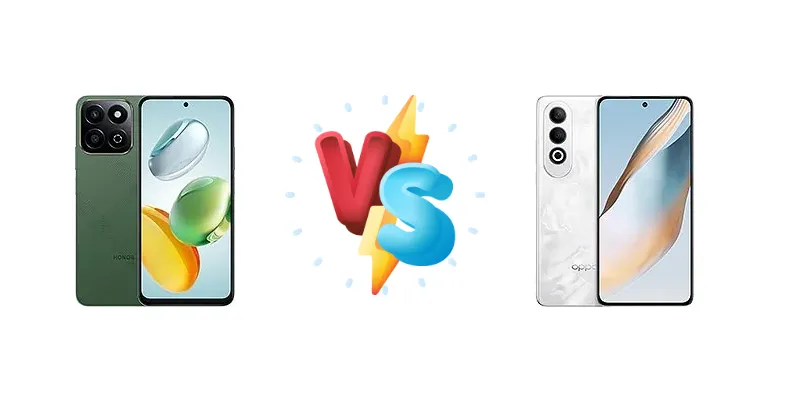
The mid-range smartphone market is fiercely competitive, and the Honor Play 60 Plus and Oppo K12 Plus both aim to deliver a compelling experience without breaking the bank. Both leverage Qualcomm's Snapdragon platform, but at different tiers. This comparison dissects the key differences – from processing power and charging speeds to overall value – to determine which device best suits your needs.
🏆 Quick Verdict
For the average user prioritizing fast charging and a smoother overall experience, the Oppo K12 Plus emerges as the winner. Its Snapdragon 7 Gen 3 chipset provides a noticeable performance uplift over the Play 60 Plus’s Snapdragon 4 Gen 2, and the 80W charging is a game-changer. However, the Honor Play 60 Plus remains a viable option for budget-conscious buyers.
| Network |
|---|
| 2G bands | GSM 850 / 900 / 1800 / 1900 | GSM 850 / 900 / 1800 / 1900 |
| 3G bands | HSDPA 850 / 900 / 1900 / 2100 | HSDPA 850 / 900 / 1700(AWS) / 1900 / 2100 |
| 4G bands | LTE | 1, 3, 4, 5, 8, 28, 34, 38, 39, 40, 41 |
| 5G bands | SA/NSA | 1, 5, 8, 28, 41, 77, 78 SA/NSA |
| Speed | HSPA, LTE, 5G | HSPA, LTE, 5G |
| Technology | GSM / HSPA / LTE / 5G | GSM / CDMA / HSPA / LTE / 5G |
| Launch |
|---|
| Announced | 2024, June 24 | 2024, October 12 |
| Status | Available. Released 2024, June 28 | Available. Released 2024, October 15 |
| Body |
|---|
| Dimensions | 167 x 76.8 x 8.1 mm (6.57 x 3.02 x 0.32 in) | 162.5 x 75.3 x 8.4 mm (6.40 x 2.96 x 0.33 in) |
| SIM | Nano-SIM + Nano-SIM | Nano-SIM + Nano-SIM |
| Weight | 197 g or 199 g (6.95 oz) | 192 g (6.77 oz) |
| Display |
|---|
| Resolution | 720 x 1610 pixels, 20:9 ratio (~261 ppi density) | 1080 x 2412 pixels, 20:9 ratio (~394 ppi density) |
| Size | 6.77 inches, 110.2 cm2 (~85.9% screen-to-body ratio) | 6.7 inches, 108.0 cm2 (~88.3% screen-to-body ratio) |
| Type | TFT LCD, 120Hz | AMOLED, 1B colors, 120Hz, 500 nits (typ), 900 nits (HBM), 1100 nits (peak) |
| Platform |
|---|
| CPU | Octa-core (2x2.2 GHz Cortex-A78 & 6x1.95 GHz Cortex-A55) | Octa-core (1x2.63 GHz Cortex-A715 & 4x2.4 GHz Cortex-A715 & 3x1.8 GHz Cortex-A510) |
| Chipset | Qualcomm SM4450 Snapdragon 4 Gen 2 (4 nm) | Qualcomm SM7550-AB Snapdragon 7 Gen 3 (4 nm) |
| GPU | Adreno 613 | Adreno 720 |
| OS | Android 14, Magic OS 8 | Android 14, ColorOS 14.0 |
| Memory |
|---|
| Card slot | Unspecified | microSDXC (uses shared SIM slot) |
| Internal | 256GB 8GB RAM, 256GB 12GB RAM, 512GB 12GB RAM | 256GB 8GB RAM, 256GB 12GB RAM, 512GB 12GB RAM |
| Main Camera |
|---|
| Dual | 50 MP, f/1.8, (wide), PDAF
Auxiliary lens | 50 MP, f/1.8, 26mm (wide), 1/1.95", 0.8µm, PDAF, OIS
8 MP, f/2.2, 16mm, 112˚ (ultrawide), 1/4.0", 1.12µm |
| Features | LED flash, HDR, panorama | Dual-LED flash, HDR, panorama |
| Video | 1080p@30fps | 4K@30fps, 1080p@30/60/120fps, gyro-EIS, OIS |
| Selfie camera |
|---|
| Features | - | Panorama |
| Single | 5 MP, f/2.2, (wide) | 16 MP, f/2.4, 26mm (wide), 1/3.0", 1.0µm |
| Video | 1080p@30fps | 1080p@30fps |
| Sound |
|---|
| 35mm jack | Yes | No |
| Loudspeaker | Yes, with stereo speakers | Yes, with stereo speakers |
| Comms |
|---|
| Bluetooth | 5.0, A2DP, LE | 5.4, A2DP, LE, aptX HD, LHDC |
| Infrared port | - | Yes |
| NFC | No | Yes |
| Positioning | GPS, GLONASS, GALILEO, BDS | GPS, GALILEO, GLONASS, BDS, QZSS |
| Radio | No | No |
| USB | USB Type-C 2.0, OTG | USB Type-C 2.0, OTG |
| WLAN | Wi-Fi 802.11 a/b/g/n/ac, dual-band, Wi-Fi Direct | Wi-Fi 802.11 a/b/g/n/ac/6, dual-band |
| Features |
|---|
| Sensors | Fingerprint (side-mounted), accelerometer, compass, proximity (ultrasonic) | Fingerprint (under display, optical), accelerometer, gyro, proximity, compass |
| Battery |
|---|
| Charging | 35W wired | 80W wired, PD, UFCS, 50% in 20 min
10W reverse wired |
| Type | Li-Po 6000 mAh | 6400 mAh |
| Misc |
|---|
| Colors | Green, Black, White | Black, White |
| Models | ALT-AN00 | PKS110 |
| Price | About 200 EUR | About 250 EUR |
Honor Play 60 Plus
- More affordable price point
- Efficient Snapdragon 4 Gen 2 chipset
- Reliable performance for basic tasks
- Slower charging speed (35W)
- Less powerful processor compared to the K12 Plus
- Likely less capable camera system
Oppo K12 Plus
- Significantly faster 80W charging
- More powerful Snapdragon 7 Gen 3 chipset
- Improved gaming and multitasking performance
- Higher price compared to the Play 60 Plus
- Potentially slightly lower battery life (depending on capacity)
- May not be a substantial upgrade for very basic users
Display Comparison
Neither device's display specifications are provided, so a direct comparison is limited. However, given the market positioning, both likely utilize LCD panels. The Oppo K12 Plus, being the slightly more premium offering, may benefit from a higher peak brightness and potentially better color calibration. The absence of LTPO technology on either suggests standard refresh rates, likely 60Hz or 90Hz, impacting smoothness during scrolling and animations.
Camera Comparison
Without detailed camera specs, analysis is limited. However, the chipset difference suggests the Oppo K12 Plus will have a more capable image signal processor (ISP), leading to better image processing, noise reduction, and dynamic range. The Snapdragon 7 Gen 3’s ISP is designed for more complex computational photography features. While both phones likely feature a multi-camera setup, the K12 Plus is expected to deliver superior image quality, particularly in low-light conditions. The absence of information regarding sensor sizes and OIS makes a definitive statement impossible, but the chipset advantage leans heavily towards the Oppo.
Performance
The core difference lies in the chipsets. The Oppo K12 Plus boasts the Snapdragon 7 Gen 3 (4nm), featuring a 1x2.63 GHz Cortex-A715 prime core and 4x2.4 GHz Cortex-A715 performance cores, alongside 3x1.8 GHz Cortex-A510 efficiency cores. This configuration represents a significant step up from the Honor Play 60 Plus’s Snapdragon 4 Gen 2 (4nm) with its 2x2.2 GHz Cortex-A78 and 6x1.95 GHz Cortex-A55 cores. The 7 Gen 3’s newer architecture and higher clock speeds translate to faster app loading, smoother multitasking, and improved gaming performance. While both are 4nm chips offering good efficiency, the 7 Gen 3’s more advanced design provides a clear advantage. The K12 Plus will likely handle graphically demanding games with higher frame rates and fewer stutters.
Battery Life
The Oppo K12 Plus’s 80W wired charging is a standout feature, capable of charging to 50% in just 20 minutes. This is a substantial advantage over the Honor Play 60 Plus’s 35W charging. While battery capacity isn’t specified, the faster charging speed of the K12 Plus mitigates any potential disadvantage from a slightly smaller battery. The inclusion of PD and UFCS protocols on the K12 Plus also adds to its versatility, while the 10W reverse wired charging is a useful addition for topping up accessories. The Honor Play 60 Plus, while adequate, simply can’t compete with the K12 Plus’s charging prowess.
Buying Guide
Buy the Honor Play 60 Plus if you need a reliably functional smartphone for everyday tasks, prioritize a lower price point, and aren't heavily reliant on demanding applications or gaming. Buy the Oppo K12 Plus if you prefer a more responsive user experience, faster charging speeds, and are willing to spend a bit more for improved performance and convenience, especially if you frequently game or use resource-intensive apps.
Frequently Asked Questions
❓ Will the Oppo K12 Plus’s Snapdragon 7 Gen 3 handle demanding games like Genshin Impact at high settings?
The Snapdragon 7 Gen 3 is a capable chipset and should handle Genshin Impact at medium to high settings with playable frame rates. However, sustained performance may be limited by thermal throttling, depending on the phone’s cooling solution. Expect a smoother experience than the Snapdragon 4 Gen 2 in the Honor Play 60 Plus.
❓ How much faster is the 80W charging on the Oppo K12 Plus compared to the 35W charging on the Honor Play 60 Plus in real-world use?
The 80W charging on the K12 Plus will dramatically reduce charging times. While the Play 60 Plus might take over 2 hours for a full charge, the K12 Plus can reach 50% in just 20 minutes and a full charge in approximately 45-60 minutes, depending on battery capacity. This is a significant convenience factor for users who frequently need to top up their phone quickly.
❓ Is the difference in performance between the Snapdragon 4 Gen 2 and Snapdragon 7 Gen 3 noticeable for everyday tasks like browsing and social media?
For basic tasks, the difference might not be immediately apparent. However, the Snapdragon 7 Gen 3 offers a smoother and more responsive experience when multitasking, switching between apps, and loading heavier web pages. The K12 Plus will feel snappier overall, even during everyday use.