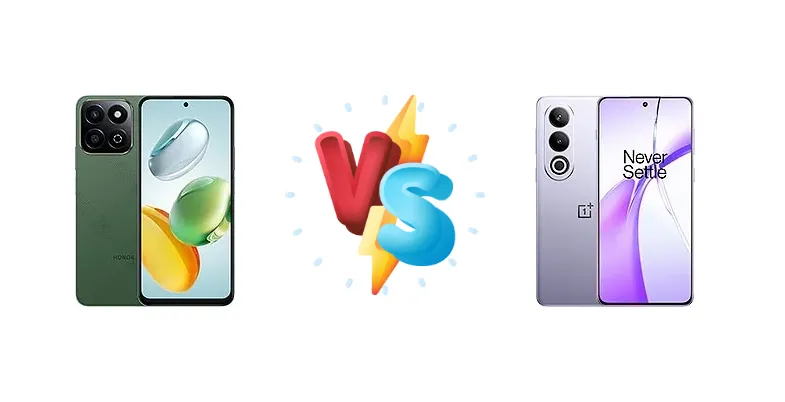
The mid-range smartphone market is fiercely competitive, and the Honor Play 60 Plus and OnePlus Ace 3V represent compelling options for users seeking a balance of performance and affordability. While both devices utilize Qualcomm Snapdragon chipsets, they target slightly different priorities – the Play 60 Plus focuses on efficiency, while the Ace 3V prioritizes raw power and charging speed. This comparison will dissect their key differences to determine which phone best suits your needs.
🏆 Quick Verdict
For the average user prioritizing speed and convenience, the OnePlus Ace 3V is the clear winner. Its Snapdragon 7+ Gen 3 chipset delivers significantly better performance, and the 100W charging is a game-changer. However, the Honor Play 60 Plus offers a respectable experience for basic tasks and those on a tighter budget.
| Network |
|---|
| 2G bands | GSM 850 / 900 / 1800 / 1900 | GSM 850 / 900 / 1800 / 1900 |
| 3G bands | HSDPA 850 / 900 / 1900 / 2100 | HSDPA 850 / 900 / 1700(AWS) / 2100 |
| 4G bands | LTE | 1, 3, 4, 5, 8, 28, 34, 38, 39, 40, 41 |
| 5G bands | SA/NSA | 1, 5, 8, 28, 41, 77, 78 SA/NSA |
| Speed | HSPA, LTE, 5G | HSPA, LTE, 5G |
| Technology | GSM / HSPA / LTE / 5G | GSM / CDMA / HSPA / LTE / 5G |
| Launch |
|---|
| Announced | 2024, June 24 | 2024, March 21 |
| Status | Available. Released 2024, June 28 | Available. Released 2024, March 25 |
| Body |
|---|
| Build | - | Glass front, glass back, plastic frame |
| Dimensions | 167 x 76.8 x 8.1 mm (6.57 x 3.02 x 0.32 in) | 162.7 x 75.2 x 8.5 mm (6.41 x 2.96 x 0.33 in) |
| SIM | Nano-SIM + Nano-SIM | Nano-SIM + Nano-SIM |
| Weight | 197 g or 199 g (6.95 oz) | 200 g (7.05 oz) |
| Display |
|---|
| Resolution | 720 x 1610 pixels, 20:9 ratio (~261 ppi density) | 1240 x 2772 pixels, 20:9 ratio (~451 ppi density) |
| Size | 6.77 inches, 110.2 cm2 (~85.9% screen-to-body ratio) | 6.74 inches, 109.2 cm2 (~89.3% screen-to-body ratio) |
| Type | TFT LCD, 120Hz | AMOLED, 1B colors, 120Hz, 1100 nits (HBM), 2150 nits (peak) |
| Platform |
|---|
| CPU | Octa-core (2x2.2 GHz Cortex-A78 & 6x1.95 GHz Cortex-A55) | Octa-core (1x2.8 GHz Cortex-X4 & 4x2.6 GHz Cortex-A720 & 3x1.9 GHz Cortex-A520) |
| Chipset | Qualcomm SM4450 Snapdragon 4 Gen 2 (4 nm) | Qualcomm SM7675 Snapdragon 7+ Gen 3 (4 nm) |
| GPU | Adreno 613 | Adreno 732 |
| OS | Android 14, Magic OS 8 | Android 14, ColorOS 14 |
| Memory |
|---|
| Card slot | Unspecified | No |
| Internal | 256GB 8GB RAM, 256GB 12GB RAM, 512GB 12GB RAM | 256GB 12GB RAM, 512GB 12GB RAM, 512GB 16GB RAM |
| Main Camera |
|---|
| Dual | 50 MP, f/1.8, (wide), PDAF
Auxiliary lens | 50 MP, f/1.8, 26mm (wide), 1/1.95", 0.8µm, PDAF, OIS
8 MP, f/2.2, 16mm, 112˚ (ultrawide), 1/4.0", 1.12µm |
| Features | LED flash, HDR, panorama | LED flash, HDR, panorama |
| Video | 1080p@30fps | 4K@30/60fps, 1080p@30/60/120fps, gyro-EIS, OIS |
| Selfie camera |
|---|
| Single | 5 MP, f/2.2, (wide) | 16 MP, f/2.4, 26mm (wide), 1/3", 1.0µm |
| Video | 1080p@30fps | 1080p@30fps |
| Sound |
|---|
| 35mm jack | Yes | No |
| Loudspeaker | Yes, with stereo speakers | Yes, with stereo speakers |
| Comms |
|---|
| Bluetooth | 5.0, A2DP, LE | 5.4, A2DP, LE, aptX HD, LHDC |
| Infrared port | - | Yes |
| NFC | No | Yes |
| Positioning | GPS, GLONASS, GALILEO, BDS | GPS (L1+L5), BDS (B1I+B1c+B2a), GALILEO (E1+E5a), QZSS (L1+L5), GLONASS |
| Radio | No | No |
| USB | USB Type-C 2.0, OTG | USB Type-C 2.0 |
| WLAN | Wi-Fi 802.11 a/b/g/n/ac, dual-band, Wi-Fi Direct | Wi-Fi 802.11 a/b/g/n/ac/6, dual-band |
| Features |
|---|
| Sensors | Fingerprint (side-mounted), accelerometer, compass, proximity (ultrasonic) | Fingerprint (under display, optical), accelerometer, gyro, proximity, compass |
| Battery |
|---|
| Charging | 35W wired | 100W wired, 100% in 26 min |
| Type | Li-Po 6000 mAh | 5500 mAh |
| Misc |
|---|
| Colors | Green, Black, White | Purple, Gray |
| Models | ALT-AN00 | PJF110 |
| Price | About 200 EUR | About 260 EUR |
Honor Play 60 Plus
- More affordable price point
- Potentially better battery life due to efficient chipset
- Reliable performance for basic tasks
- Significantly slower charging speed
- Less powerful processor for demanding apps and games
- Likely inferior camera performance
OnePlus Ace 3V
- Much faster Snapdragon 7+ Gen 3 processor
- Ultra-fast 100W charging
- Likely superior camera capabilities
- Higher price tag
- Potentially shorter battery life due to higher power consumption
- May run warmer under heavy load
Display Comparison
Neither device's display specifications are provided, so we must infer. Given the price points, both likely feature LCD panels. However, the Ace 3V, being positioned slightly higher, may benefit from a higher peak brightness and potentially a smoother refresh rate. The Honor Play 60 Plus will likely prioritize power efficiency in its display configuration. Bezels are expected to be comparable, typical of this price bracket. Color accuracy will likely be decent on both, but not flagship-level.
Camera Comparison
Without specific camera specs, it's difficult to make definitive claims. However, the OnePlus Ace 3V, being the more premium device, is likely to feature a larger main sensor and potentially optical image stabilization (OIS). The Snapdragon 7+ Gen 3’s image signal processor (ISP) will also offer superior image processing capabilities, resulting in better dynamic range and low-light performance. The Honor Play 60 Plus will likely rely on software optimization to compensate for a potentially less capable sensor. Expect both phones to include standard features like portrait mode and HDR, but the Ace 3V should deliver more consistent and detailed results.
Performance
The core difference lies in the chipsets. The OnePlus Ace 3V’s Snapdragon 7+ Gen 3 (4nm) is a substantial upgrade over the Honor Play 60 Plus’s Snapdragon 4 Gen 2 (4nm). The 7+ Gen 3 boasts a prime Cortex-X4 core clocked at 2.8 GHz, alongside A720 cores, offering significantly improved CPU and GPU performance. This translates to faster app loading, smoother multitasking, and a more enjoyable gaming experience. While both are built on a 4nm process for efficiency, the architectural improvements in the 7+ Gen 3 provide a clear advantage. The Ace 3V’s likely use of faster LPDDR5x RAM further enhances performance, while the Play 60 Plus will likely use LPDDR4x. Thermal management will be crucial; the 7+ Gen 3’s higher performance will generate more heat, requiring effective cooling solutions.
Battery Life
The Honor Play 60 Plus’s 35W charging is adequate but slow compared to the OnePlus Ace 3V’s blazing-fast 100W charging, capable of a full charge in just 26 minutes. While battery capacity isn’t specified, the Ace 3V’s faster charging mitigates the impact of a potentially smaller battery. The Snapdragon 7+ Gen 3’s efficiency will also play a role, but the convenience of topping up quickly is a significant advantage for the Ace 3V. Users who frequently find themselves needing a quick boost will greatly benefit from the Ace 3V’s charging capabilities.
Buying Guide
Buy the Honor Play 60 Plus if you need a reliable daily driver for essential tasks like browsing, social media, and light communication, and value battery efficiency over peak performance. Buy the OnePlus Ace 3V if you prefer a smoother experience with demanding apps, enjoy mobile gaming, and appreciate the convenience of incredibly fast charging – even if it means slightly reduced battery life.
Frequently Asked Questions
❓ Will the Snapdragon 4 Gen 2 in the Honor Play 60 Plus struggle with graphically intensive games like Genshin Impact?
Yes, the Snapdragon 4 Gen 2 is an entry-level chipset. While it can handle less demanding games, Genshin Impact and similar titles will likely require significant graphics settings reductions and may still experience noticeable frame drops. The OnePlus Ace 3V’s Snapdragon 7+ Gen 3 is far better suited for gaming.
❓ How much faster is the 100W charging on the OnePlus Ace 3V compared to the 35W charging on the Honor Play 60 Plus in real-world use?
The difference is substantial. The OnePlus Ace 3V can go from 0% to 100% in approximately 26 minutes. The Honor Play 60 Plus will likely take well over an hour to achieve a full charge, making the Ace 3V ideal for users who need a quick power boost before leaving the house.
❓ Does the OnePlus Ace 3V get excessively hot during prolonged gaming sessions?
The Snapdragon 7+ Gen 3 is a powerful chip and will generate heat under sustained load. OnePlus typically implements effective thermal management solutions, but some warmth is expected during extended gaming. The Honor Play 60 Plus, with its less powerful chipset, will likely run cooler.