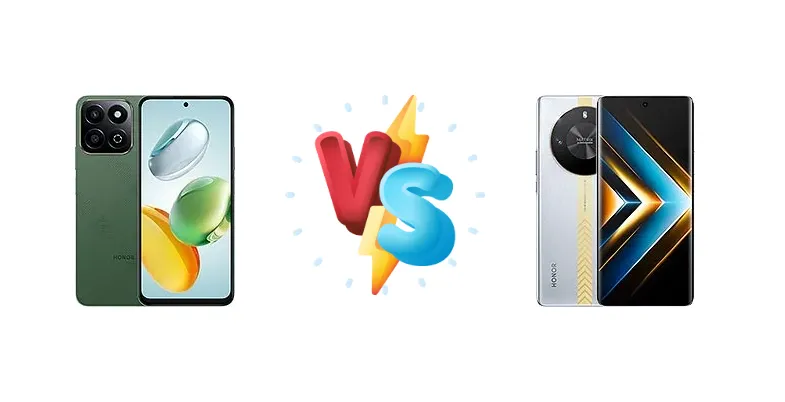
Honor is aggressively targeting the mid-range market with the Play 60 Plus and X50 GT, but they cater to different priorities. The Play 60 Plus focuses on efficiency with a newer Snapdragon 4 Gen 2, while the X50 GT packs a flagship-level Snapdragon 8+ Gen 1. This comparison dissects the key differences to determine which phone best suits your needs.
🏆 Quick Verdict
For most users, the Honor X50 GT is the clear winner. The Snapdragon 8+ Gen 1 provides significantly superior performance for gaming and demanding tasks, justifying the price difference. However, the Play 60 Plus offers a compelling option for those prioritizing battery life and a lower price point.
| Network |
|---|
| 2G bands | GSM 850 / 900 / 1800 / 1900 | GSM 850 / 900 / 1800 / 1900 |
| 3G bands | HSDPA 850 / 900 / 1900 / 2100 | HSDPA 850 / 900 / 1700(AWS) / 1900 / 2100 |
| 4G bands | LTE | LTE |
| 5G bands | SA/NSA | SA/NSA |
| Speed | HSPA, LTE, 5G | HSPA, LTE, 5G |
| Technology | GSM / HSPA / LTE / 5G | GSM / CDMA / HSPA / CDMA2000 / LTE / 5G |
| Launch |
|---|
| Announced | 2024, June 24 | 2024, January 04 |
| Status | Available. Released 2024, June 28 | Available. Released 2024, January 09 |
| Body |
|---|
| Dimensions | 167 x 76.8 x 8.1 mm (6.57 x 3.02 x 0.32 in) | 163.6 x 75.5 x 8 mm (6.44 x 2.97 x 0.31 in) |
| SIM | Nano-SIM + Nano-SIM | Nano-SIM + Nano-SIM |
| Weight | 197 g or 199 g (6.95 oz) | 192 g (6.77 oz) |
| Display |
|---|
| Resolution | 720 x 1610 pixels, 20:9 ratio (~261 ppi density) | 1220 x 2652 pixels, 19.5:9 ratio (~431 ppi density) |
| Size | 6.77 inches, 110.2 cm2 (~85.9% screen-to-body ratio) | 6.78 inches, 112.6 cm2 (~91.2% screen-to-body ratio) |
| Type | TFT LCD, 120Hz | AMOLED, 1B colors, 120Hz |
| Platform |
|---|
| CPU | Octa-core (2x2.2 GHz Cortex-A78 & 6x1.95 GHz Cortex-A55) | Octa-core (1x3.0 GHz Cortex-X2 & 3x2.5 GHz Cortex-A710 & 4x1.80 GHz Cortex-A510) |
| Chipset | Qualcomm SM4450 Snapdragon 4 Gen 2 (4 nm) | Qualcomm SM8475 Snapdragon 8+ Gen 1 (4 nm) |
| GPU | Adreno 613 | Adreno 730 |
| OS | Android 14, Magic OS 8 | Android 13, MagicOS 7.2 |
| Memory |
|---|
| Card slot | Unspecified | No |
| Internal | 256GB 8GB RAM, 256GB 12GB RAM, 512GB 12GB RAM | 256GB 12GB RAM, 256GB 16GB RAM, 512GB 16GB RAM, 1TB 16GB RAM |
| Main Camera |
|---|
| Dual | 50 MP, f/1.8, (wide), PDAF
Auxiliary lens | 108 MP, f/1.8, (wide), 1/1.67", PDAF
Auxiliary lens |
| Features | LED flash, HDR, panorama | LED flash, panorama, HDR |
| Video | 1080p@30fps | 4K@30fps, 1080p@30fps |
| Selfie camera |
|---|
| Single | 5 MP, f/2.2, (wide) | 8 MP, f/2.0, (wide) |
| Video | 1080p@30fps | 1080p@30fps |
| Sound |
|---|
| 35mm jack | Yes | No |
| Loudspeaker | Yes, with stereo speakers | Yes |
| Comms |
|---|
| Bluetooth | 5.0, A2DP, LE | 5.2, A2DP, LE, aptX HD |
| NFC | No | Yes |
| Positioning | GPS, GLONASS, GALILEO, BDS | GPS, GLONASS, GALILEO, BDS |
| Radio | No | No |
| USB | USB Type-C 2.0, OTG | USB Type-C 2.0, OTG |
| WLAN | Wi-Fi 802.11 a/b/g/n/ac, dual-band, Wi-Fi Direct | Wi-Fi 802.11 a/b/g/n/ac/6, dual-band, Wi-Fi Direct |
| Features |
|---|
| Sensors | Fingerprint (side-mounted), accelerometer, compass, proximity (ultrasonic) | Fingerprint (under display, optical), accelerometer, gyro, ultrasound proximity, compass |
| Battery |
|---|
| Charging | 35W wired | 35W wired
7.5W reverse wired |
| Type | Li-Po 6000 mAh | Li-Po 5800 mAh |
| Misc |
|---|
| Colors | Green, Black, White | Black, Silver |
| Models | ALT-AN00 | ALP-AN00 |
| Price | About 200 EUR | About 260 EUR |
Honor Play 60 Plus
- More power-efficient Snapdragon 4 Gen 2 chipset
- Likely longer battery life
- More affordable price point
- Significantly lower performance for gaming and demanding tasks
- Potentially lower quality display
- Lacks reverse wireless charging
Honor X50 GT
- Flagship-level Snapdragon 8+ Gen 1 performance
- Superior gaming experience
- Includes 7.5W reverse wired charging
- Higher price
- Potentially shorter battery life
- May experience more thermal throttling under sustained load
Display Comparison
Both phones lack detailed display specifications in the provided data. However, given the X50 GT’s positioning, it likely features a higher quality panel with potentially a higher refresh rate and peak brightness compared to the Play 60 Plus. The X50 GT is also more likely to have a more sophisticated color calibration. Without further data, it's reasonable to assume the X50 GT offers a more visually immersive experience.
Camera Comparison
The provided data doesn't offer camera specifics. However, the X50 GT, being the higher-tier device, is expected to have a more capable camera system. This likely includes a larger main sensor, potentially with Optical Image Stabilization (OIS), and more advanced image processing algorithms. While both phones may offer similar features like night mode and portrait mode, the X50 GT should deliver superior image quality, particularly in low-light conditions. The Play 60 Plus will likely focus on providing adequate camera performance for social media sharing, while the X50 GT aims for a more enthusiast-level experience.
Performance
The core difference lies in the chipsets. The Honor X50 GT’s Snapdragon 8+ Gen 1 (4nm) is a substantial upgrade over the Play 60 Plus’s Snapdragon 4 Gen 2 (4nm). The 8+ Gen 1 features a Cortex-X2 prime core clocked at 3.0 GHz, alongside three Cortex-A710 performance cores and four Cortex-A510 efficiency cores. This contrasts with the Play 60 Plus’s two Cortex-A78 cores at 2.2 GHz and six Cortex-A55 cores at 1.95 GHz. The 8+ Gen 1’s architecture delivers significantly higher CPU and GPU performance, translating to smoother gaming, faster app loading times, and improved multitasking. While both are built on a 4nm process, the 8+ Gen 1’s more advanced architecture and higher clock speeds provide a clear advantage. The X50 GT is also likely to benefit from faster RAM (likely LPDDR5X) compared to the Play 60 Plus, further enhancing performance.
Battery Life
Both phones support 35W wired charging, suggesting similar charging speeds (around 60-70 minutes for a full charge). The X50 GT also includes 7.5W reverse wired charging, a feature absent on the Play 60 Plus. While battery capacity isn't specified, the Snapdragon 8+ Gen 1 is more power-hungry than the Snapdragon 4 Gen 2. Therefore, the Play 60 Plus is likely to offer longer battery life under typical usage scenarios. However, the X50 GT’s faster performance may offset some of this difference during intensive tasks like gaming.
Buying Guide
Buy the Honor Play 60 Plus if you need a reliable daily driver with excellent battery life and are primarily focused on casual gaming and everyday tasks. It’s ideal for users who value efficiency and affordability. Buy the Honor X50 GT if you prioritize raw performance for gaming, multitasking, and future-proofing. This is the phone for users who demand a smooth experience with graphically intensive applications and don't mind potentially shorter battery life.
Frequently Asked Questions
❓ Will the Snapdragon 8+ Gen 1 in the X50 GT overheat during prolonged gaming sessions?
The Snapdragon 8+ Gen 1 is known to generate heat under sustained load. However, Honor likely implemented thermal management solutions, such as vapor chamber cooling, to mitigate throttling. While some performance reduction is possible during extended gaming, the X50 GT should still provide a significantly better gaming experience than the Play 60 Plus.
❓ Is the 7.5W reverse wired charging on the X50 GT useful for topping up accessories like earbuds?
Yes, the 7.5W reverse wired charging is a convenient feature for charging small accessories like wireless earbuds or a smartwatch. While it's not as fast as dedicated charging, it can provide a useful boost when you're away from a power outlet.
❓ How much of a performance difference can I realistically expect between the Snapdragon 4 Gen 2 and 8+ Gen 1 in everyday tasks?
For basic tasks like browsing, social media, and messaging, the difference won't be dramatically noticeable. However, when opening multiple apps, editing photos/videos, or running demanding applications, the Snapdragon 8+ Gen 1 will provide a much smoother and faster experience. The X50 GT will feel significantly more responsive.