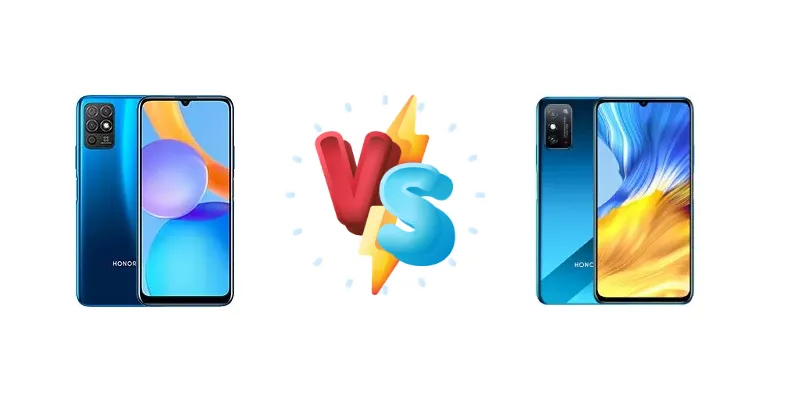
The Honor Play 5T Youth and X10 Max 5G represent different approaches to the budget smartphone market. The Play 5T Youth aims for affordability, while the X10 Max 5G pushes for 5G connectivity and a more powerful processor. This comparison dissects their key differences to help you determine which device best suits your needs.
🏆 Quick Verdict
For the average user prioritizing smooth performance and 5G capabilities, the Honor X10 Max 5G is the clear winner. Its Dimensity 800 chipset delivers a significantly more responsive experience than the Play 5T Youth’s Helio P35, justifying the price difference for those who demand more from their smartphone.
| Network |
|---|
| 2G bands | GSM 850 / 900 / 1800 / 1900 | GSM 850 / 900 / 1800 / 1900 |
| 3G bands | HSDPA 850 / 900 / 1900 / 2100 | HSDPA 800 / 850 / 900 / 1700(AWS) / 1900 / 2100 |
| 4G bands | LTE | 1, 2, 3, 4, 5, 8, 18, 19, 26, 34, 38, 39, 40, 41 |
| 5G bands | - | 1, 3, 38, 41, 77, 78, 79, 80, 84 SA/NSA |
| Speed | HSPA, LTE | HSPA, LTE, 5G |
| Technology | GSM / CDMA / HSPA / CDMA2000 / LTE | GSM / HSPA / LTE / 5G |
| | CDMA2000 1x | - |
| Launch |
|---|
| Announced | 2021, April 20 | 2020, July 02. Released 2020, July 03 |
| Status | Available. Released 2021, April 27 | Discontinued |
| Body |
|---|
| Build | Glass front, plastic back, plastic frame | - |
| Dimensions | 165.2 x 76 x 9.2 mm (6.50 x 2.99 x 0.36 in) | 174.4 x 84.9 x 8.3 mm (6.87 x 3.34 x 0.33 in) |
| SIM | Nano-SIM + Nano-SIM | Nano-SIM + Nano-SIM |
| Weight | 191 g (6.74 oz) | 232 g (8.18 oz) |
| Display |
|---|
| Resolution | 720 x 1600 pixels, 20:9 ratio (~266 ppi density) | 1080 x 2280 pixels, 19:9 ratio (~356 ppi density) |
| Size | 6.6 inches, 105.2 cm2 (~83.8% screen-to-body ratio) | 7.09 inches, 125.5 cm2 (~84.7% screen-to-body ratio) |
| Type | IPS LCD | IPS LCD, HDR10 |
| Platform |
|---|
| CPU | Octa-core (4x2.35 GHz Cortex-A53 & 4x1.8 GHz Cortex-A53) | Octa-core (4x2.0 GHz Cortex-A76 & 4x2.0 GHz Cortex-A55) |
| Chipset | Mediatek MT6765 Helio P35 (12 nm) | Mediatek Dimensity 800 (7 nm) |
| GPU | PowerVR GE8320 | Mali-G57MP4 |
| OS | Android 10, Magic UI 4.0, no Google Play Services | Android 10, Magic UI 3.1, no Google Play Services |
| Memory |
|---|
| Card slot | microSDXC (uses shared SIM slot) | Nano Memory (uses shared SIM slot) |
| Internal | 128GB 6GB RAM, 128GB 8GB RAM | 64GB 6GB RAM, 128GB 6GB RAM, 128GB 8GB RAM |
| | eMMC 5.1 | - |
| Main Camera |
|---|
| Dual | - | 48 MP, f/1.8, 26mm (wide), 1/2.0", 0.8µm, PDAF
Auxiliary lens |
| Features | LED flash, HDR, panorama | LED flash, panorama, HDR |
| Quad | 13 MP, (wide), PDAF
5 MP, (ultrawide)
2 MP (macro)
Auxiliary lens | - |
| Video | 1080p@30fps | 4K@30fps, 1080p@30fps, gyro-EIS |
| Selfie camera |
|---|
| Features | - | HDR |
| Single | 8 MP, (wide) | 8 MP |
| Video | 1080p@30fps | 1080p@30fps |
| Sound |
|---|
| 3.5mm jack | Yes | Yes |
| 35mm jack | Yes | Yes |
| Loudspeaker | Yes | Yes, with dual speakers |
| Comms |
|---|
| Bluetooth | 5.1, A2DP, LE | 5.1, A2DP, LE |
| NFC | No | Yes |
| Positioning | GPS, GLONASS, BDS | GPS, GLONASS, BDS |
| Radio | No | No |
| USB | USB Type-C 2.0 | USB Type-C 2.0, OTG |
| WLAN | Wi-Fi 802.11 b/g/n, Wi-Fi Direct | Wi-Fi 802.11 a/b/g/n/ac, dual-band, Wi-Fi Direct |
| Features |
|---|
| Sensors | Fingerprint (side-mounted), accelerometer, proximity | Fingerprint (side-mounted), accelerometer, gyro, proximity, compass |
| Battery |
|---|
| Charging | 22.5W wired | 22.5W wired |
| Type | Li-Po 5000 mAh | Li-Po 5000 mAh |
| Misc |
|---|
| Colors | Black, Blue | Black, Blue, Silver |
| Models | NZA-AL00, KOZ-AL40 | KKG-AN00 |
| Price | About 170 EUR | About 240 EUR |
Honor Play 5T Youth
- More affordable price point
- Sufficient for basic smartphone tasks
- 22.5W fast charging
- Significantly weaker performance compared to the X10 Max 5G
- Helio P35 chipset may struggle with demanding apps
- Limited future-proofing
Honor X10 Max 5G
- Powerful Dimensity 800 chipset for smooth performance
- 5G connectivity for faster data speeds
- More efficient processor for potentially longer battery life
- Higher price compared to the Play 5T Youth
- May be overkill for users with basic needs
- Potential for more heat generation under heavy load (though mitigated by 7nm process)
Display Comparison
While both devices likely feature LCD panels (based on market segment), the comparison stops there. Detailed display specs are unavailable, but the X10 Max 5G, being a higher-tier device, likely benefits from a higher resolution and potentially better color calibration. The Play 5T Youth’s display is expected to be adequate for basic use, but won’t offer the visual fidelity of its more expensive counterpart.
Camera Comparison
Without detailed camera specifications, a direct comparison is limited. However, the X10 Max 5G, positioned as a more premium device, likely features a more capable main sensor and potentially better image processing algorithms. The Play 5T Youth likely relies on a more basic camera setup, suitable for casual snapshots. The presence of a 5G modem in the X10 Max 5G suggests a more advanced ISP (Image Signal Processor) integrated within the Dimensity 800, potentially leading to improved image quality and video recording capabilities.
Performance
The core difference lies in the chipsets. The Honor X10 Max 5G’s Mediatek Dimensity 800 (7nm) is a substantial leap over the Play 5T Youth’s Helio P35 (12nm). The Dimensity 800 utilizes Cortex-A76 cores, offering significantly higher single-core performance compared to the Cortex-A53 cores in the P35. This translates to faster app loading times, smoother multitasking, and a more enjoyable gaming experience. The 7nm process also contributes to better thermal efficiency, reducing the likelihood of throttling under sustained load. The X10 Max 5G’s CPU configuration (4x2.0 GHz Cortex-A76 & 4x2.0 GHz Cortex-A55) is architecturally superior, providing a more modern and efficient processing experience.
Battery Life
Both devices share a 22.5W wired charging capability, suggesting similar charging speeds. However, the Dimensity 800’s superior efficiency in the X10 Max 5G could offset a potentially smaller battery capacity (spec not provided). The P35 in the Play 5T Youth, being less efficient, may require more frequent charging despite a potentially larger battery. Real-world battery life will depend heavily on usage patterns, but the X10 Max 5G has the potential for longer sustained use due to its more efficient chipset.
Buying Guide
Buy the Honor Play 5T Youth if you need a basic, affordable smartphone for everyday tasks like calling, texting, and light social media use. Its Helio P35 is sufficient for these scenarios. Buy the Honor X10 Max 5G if you prioritize faster performance for gaming, multitasking, and future-proofing with 5G connectivity. The Dimensity 800 offers a substantial upgrade in processing power and responsiveness.
Frequently Asked Questions
❓ Will the Honor X10 Max 5G handle demanding games like PUBG Mobile smoothly?
Yes, the Dimensity 800 chipset in the X10 Max 5G is capable of running PUBG Mobile at high settings with stable frame rates. The Cortex-A76 cores provide the necessary processing power for a smooth gaming experience, and the 7nm process helps prevent overheating and throttling.
❓ Is the Helio P35 in the Honor Play 5T Youth sufficient for everyday social media and browsing?
Yes, the Helio P35 is adequate for basic tasks like browsing social media, checking email, and making calls. However, it may exhibit lag or slowdowns when multitasking or running more demanding applications. It's best suited for users with light smartphone usage.
❓ Does the Honor X10 Max 5G's 5G connectivity actually make a noticeable difference in real-world usage?
The benefit of 5G depends on network availability in your area. If you have access to a 5G network, you'll experience significantly faster download and upload speeds compared to 4G LTE. This is particularly noticeable when streaming high-resolution video or downloading large files.