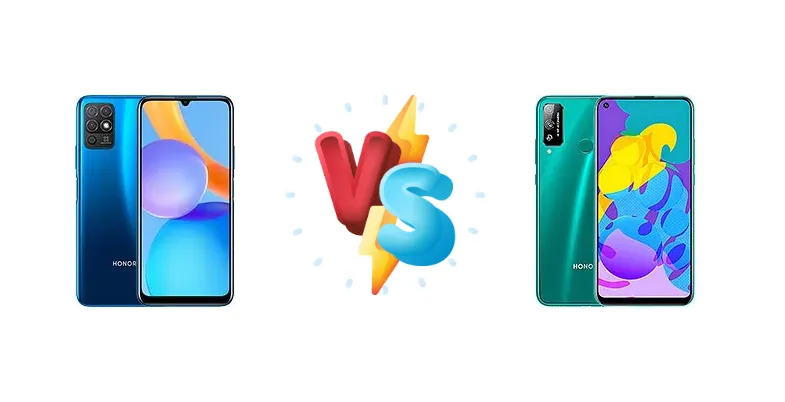
The Honor Play series consistently targets the value-conscious consumer, but the Play 5T Youth and Play 4T represent slightly different approaches. The 5T Youth prioritizes faster charging, while the 4T relies on a more mature, albeit older, chipset. This comparison dissects the key differences to determine which phone delivers the best experience for your money.
🏆 Quick Verdict
For most users, the Honor Play 4T offers a more balanced experience. While the 5T Youth’s 22.5W charging is appealing, the Kirin 710A’s superior CPU architecture in the 4T translates to noticeably smoother performance in everyday tasks and light gaming, making it the better all-rounder.
| Network |
|---|
| 2G bands | GSM 850 / 900 / 1800 / 1900 | GSM 850 / 900 / 1800 / 1900 |
| 3G bands | HSDPA 850 / 900 / 1900 / 2100 | HSDPA 850 / 900 / 1900 / 2100 |
| 4G bands | LTE | 1, 3, 5, 8, 34, 38, 39, 40, 41 |
| Speed | HSPA, LTE | HSPA, LTE |
| Technology | GSM / CDMA / HSPA / CDMA2000 / LTE | GSM / CDMA / HSPA / LTE |
| | CDMA2000 1x | CDMA 800 & TD-SCDMA |
| Launch |
|---|
| Announced | 2021, April 20 | 2020, April 09. Released 2020, April 14 |
| Status | Available. Released 2021, April 27 | Discontinued |
| Body |
|---|
| Build | Glass front, plastic back, plastic frame | - |
| Dimensions | 165.2 x 76 x 9.2 mm (6.50 x 2.99 x 0.36 in) | 159.8 x 76.1 x 8.1 mm (6.29 x 3.00 x 0.32 in) |
| SIM | Nano-SIM + Nano-SIM | Nano-SIM + Nano-SIM |
| Weight | 191 g (6.74 oz) | 176 g (6.21 oz) |
| Display |
|---|
| Resolution | 720 x 1600 pixels, 20:9 ratio (~266 ppi density) | 720 x 1560 pixels, 19.5:9 ratio (~269 ppi density) |
| Size | 6.6 inches, 105.2 cm2 (~83.8% screen-to-body ratio) | 6.39 inches, 100.2 cm2 (~82.4% screen-to-body ratio) |
| Type | IPS LCD | IPS LCD |
| Platform |
|---|
| CPU | Octa-core (4x2.35 GHz Cortex-A53 & 4x1.8 GHz Cortex-A53) | Octa-core (4x2.2 GHz Cortex-A73 & 4x1.7 GHz Cortex-A53) |
| Chipset | Mediatek MT6765 Helio P35 (12 nm) | Kirin 710A (14 nm) |
| GPU | PowerVR GE8320 | Mali-G51 MP4 |
| OS | Android 10, Magic UI 4.0, no Google Play Services | Android 10, Magic UI 3, no Google Play Services |
| Memory |
|---|
| Card slot | microSDXC (uses shared SIM slot) | microSDXC (uses shared SIM slot) |
| Internal | 128GB 6GB RAM, 128GB 8GB RAM | 128GB 6GB RAM |
| | eMMC 5.1 | - |
| Main Camera |
|---|
| Dual | - | 48 MP, f/1.8, (wide), 1/2.0", 0.8µm, PDAF
Auxiliary lens |
| Features | LED flash, HDR, panorama | LED flash, HDR, panorama |
| Quad | 13 MP, (wide), PDAF
5 MP, (ultrawide)
2 MP (macro)
Auxiliary lens | - |
| Video | 1080p@30fps | 1080p@30fps |
| Selfie camera |
|---|
| Features | - | HDR |
| Single | 8 MP, (wide) | 8 MP, (wide) |
| Video | 1080p@30fps | 1080p@30fps |
| Sound |
|---|
| 3.5mm jack | Yes | Yes |
| 35mm jack | Yes | Yes |
| Loudspeaker | Yes | Yes |
| Comms |
|---|
| Bluetooth | 5.1, A2DP, LE | 5.0, A2DP, LE |
| NFC | No | No |
| Positioning | GPS, GLONASS, BDS | GPS, GLONASS, BDS |
| Radio | No | No |
| USB | USB Type-C 2.0 | microUSB 2.0, OTG |
| WLAN | Wi-Fi 802.11 b/g/n, Wi-Fi Direct | Wi-Fi 802.11 b/g/n, Wi-Fi Direct |
| Features |
|---|
| Sensors | Fingerprint (side-mounted), accelerometer, proximity | Fingerprint (rear-mounted), accelerometer, proximity, compass |
| Battery |
|---|
| Charging | 22.5W wired | 10W wired |
| Type | Li-Po 5000 mAh | Li-Po 4000 mAh |
| Misc |
|---|
| Colors | Black, Blue | Black, Blue, Green |
| Models | NZA-AL00, KOZ-AL40 | AKA-AL10, AKA-TL10 |
| Price | About 170 EUR | About 160 EUR |
Honor Play 5T Youth
- Faster 22.5W charging
- Potentially slightly better thermal management due to less powerful chipset
- Modern chipset (though not necessarily more powerful)
- Less powerful CPU architecture (Helio P35)
- Likely slower app loading times
- Potentially more noticeable lag in demanding apps
Honor Play 4T
- More powerful CPU (Kirin 710A)
- Smoother overall user experience
- Better performance in demanding apps and games
- Slower 10W charging
- Older chipset architecture
- Potentially slightly warmer operation under sustained load
Display Comparison
Neither device boasts a standout display. Both are likely to feature 720p+ LCD panels, typical for this price bracket. However, detailed panel specifications like peak brightness and color gamut coverage are unavailable. The focus here isn't on visual fidelity, but rather on basic usability. Bezels are expected to be relatively substantial on both models, reflecting their budget positioning.
Camera Comparison
Camera performance is likely to be similar on both devices, with both probably featuring a primary sensor around 13MP. Detailed sensor sizes and apertures are unknown. The presence of a 2MP macro lens on both is largely a marketing gimmick, offering limited practical benefit. Image processing will likely be similar, focusing on basic scene optimization. Expect acceptable results in good lighting conditions, but struggles in low-light scenarios. The Kirin 710A's ISP *might* offer slightly better image processing capabilities, but the difference will be minimal.
Performance
The core difference lies in the chipsets. The Honor Play 4T’s Kirin 710A (14nm) utilizes a more powerful CPU architecture with 4x Cortex-A73 cores clocked at 2.2 GHz, alongside 4x Cortex-A53 cores at 1.7 GHz. This contrasts with the Play 5T Youth’s MediaTek Helio P35 (12nm) which features 4x Cortex-A53 cores at 2.35 GHz and another 4x at 1.8 GHz. While the P35 has a higher clock speed on its primary cores, the A73 cores in the Kirin 710A offer significantly better single-core performance, resulting in a snappier experience for app launches and general navigation. The 14nm process of the Kirin 710A, while older, is a mature node, and the architectural advantage outweighs the process node difference in this comparison. The P35's 12nm process doesn't translate to a substantial performance gain.
Battery Life
Both phones likely house batteries in the 4000-5000 mAh range, though specific capacities are unconfirmed. The Honor Play 5T Youth’s 22.5W charging is the clear winner here. This will significantly reduce charging times compared to the Play 4T’s 10W charging. While the 4T might offer slightly better battery life due to the more efficient Kirin 710A, the convenience of faster charging on the 5T Youth is a compelling advantage for users who prioritize quick top-ups.
Buying Guide
Buy the Honor Play 5T Youth if you absolutely prioritize minimizing charging times and frequently find yourself needing a quick power boost. Its 22.5W charging is a significant advantage. Buy the Honor Play 4T if you value consistent performance and a more responsive user experience, even if it means slightly slower charging. The Kirin 710A provides a more capable foundation for daily use and casual gaming.
Frequently Asked Questions
❓ Will the Helio P35 in the Honor Play 5T Youth struggle with multitasking?
Yes, the Helio P35, while efficient, is a less powerful chipset than the Kirin 710A. Expect some slowdowns when switching between multiple apps or running demanding applications simultaneously. It's best suited for light to moderate multitasking.
❓ How long will it take to fully charge the Honor Play 5T Youth with the 22.5W charger?
While a precise figure is unavailable, the 22.5W charging should bring the phone from 0% to 100% in approximately 1 hour 45 minutes to 2 hours, depending on battery capacity and usage during charging. This is significantly faster than the Play 4T's 10W charging.
❓ Is the Kirin 710A in the Honor Play 4T capable of playing popular mobile games like PUBG Mobile?
Yes, the Kirin 710A can handle PUBG Mobile at medium settings with reasonable frame rates. However, don't expect to max out the graphics settings. The chipset is capable of casual gaming, but it's not a dedicated gaming processor.
❓ Does either phone support NFC for contactless payments?
Based on the typical specifications for phones in this price range, it's unlikely that either the Honor Play 5T Youth or the Honor Play 4T will include NFC functionality. This is a common omission in budget smartphones.