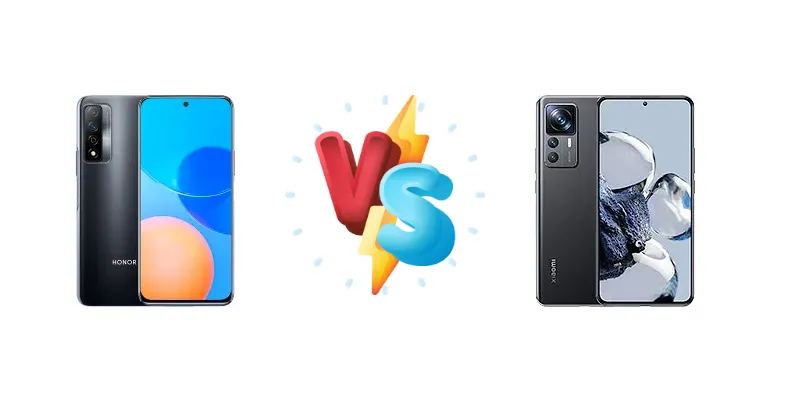
The smartphone market is overflowing with options, making it tough to choose. Today, we pit the budget-friendly Honor Play 5T Pro against the powerhouse Xiaomi 12T Pro. This comparison will break down their strengths and weaknesses to help you find the perfect fit for your needs.
🏆 Quick Verdict
The Xiaomi 12T Pro is the clear winner, boasting a significantly faster processor, superior camera system, and blazing-fast 120W charging. While the Honor Play 5T Pro offers decent value, it can't compete with the 12T Pro's premium features and performance.
| Network |
|---|
| 2G bands | GSM 850 / 900 / 1800 / 1900 | GSM 850 / 900 / 1800 / 1900 |
| 3G bands | HSDPA 850 / 900 / 1900 / 2100 | HSDPA 800 / 850 / 900 / 1700(AWS) / 1900 / 2100 |
| 4G bands | LTE | 1, 2, 3, 4, 5, 7, 8, 12, 13, 17, 18, 19, 20, 25, 26, 28, 32, 38, 39, 40, 41, 42, 48, 66 |
| 5G bands | - | 1, 3, 5, 7, 8, 20, 28, 38, 40, 41, 66, 77, 78, 75 SA/NSA |
| Speed | HSPA, LTE | HSPA, LTE, 5G |
| Technology | GSM / CDMA / HSPA / CDMA2000 / LTE | GSM / HSPA / LTE / 5G |
| | CDMA2000 1x | - |
| Launch |
|---|
| Announced | 2021, August 05 | 2022, October 04 |
| Status | Available. Released 2021, August 05 | Available. Released 2022, October 06 |
| Body |
|---|
| Dimensions | 160.7 x 73.3 x 8.4 mm (6.33 x 2.89 x 0.33 in) | 163.1 x 75.9 x 8.6 mm (6.42 x 2.99 x 0.34 in) |
| SIM | Nano-SIM + Nano-SIM | · Nano-SIM + eSIM· Nano-SIM + Nano-SIM |
| Weight | 179 g (6.31 oz) | 205 g (7.23 oz) |
| | - | IP53, dust and splash resistant |
| Display |
|---|
| Protection | - | Corning Gorilla Glass 5 |
| Resolution | 1080 x 2400 pixels, 20:9 ratio (~399 ppi density) | 1220 x 2712 pixels, 20:9 ratio (~446 ppi density) |
| Size | 6.6 inches, 105.2 cm2 (~89.3% screen-to-body ratio) | 6.67 inches, 107.4 cm2 (~86.7% screen-to-body ratio) |
| Type | IPS LCD | AMOLED, 68B colors, 120Hz, Dolby Vision, HDR10+, 500 nits (typ), 900 nits (peak) |
| Platform |
|---|
| CPU | Octa-core (2x2.0 GHz Cortex-A75 & 6x1.8 GHz Cortex-A55) | Octa-core (1x3.19 GHz Cortex-X2 & 3x2.75 GHz Cortex-A710 & 4x2.0 GHz Cortex-A510) |
| Chipset | Mediatek MT6769V/CU Helio G80 (12 nm) | Qualcomm SM8475 Snapdragon 8+ Gen 1 (4 nm) |
| GPU | Mali-G52 MC2 | Adreno 730 |
| OS | Android 11, Magic UI 4.0 | Android 12, upgradable to Android 14, HyperOS |
| Memory |
|---|
| Card slot | No | No |
| Internal | 128GB 8GB RAM | 128GB 8GB RAM, 256GB 8GB RAM, 256GB 12GB RAM |
| | - | UFS 3.1 |
| Main Camera |
|---|
| Dual | 64 MP, f/1.9, 27mm (wide), PDAF
Auxiliary lens | - |
| Features | LED flash, HDR, panorama | Color spectrum sensor, Dual-LED dual-tone flash, HDR, panorama |
| Single | 16 MP, f/2.0, (wide) | - |
| Triple | - | 200 MP, f/1.7, (wide), 1/1.22", 0.64µm, PDAF, OIS
8 MP, f/2.2, 120˚ (ultrawide), 1/4.0", 1.12µm
2 MP (macro) |
| Video | 1080p@30fps, gyro-EIS | 8K@24fps, 4K@30/60fps, 1080p@30/60/120/240fps, HDR10+ |
| Selfie camera |
|---|
| Features | - | HDR, panorama |
| Single | 16 MP, f/2.0, (wide) | 20 MP, f/2.2, (wide), 1/3.47", 0.8µm |
| Video | 1080p@30fps | 1080p@30/60fps, HDR |
| Sound |
|---|
| 3.5mm jack | Yes | No |
| 35mm jack | Yes | No |
| Loudspeaker | Yes | Yes, with stereo speakers |
| | - | Tuned by Harman Kardon
24-bit/192kHz audio |
| Comms |
|---|
| Bluetooth | 5.1, A2DP, LE | 5.2, A2DP, LE, aptX HD |
| Infrared port | - | Yes |
| NFC | No | Yes (market/region dependent) |
| Positioning | GPS, GLONASS, GALILEO, BDS | GPS (L1+L5), GLONASS (L1), BDS (B1I+B1c+B2a), GALILEO (E1+E5a), QZSS (L1+L5), NavIC (L5) |
| Radio | No | No |
| USB | USB Type-C 2.0, OTG | USB Type-C 2.0, OTG |
| WLAN | Wi-Fi 802.11 a/b/g/n/ac, dual-band, Wi-Fi Direct | Wi-Fi 802.11 a/b/g/n/ac/6, dual-band, Wi-Fi Direct |
| Features |
|---|
| Sensors | Fingerprint (side-mounted), accelerometer, gyro, proximity, compass | Fingerprint (under display, optical), accelerometer, gyro, proximity, compass |
| Battery |
|---|
| Charging | 22.5W wired | 120W wired, 100% in 19 min |
| Type | Li-Po 4000 mAh | Li-Po 5000 mAh |
| Misc |
|---|
| Colors | Magic Black, Titanium Silver | Black, Silver, Blue |
| Models | - | 22081212UG, 22081212G |
| Price | About 200 EUR | $ 208.76 / € 167.62 |
| SAR | - | 1.08 W/kg (head) 1.07 W/kg (body) |
| SAR EU | - | 1.00 W/kg (head) 1.00 W/kg (body) |
| Tests |
|---|
| Battery life | - | Endurance rating 91h |
| Camera | - | Photo / Video |
| Display | - | Contrast ratio: Infinite (nominal) |
| Loudspeaker | - | -24.1 LUFS (Very good) |
| Performance | - | AnTuTu: 1032185 (v9)
GeekBench: 4081 (v5.1)
GFXBench: 65fps (ES 3.1 onscreen) |
Honor Play 5T Pro
- Affordable
- Decent battery life
- Good value for money
- Lower performance
- Less impressive camera
- Slower charging
- Basic display
Xiaomi 12T Pro
- Flagship performance
- Excellent camera
- Blazing-fast charging
- Stunning display
- More expensive
- Potentially less durable (glass back)
Display Comparison
The Xiaomi 12T Pro's 6.67-inch AMOLED display with a 120Hz refresh rate and a peak brightness of 913 nits blows the Honor Play 5T Pro's display out of the water. Colors are more vibrant, blacks are deeper, and the higher refresh rate provides a smoother visual experience. The Honor likely uses an LCD panel with a standard refresh rate, resulting in a less immersive experience.
Camera Comparison
The Xiaomi 12T Pro's camera system is a major upgrade. While specific megapixel counts aren't the whole story, the combination of the Snapdragon 8+ Gen 1's image processing and likely better sensors results in superior photo and video quality, especially in low light. The Honor Play 5T Pro's camera is adequate for casual snapshots but lacks the detail and dynamic range of the 12T Pro.
Performance
The Snapdragon 8+ Gen 1 in the Xiaomi 12T Pro is a flagship-level chipset, offering significantly faster processing speeds and smoother multitasking than the Helio G80 in the Honor Play 5T Pro. Gaming performance will be dramatically better on the 12T Pro, and demanding apps will run with ease. The Honor will handle everyday tasks adequately, but struggles with intensive workloads.
Battery Life
Both phones boast impressive endurance ratings (91h), suggesting excellent battery life. However, the Xiaomi 12T Pro's 120W charging is a game-changer, allowing it to charge from 0% to 100% in just 19 minutes – a massive advantage over the Honor's 22.5W charging.
Buying Guide
The Honor Play 5T Pro is ideal for budget-conscious users who prioritize affordability and basic functionality. The Xiaomi 12T Pro is for those seeking top-tier performance, a stunning display, a versatile camera, and incredibly fast charging, regardless of price.
Frequently Asked Questions
❓ Is the Honor Play 5T Pro good for gaming?
It can handle casual games, but demanding titles will likely suffer from lag and reduced graphics settings due to its less powerful chipset.
❓ How much does the Xiaomi 12T Pro cost?
The Xiaomi 12T Pro typically retails for around $500-$700, depending on the configuration and retailer.
❓ What type of charging does the Honor Play 5T Pro use?
It uses 22.5W wired charging, which is relatively slow compared to the Xiaomi 12T Pro's 120W charging.