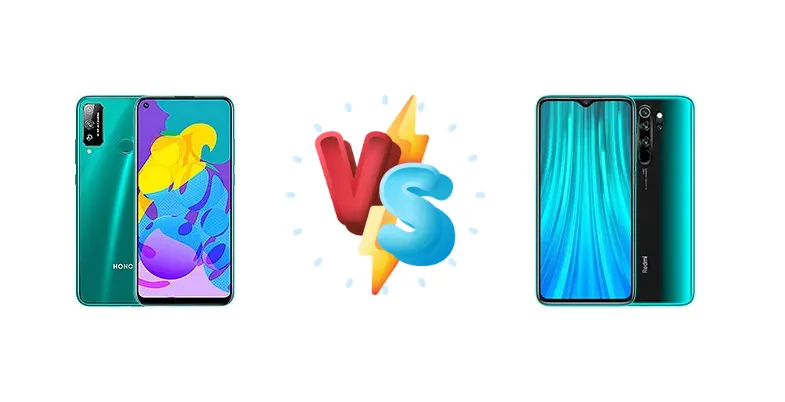
Choosing a new smartphone can be overwhelming, especially with so many options available. Today, we're pitting two popular contenders against each other: the Honor Play 4T and the Xiaomi Redmi Note 8 Pro. Let's dive into a detailed comparison to help you decide which one is right for you.
🏆 Quick Verdict
The Xiaomi Redmi Note 8 Pro emerges as the clear winner, offering superior performance thanks to the Helio G90T chipset, a brighter display, faster charging, and a generally more feature-rich experience. While the Honor Play 4T is a budget-friendly option, it falls short in key areas.
| Network |
|---|
| 2G bands | GSM 850 / 900 / 1800 / 1900 | GSM 850 / 900 / 1800 / 1900 |
| 3G bands | HSDPA 850 / 900 / 1900 / 2100 | HSDPA 850 / 900 / 1900 / 2100 |
| 4G bands | 1, 3, 5, 8, 34, 38, 39, 40, 41 | 1, 3, 5, 7, 8, 40, 41 |
| Speed | HSPA, LTE | HSPA, LTE |
| Technology | GSM / CDMA / HSPA / LTE | GSM / HSPA / LTE |
| | CDMA 800 & TD-SCDMA | - |
| Launch |
|---|
| Announced | 2020, April 09. Released 2020, April 14 | 2019, August 29. Released 2019, September 24 |
| Status | Discontinued | Discontinued |
| Body |
|---|
| Build | - | Glass front (Gorilla Glass 5), glass back (Gorilla Glass 5), plastic frame |
| Dimensions | 159.8 x 76.1 x 8.1 mm (6.29 x 3.00 x 0.32 in) | 161.4 x 76.4 x 8.8 mm (6.35 x 3.01 x 0.35 in) |
| SIM | Nano-SIM + Nano-SIM | Nano-SIM + Nano-SIM |
| Weight | 176 g (6.21 oz) | 200 g (7.05 oz) |
| Display |
|---|
| Protection | - | Corning Gorilla Glass 5 |
| Resolution | 720 x 1560 pixels, 19.5:9 ratio (~269 ppi density) | 1080 x 2340 pixels, 19.5:9 ratio (~395 ppi density) |
| Size | 6.39 inches, 100.2 cm2 (~82.4% screen-to-body ratio) | 6.53 inches, 104.7 cm2 (~84.9% screen-to-body ratio) |
| Type | IPS LCD | IPS LCD, HDR, 500 nits (typ) |
| Platform |
|---|
| CPU | Octa-core (4x2.2 GHz Cortex-A73 & 4x1.7 GHz Cortex-A53) | Octa-core (2x2.05 GHz Cortex-A76 & 6x2.0 GHz Cortex-A55) |
| Chipset | Kirin 710A (14 nm) | Mediatek MT6785V/CC Helio G90T (12 nm) |
| GPU | Mali-G51 MP4 | Mali-G76 MC4 |
| OS | Android 10, Magic UI 3, no Google Play Services | Android 9.0 (Pie), upgradable to Android 11, MIUI 12.5 |
| Memory |
|---|
| Card slot | microSDXC (uses shared SIM slot) | microSDXC (uses shared SIM slot) |
| Internal | 128GB 6GB RAM | 64GB 4GB RAM, 64GB 6GB RAM, 128GB 4GB RAM, 128GB 6GB RAM, 128GB 8GB RAM, 256GB 8GB RAM |
| | - | UFS 2.1 |
| Main Camera |
|---|
| Dual | 48 MP, f/1.8, (wide), 1/2.0", 0.8µm, PDAF
Auxiliary lens | - |
| Features | LED flash, HDR, panorama | LED flash, HDR, panorama |
| Quad | - | 64 MP, f/1.9, 26mm (wide), 1/1.72", 0.8µm, PDAF
8 MP, f/2.2, 13mm (ultrawide), 1/4.0", 1.12µm
2 MP (macro)
Auxiliary lens |
| Video | 1080p@30fps | 4K@30fps, 1080p@30/60/120fps, 720p@960fps, gyro-EIS |
| Selfie camera |
|---|
| Features | HDR | HDR, panorama |
| Single | 8 MP, (wide) | 20 MP, f/2.0, (wide), 1/3", 0.9µm |
| Video | 1080p@30fps | 1080p@30fps |
| Sound |
|---|
| 3.5mm jack | Yes | Yes |
| 35mm jack | Yes | Yes |
| Loudspeaker | Yes | Yes |
| Comms |
|---|
| Bluetooth | 5.0, A2DP, LE | 5.0, A2DP, LE |
| Infrared port | - | Yes |
| NFC | No | Yes |
| Positioning | GPS, GLONASS, BDS | GPS, GLONASS, GALILEO, BDS |
| Radio | No | FM radio, recording |
| USB | microUSB 2.0, OTG | USB Type-C 2.0 |
| WLAN | Wi-Fi 802.11 b/g/n, Wi-Fi Direct | Wi-Fi 802.11 a/b/g/n/ac, dual-band, Wi-Fi Direct |
| Features |
|---|
| Sensors | Fingerprint (rear-mounted), accelerometer, proximity, compass | Fingerprint (rear-mounted), accelerometer, gyro, proximity, compass |
| Battery |
|---|
| Charging | 10W wired | 18W wired |
| Type | Li-Po 4000 mAh | Li-Po 4500 mAh, non-removable |
| Misc |
|---|
| Colors | Black, Blue, Green | Black, Red, Blue, White, Deep Sea Blue, Midnight Blue, Electric Blue, Twilight Orange |
| Models | AKA-AL10, AKA-TL10 | 2015105, M1906G7I, M1906G7G |
| Price | About 160 EUR | About 220 EUR |
| SAR | - | 1.15 W/kg (head) 1.18 W/kg (body) |
| SAR EU | - | 1.00 W/kg (head) 1.47 W/kg (body) |
| Tests |
|---|
| Audio quality | - |
Noise -93.6dB / Crosstalk -91.9dB |
| Battery life | - | Endurance rating 114h |
| Camera | - |
Photo / Video |
| Display | - |
Contrast ratio: 1326:1 (nominal) |
| Loudspeaker | - |
Voice 64dB / Noise 71dB / Ring 82dB |
| Performance | - |
AnTuTu: 224759 (v7), 279355 (v8)
GeekBench: 6999 (v4.4), 1622 (v5.1)
GFXBench: 14fps (ES 3.1 onscreen) |
Honor Play 4T
- Affordable
- Decent battery life (claimed)
- Simple user interface
- Weaker performance
- Slower charging
- Likely inferior camera
- Lower brightness display
- Missing key specs
Xiaomi Redmi Note 8 Pro
- Powerful Helio G90T chipset
- Brighter display
- Faster 18W charging
- Likely better camera
- Good value for money
- Software bloat (potential)
- Design may not appeal to everyone
Display Comparison
The Redmi Note 8 Pro boasts a significantly brighter display at 640 nits compared to the Play 4T (specs unavailable, assumed lower). Both offer a 1326:1 contrast ratio, but the Note 8 Pro's higher brightness makes for a more vibrant and enjoyable viewing experience, especially outdoors. The Note 8 Pro likely has a slightly larger screen as well, though exact dimensions are needed for confirmation.
Camera Comparison
While both phones offer 'Photo / Video' capabilities, the Redmi Note 8 Pro is expected to have a more advanced camera system. The Note 8 Pro likely features a higher resolution main sensor and potentially additional lenses (ultrawide, macro, depth) for greater versatility. The Kirin 710A's image processing capabilities are also likely less sophisticated than the Helio G90T's.
Performance
Here, the Redmi Note 8 Pro takes a commanding lead. The Helio G90T chipset is considerably more powerful than the Kirin 710A. Expect smoother multitasking, faster app loading times, and better gaming performance on the Note 8 Pro. The Note 8 Pro's CPU architecture (Cortex-A76 cores) also contributes to its superior performance.
Battery Life
Both phones claim impressive endurance ratings (114h), suggesting excellent battery life. However, the Redmi Note 8 Pro's 18W fast charging provides a significant advantage over the Honor Play 4T's 10W charging, allowing for quicker top-ups.
Buying Guide
The Honor Play 4T is ideal for users on a very tight budget who prioritize basic functionality and a simple user experience. The Xiaomi Redmi Note 8 Pro is a better choice for those seeking a more powerful phone with a better camera, display, and faster charging, without breaking the bank.
Frequently Asked Questions
❓ Is the Honor Play 4T good for gaming?
The Honor Play 4T's Kirin 710A chipset is adequate for basic games, but it will struggle with more demanding titles. The Redmi Note 8 Pro is a much better choice for gaming.
❓ Which phone has better battery life?
Both phones claim excellent battery life (114h endurance rating). However, the Redmi Note 8 Pro's faster charging makes it more convenient.