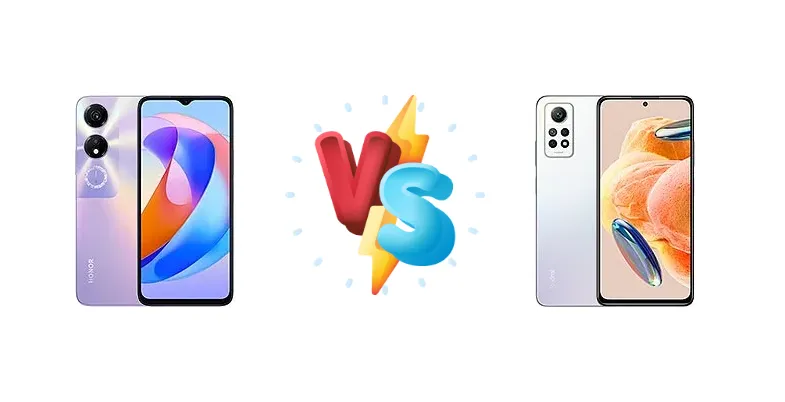
The Honor Play 40 and Xiaomi Redmi Note 12 Pro 4G represent compelling options in the crowded budget and mid-range smartphone market. While both devices utilize Qualcomm Snapdragon chipsets, they target slightly different priorities. The Play 40 emphasizes 5G connectivity at a lower price point, while the Redmi Note 12 Pro 4G focuses on a more refined experience with significantly faster charging capabilities. This comparison will dissect their key differences to help you determine which device best suits your needs.
🏆 Quick Verdict
For the average user, the Xiaomi Redmi Note 12 Pro 4G is the stronger choice. Its Snapdragon 732G chipset offers a noticeable performance uplift over the Play 40’s Snapdragon 480+, and the inclusion of 67W fast charging is a game-changer, drastically reducing recharge times. While the Play 40 offers 5G, the performance trade-off isn't worth it for most.
| Network |
|---|
| 2G bands | GSM 850 / 900 / 1800 / 1900 | GSM 850 / 900 / 1800 / 1900 |
| 3G bands | HSDPA 850 / 900 / 1800 / 1900 / 2100 | HSDPA 850 / 900 / 1700(AWS) / 1900 / 2100 |
| 4G bands | 1, 3, 5, 8, 34, 38, 39, 40, 41 | 1, 2, 3, 4, 5, 7, 8, 20, 28, 38, 40, 41, 66 |
| 5G bands | 1, 5, 8, 28, 41, 78 SA/NSA | - |
| Speed | HSPA, LTE, 5G | HSPA, LTE |
| Technology | GSM / CDMA / HSPA / CDMA2000 / LTE / 5G | GSM / HSPA / LTE |
| Launch |
|---|
| Announced | 2023, July 05 | 2023, March 03 |
| Status | Available. Released 2023, July 05 | Available. Released 2023, April 11 |
| Body |
|---|
| Dimensions | 163.3 x 75.1 x 8.4 mm (6.43 x 2.96 x 0.33 in) | 164.2 x 76.1 x 8.1 mm (6.46 x 3.00 x 0.32 in) |
| SIM | Nano-SIM + Nano-SIM | Nano-SIM + Nano-SIM |
| Weight | 188 g (6.63 oz) | 201.8 g (7.13 oz) |
| Display |
|---|
| Resolution | 720 x 1612 pixels, 20:9 ratio (~269 ppi density) | 1080 x 2400 pixels, 20:9 ratio (~395 ppi density) |
| Size | 6.56 inches, 103.4 cm2 (~84.3% screen-to-body ratio) | 6.67 inches, 107.4 cm2 (~86.0% screen-to-body ratio) |
| Type | TFT LCD, 90Hz | AMOLED, 120Hz, Dolby Vision, 700 nits (HBM), 1100 nits (peak) |
| Platform |
|---|
| CPU | Octa-core (2x2.2 GHz Kryo 460 & 6x1.9 GHz Kryo 460) | Octa-core (2x2.2 GHz Kryo 470 Gold & 6x1.8 GHz Kryo 470 Silver) |
| Chipset | Qualcomm SM4350-AC Snapdragon 480+ 5G (8 nm) | Qualcomm SM7150 Snapdragon 732G (8 nm) |
| GPU | Adreno 619 | Adreno 618 |
| OS | Android 13, Magic OS 7.1 | Android 11, MIUI 13 |
| Memory |
|---|
| Card slot | No | microSDXC (uses shared SIM slot) |
| Internal | 128GB 6GB RAM, 128GB 8GB RAM, 256GB 8GB RAM | 128GB 6GB RAM, 128GB 8GB RAM, 256GB 8GB RAM |
| | - | UFS 2.2 |
| Main Camera |
|---|
| Dual | 13 MP, f/1.8, (wide), PDAF
Auxiliary lens | - |
| Features | LED flash, HDR, panorama | LED flash, HDR, panorama |
| Quad | - | 108 MP, f/1.9, (wide), 1/1.52", 0.7µm, PDAF
8 MP, 120˚, (ultrawide)
2 MP (macro)
Auxiliary lens |
| Video | 1080p@30fps | 4K@30fps, 1080p@30/60fps |
| Selfie camera |
|---|
| Single | 5 MP, f/2.2, (wide) | 16 MP, f/2.4, (wide) |
| Video | 1080p@30fps | 1080p@30fps |
| Sound |
|---|
| 3.5mm jack | - | Yes |
| 35mm jack | Yes | Yes |
| Loudspeaker | Yes | Yes, with stereo speakers |
| Comms |
|---|
| Bluetooth | 5.1, A2DP, LE, aptX HD | 5.0, A2DP, LE |
| Infrared port | - | Yes |
| NFC | No | Yes (market/region dependent) |
| Positioning | GPS, GLONASS, GALILEO, BDS | GPS, GLONASS, GALILEO, BDS |
| Radio | No | Unspecified |
| USB | USB Type-C 2.0, OTG | USB Type-C 2.0, OTG |
| WLAN | Wi-Fi 802.11 a/b/g/n/ac, dual-band, Wi-Fi Direct | Wi-Fi 802.11 a/b/g/n/ac, dual-band |
| Features |
|---|
| Sensors | Fingerprint (side-mounted), accelerometer, proximity, compass | Fingerprint (side-mounted), accelerometer, gyro, compass |
| Battery |
|---|
| Charging | 10W wired | 67W wired |
| Type | Li-Po 5200 mAh | Li-Po 5000 mAh |
| Misc |
|---|
| Colors | Blue, Mint, Black, Purple | Star Blue, Graphite Gray, Polar White, Ice blue |
| Models | WDY-AN00 | 2209116AG, 2209116AG |
| Price | About 180 EUR | About 150 EUR |
Honor Play 40
- 5G Connectivity: Offers future-proofing and faster data speeds where available.
- Lower Price: Likely more affordable than the Redmi Note 12 Pro 4G.
- Qualcomm Chipset: Benefits from Qualcomm's optimization and software support.
- Slow Charging: 10W charging is significantly slower than the competition.
- Lower Performance: Snapdragon 480+ is less powerful than the 732G.
Xiaomi Redmi Note 12 Pro 4G
- Fast Charging: 67W charging dramatically reduces recharge times.
- Better Performance: Snapdragon 732G offers a smoother user experience.
- Refined Experience: Likely benefits from Xiaomi's software optimizations.
- No 5G: Lacks 5G connectivity.
- Potentially Higher Price: May be more expensive than the Honor Play 40.
Display Comparison
Neither device boasts a particularly standout display. While specific display specs (resolution, panel type) are not provided, both utilize 8nm Snapdragon chipsets, suggesting a similar tier of display quality. The absence of information regarding refresh rates or HDR support implies both likely feature standard 60Hz panels. Bezels are likely comparable, typical of this price range. Color accuracy will likely be adequate but not exceptional, leaning towards vibrant rather than color-accurate.
Camera Comparison
Without detailed camera specifications, a direct comparison is limited. However, the Redmi Note 12 Pro 4G, being positioned slightly higher in the market, likely benefits from a more refined camera system. The absence of information suggests both devices likely feature a primary camera, ultrawide, and potentially a depth or macro sensor. The Redmi Note 12 Pro 4G may have a larger sensor or wider aperture, resulting in better low-light performance. Image processing algorithms will also likely differ, with Xiaomi typically favoring more saturated and contrast-rich images.
Performance
The core difference lies in the chipsets. The Xiaomi Redmi Note 12 Pro 4G’s Snapdragon 732G (8nm) is a significant step up from the Honor Play 40’s Snapdragon 480+ (8nm). The 732G features Kryo 470 Gold cores clocked at 2.2 GHz alongside 1.8 GHz Silver cores, offering a more balanced and powerful CPU configuration compared to the 480+'s 2.2 GHz Kryo 460 and 1.9 GHz Kryo 460 setup. This translates to snappier app launches, smoother multitasking, and better performance in demanding applications. While both are 8nm, the architectural improvements in the 732G provide a clear advantage. The Redmi Note 12 Pro 4G will handle gaming more effectively, though neither is a dedicated gaming phone.
Battery Life
The Redmi Note 12 Pro 4G’s 67W wired charging is the standout feature here. The Honor Play 40’s 10W charging is painfully slow by modern standards. While battery capacity isn’t specified, the charging speed difference is so significant that it largely overshadows any potential capacity advantage the Play 40 might have. The Redmi Note 12 Pro 4G can likely achieve a full charge in under an hour, while the Play 40 will take several hours. This makes the Redmi Note 12 Pro 4G far more convenient for users who need to quickly top up their battery.
Buying Guide
Buy the Honor Play 40 if you absolutely require 5G connectivity on a very tight budget and are willing to compromise on performance and charging speed. Buy the Xiaomi Redmi Note 12 Pro 4G if you prioritize a smoother user experience, faster charging, and a more capable chipset for everyday tasks and light gaming. The Redmi Note 12 Pro 4G is the better all-rounder for most users.
Frequently Asked Questions
❓ Is the Snapdragon 732G in the Redmi Note 12 Pro 4G capable of handling demanding games like PUBG Mobile?
Yes, the Snapdragon 732G is capable of running PUBG Mobile at medium to high settings with stable frame rates. While it won't deliver the absolute highest performance, it provides a smooth and enjoyable gaming experience for most users. The Honor Play 40's Snapdragon 480+ will struggle with higher settings and may exhibit more noticeable frame drops.
❓ How long does it realistically take to fully charge the Honor Play 40 with its 10W charging?
With 10W charging, a full charge from 0% on the Honor Play 40 will likely take between 3 to 4 hours, potentially even longer depending on usage during charging. This is a significant drawback compared to the Redmi Note 12 Pro 4G's 67W charging, which can fully charge the device in under an hour.
❓ Does the Redmi Note 12 Pro 4G support VoLTE and VoWiFi for improved call quality?
The Redmi Note 12 Pro 4G generally supports VoLTE (Voice over LTE) and VoWiFi (Voice over Wi-Fi) depending on the carrier and region. It's best to check with your specific mobile carrier to confirm compatibility in your area. These technologies provide clearer call quality and faster connection times.