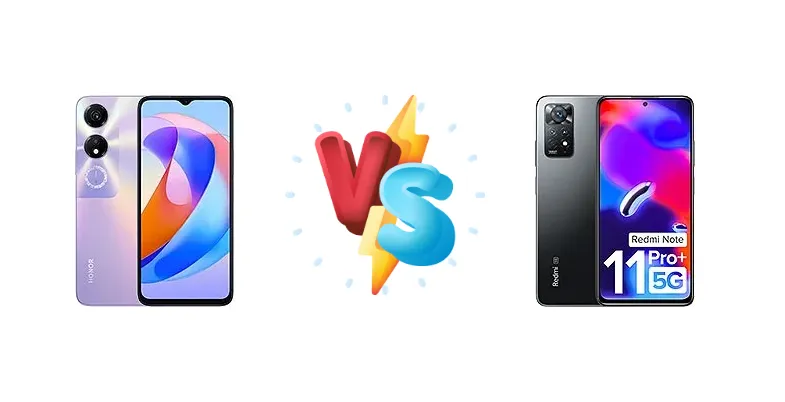
Both the Honor Play 40 and the Xiaomi Redmi Note 11 Pro+ 5G (India) target the budget-conscious 5G smartphone user. However, they take different approaches to achieving affordability. The Honor Play 40 prioritizes a streamlined experience, while the Redmi Note 11 Pro+ 5G focuses on delivering a faster charging experience and a slightly more powerful chipset. This comparison will dissect the key differences to help you choose the right device.
🏆 Quick Verdict
For the average user, the Xiaomi Redmi Note 11 Pro+ 5G (India) is the better choice. Its Snapdragon 695, built on a more efficient 6nm process, offers a performance edge, and the 67W charging is a game-changer, significantly reducing downtime compared to the Honor Play 40’s 10W charging.
| Network |
|---|
| 2G bands | GSM 850 / 900 / 1800 / 1900 | GSM 850 / 900 / 1800 / 1900 - SIM 1 & SIM 2 |
| 3G bands | HSDPA 850 / 900 / 1800 / 1900 / 2100 | HSDPA 850 / 900 / 1900 / 2100 |
| 4G bands | 1, 3, 5, 8, 34, 38, 39, 40, 41 | 1, 3, 5, 8, 40, 41 |
| 5G bands | 1, 5, 8, 28, 41, 78 SA/NSA | 1, 3, 5, 8, 28, 40, 78 SA/NSA |
| Speed | HSPA, LTE, 5G | HSPA, LTE-A (CA), 5G |
| Technology | GSM / CDMA / HSPA / CDMA2000 / LTE / 5G | GSM / HSPA / LTE / 5G |
| Launch |
|---|
| Announced | 2023, July 05 | 2022, March 09 |
| Status | Available. Released 2023, July 05 | Available. Released 2022, March 15 |
| Body |
|---|
| Build | - | Glass front (Gorilla Glass 5), glass back |
| Dimensions | 163.3 x 75.1 x 8.4 mm (6.43 x 2.96 x 0.33 in) | 164.2 x 76.1 x 8.1 mm (6.46 x 3.00 x 0.32 in) |
| SIM | Nano-SIM + Nano-SIM | Hybrid Dual SIM (Nano-SIM, dual stand-by) |
| Weight | 188 g (6.63 oz) | 202 g (7.13 oz) |
| | - | IP53, dust and splash resistant |
| Display |
|---|
| Protection | - | Corning Gorilla Glass 5 |
| Resolution | 720 x 1612 pixels, 20:9 ratio (~269 ppi density) | 1080 x 2400 pixels, 20:9 ratio (~395 ppi density) |
| Size | 6.56 inches, 103.4 cm2 (~84.3% screen-to-body ratio) | 6.67 inches, 107.4 cm2 (~86.0% screen-to-body ratio) |
| Type | TFT LCD, 90Hz | Super AMOLED, 120Hz, 700 nits, 1200 nits (peak) |
| Platform |
|---|
| CPU | Octa-core (2x2.2 GHz Kryo 460 & 6x1.9 GHz Kryo 460) | Octa-core (2x2.2 GHz Kryo 660 Gold & 6x1.7 GHz Kryo 660 Silver) |
| Chipset | Qualcomm SM4350-AC Snapdragon 480+ 5G (8 nm) | Qualcomm SM6375 Snapdragon 695 5G (6 nm) |
| GPU | Adreno 619 | Adreno 619 |
| OS | Android 13, Magic OS 7.1 | Android 11, MIUI 13 |
| Memory |
|---|
| Card slot | No | microSDXC (uses shared SIM slot) |
| Internal | 128GB 6GB RAM, 128GB 8GB RAM, 256GB 8GB RAM | 64GB 6GB RAM, 128GB 6GB RAM, 128GB 8GB RAM, 256GB 8GB RAM |
| | - | UFS 2.2 |
| Main Camera |
|---|
| Dual | 13 MP, f/1.8, (wide), PDAF
Auxiliary lens | - |
| Features | LED flash, HDR, panorama | LED flash, HDR, panorama |
| Triple | - | 108 MP, f/1.9, 26mm (wide), 1/1.52", 0.7µm, PDAF
8 MP, f/2.2, 118˚ (ultrawide)
2 MP, f/2.4, (macro) |
| Video | 1080p@30fps | 1080p@30fps |
| Selfie camera |
|---|
| Single | 5 MP, f/2.2, (wide) | 16 MP, f/2.5, (wide), 1/3.06" 1.0µm |
| Video | 1080p@30fps | 1080p@30fps |
| Sound |
|---|
| 3.5mm jack | - | Yes |
| 35mm jack | Yes | - |
| Loudspeaker | Yes | Yes, with stereo speakers |
| | - | 24-bit/192kHz audio |
| Comms |
|---|
| Bluetooth | 5.1, A2DP, LE, aptX HD | 5.1, A2DP, LE |
| Infrared port | - | Yes |
| NFC | No | No |
| Positioning | GPS, GLONASS, GALILEO, BDS | GPS, GLONASS, BDS, GALILEO |
| Radio | No | Unspecified |
| USB | USB Type-C 2.0, OTG | USB Type-C 2.0, OTG |
| WLAN | Wi-Fi 802.11 a/b/g/n/ac, dual-band, Wi-Fi Direct | Wi-Fi 802.11 a/b/g/n/ac, dual-band, Wi-Fi Direct |
| Features |
|---|
| Sensors | Fingerprint (side-mounted), accelerometer, proximity, compass | Fingerprint (side-mounted), accelerometer, gyro, proximity, compass |
| Battery |
|---|
| Charging | 10W wired | 67W wired, PD3.0, QC3, 50% in 15 min, 100% in 42 min (advertised) |
| Type | Li-Po 5200 mAh | Li-Po 5000 mAh, non-removable |
| Misc |
|---|
| Colors | Blue, Mint, Black, Purple | Mirage Blue, Phantom White, Stealth Black |
| Models | WDY-AN00 | 2201116SI |
| Price | About 180 EUR | About 250 EUR |
Honor Play 40
- Potentially lower initial cost
- Simple and streamlined user experience
- 5G connectivity
- Slow 10W charging
- Less powerful Snapdragon 480+ chipset
- Limited performance for demanding tasks
Xiaomi Redmi Note 11 Pro+ 5G (India)
- Faster 67W charging with PD3.0/QC3
- More powerful Snapdragon 695 chipset (6nm)
- Likely better camera system
- Potentially higher price point
- May include bloatware (typical of Xiaomi)
- Larger size/weight compared to the Honor Play 40 (likely)
Display Comparison
Neither device boasts a flagship-level display. While specific display specs (resolution, panel type) are missing for the Honor Play 40, the Redmi Note 11 Pro+ 5G likely features a standard AMOLED panel common in its price bracket. The key differentiator here isn't display quality, but charging speed, which impacts how often you're looking *at* the display. The Redmi's faster charging means less time tethered to a wall.
Camera Comparison
Without detailed camera specifications for the Honor Play 40, a direct comparison is limited. However, the Redmi Note 11 Pro+ 5G (India) likely features a more sophisticated camera system, typical of Xiaomi’s ‘Pro’ series. The focus should be on the main sensor and its aperture; larger sensors and wider apertures capture more light, resulting in better low-light performance. The Redmi’s image processing algorithms are also likely more refined, offering better dynamic range and color accuracy. The presence of OIS (Optical Image Stabilization) on the Redmi, if equipped, would further enhance image quality, particularly in videos.
Performance
The Xiaomi Redmi Note 11 Pro+ 5G (India) holds a clear advantage in performance thanks to its Qualcomm Snapdragon 695 5G (6nm). This chipset, with its Kryo 660 Gold and Silver cores, offers a more balanced and efficient architecture compared to the Honor Play 40’s Snapdragon 480+ (8nm). The 6nm process node of the 695 translates to better thermal efficiency and potentially sustained performance under load. While both CPUs peak at 2.2 GHz, the architectural improvements in the 695 provide a noticeable benefit in real-world usage, especially for multitasking and gaming.
Battery Life
The Redmi Note 11 Pro+ 5G (India) truly shines in the battery and charging department. While the actual battery capacity isn't specified for either device, the Redmi’s 67W wired charging, supporting PD3.0 and QC3, is a massive advantage. Advertised figures claim a 50% charge in 15 minutes and a full charge in 42 minutes. The Honor Play 40’s 10W charging is comparatively slow, requiring significantly longer to reach a full charge. This difference in charging speed directly impacts usability and convenience, making the Redmi a more practical choice for users who need to quickly top up their battery.
Buying Guide
Buy the Honor Play 40 if you prioritize simplicity and a lower initial cost, and aren't concerned with fast charging or demanding applications. Buy the Xiaomi Redmi Note 11 Pro+ 5G (India) if you value quicker charging speeds, a more capable processor for multitasking and light gaming, and a generally more responsive user experience. The Redmi is the better all-rounder.
Frequently Asked Questions
❓ Is the Snapdragon 695 in the Redmi Note 11 Pro+ 5G (India) capable of handling demanding games like PUBG Mobile?
The Snapdragon 695 is capable of running PUBG Mobile, but you'll likely need to use medium graphics settings for a smooth experience. It's not a gaming powerhouse, but it's significantly more capable than the Snapdragon 480+ in the Honor Play 40.
❓ How much faster is the 67W charging on the Redmi Note 11 Pro+ 5G (India) compared to the 10W charging on the Honor Play 40 in real-world use?
The difference is substantial. The Redmi can go from 0-50% in just 15 minutes, and fully charge in around 42 minutes. The Honor Play 40, with its 10W charging, will take several hours to fully charge, making it less convenient for users who need a quick power boost.
❓ Does the Redmi Note 11 Pro+ 5G (India) suffer from significant thermal throttling during extended gaming sessions?
The Snapdragon 695, built on a 6nm process, is relatively efficient. While some throttling is expected during prolonged gaming, it's generally well-managed and shouldn't lead to drastic performance drops. The Honor Play 40's 8nm chip is more prone to throttling.