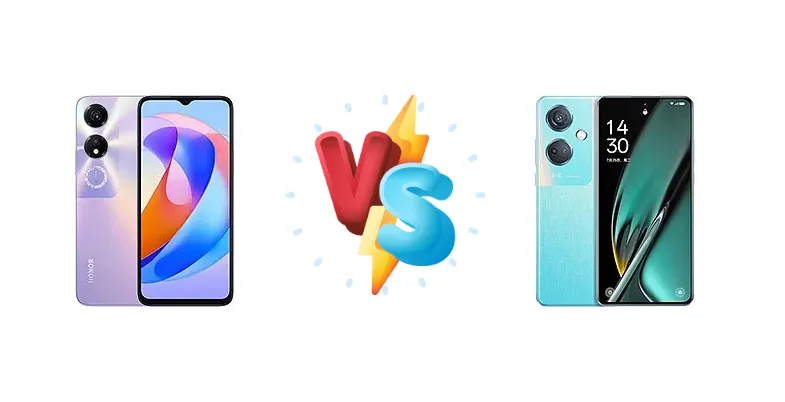
The Honor Play 40 and Oppo K11 represent compelling options in the increasingly competitive budget 5G smartphone market. While both aim to deliver connectivity and essential features at an accessible price point, they diverge significantly in their core processing power and charging capabilities. This comparison dissects these differences to determine which device offers the best value for your money.
🏆 Quick Verdict
For the average user prioritizing responsiveness and future-proofing, the Oppo K11 is the clear winner. Its Snapdragon 782G chipset delivers substantially better performance than the Honor Play 40’s Snapdragon 480+, and the inclusion of 100W charging is a game-changer for convenience, despite a similar battery capacity.
| Network |
|---|
| 2G bands | GSM 850 / 900 / 1800 / 1900 | GSM 850 / 900 / 1800 / 1900 |
| 3G bands | HSDPA 850 / 900 / 1800 / 1900 / 2100 | HSDPA 850 / 900 / 1700(AWS) / 1900 / 2100 |
| 4G bands | 1, 3, 5, 8, 34, 38, 39, 40, 41 | 1, 2, 3, 4, 5, 7, 8, 28, 34, 38, 39, 40, 41 |
| 5G bands | 1, 5, 8, 28, 41, 78 SA/NSA | 1, 3, 5, 8, 28, 40, 41, 77, 78 SA/NSA |
| Speed | HSPA, LTE, 5G | HSPA, LTE, 5G |
| Technology | GSM / CDMA / HSPA / CDMA2000 / LTE / 5G | GSM / CDMA / HSPA / CDMA2000 / LTE / 5G |
| Launch |
|---|
| Announced | 2023, July 05 | 2023, July 25 |
| Status | Available. Released 2023, July 05 | Available. Released 2023, August 01 |
| Body |
|---|
| Build | - | Glass front, plastic frame, plastic back |
| Dimensions | 163.3 x 75.1 x 8.4 mm (6.43 x 2.96 x 0.33 in) | 162.7 x 75.5 x 8.2 mm (6.41 x 2.97 x 0.32 in) |
| SIM | Nano-SIM + Nano-SIM | Nano-SIM + Nano-SIM |
| Weight | 188 g (6.63 oz) | 184 g (6.49 oz) |
| Display |
|---|
| Protection | - | Corning Gorilla Glass 5 |
| Resolution | 720 x 1612 pixels, 20:9 ratio (~269 ppi density) | 1080 x 2400 pixels, 20:9 ratio (~393 ppi density) |
| Size | 6.56 inches, 103.4 cm2 (~84.3% screen-to-body ratio) | 6.7 inches, 108.4 cm2 (~88.2% screen-to-body ratio) |
| Type | TFT LCD, 90Hz | AMOLED, 1B colors, 120Hz, HDR10+, 500 nits (typical), 1100 nits (peak) |
| Platform |
|---|
| CPU | Octa-core (2x2.2 GHz Kryo 460 & 6x1.9 GHz Kryo 460) | Octa-core (1x2.7 GHz Cortex-A78 & 3x2.4 GHz Cortex-A78 & 4x1.8 GHz Cortex-A55) |
| Chipset | Qualcomm SM4350-AC Snapdragon 480+ 5G (8 nm) | Qualcomm Snapdragon 782G (6 nm) |
| GPU | Adreno 619 | Adreno 642L |
| OS | Android 13, Magic OS 7.1 | Android 13, ColorOS 13.1 |
| Memory |
|---|
| Card slot | No | microSDXC (dedicated slot) |
| Internal | 128GB 6GB RAM, 128GB 8GB RAM, 256GB 8GB RAM | 256GB 8GB RAM, 256GB 12GB RAM, 512GB 12GB RAM |
| Main Camera |
|---|
| Dual | 13 MP, f/1.8, (wide), PDAF
Auxiliary lens | - |
| Features | LED flash, HDR, panorama | LED flash, HDR, panorama |
| Triple | - | 50 MP, f/1.8, 24mm (wide), 1/1.56", 1.0µm, multi-directional PDAF, OIS
8 MP, f/2.2, 112˚ (ultrawide), 1/4.0", 1.12µm
2 MP (macro) |
| Video | 1080p@30fps | 4K@30fps, 1080p@30/60/120fps, gyro-EIS |
| Selfie camera |
|---|
| Features | - | HDR |
| Single | 5 MP, f/2.2, (wide) | 16 MP, f/2.4, 24mm (wide), 1.0µm |
| Video | 1080p@30fps | 1080p@30fps, gyro-EIS |
| Sound |
|---|
| 35mm jack | Yes | No |
| Loudspeaker | Yes | Yes, with stereo speakers |
| Comms |
|---|
| Bluetooth | 5.1, A2DP, LE, aptX HD | 5.2, A2DP, LE, aptX HD |
| NFC | No | Yes |
| Positioning | GPS, GLONASS, GALILEO, BDS | GPS, GLONASS, GALILEO, BDS, QZSS |
| Radio | No | No |
| USB | USB Type-C 2.0, OTG | USB Type-C 2.0, OTG |
| WLAN | Wi-Fi 802.11 a/b/g/n/ac, dual-band, Wi-Fi Direct | Wi-Fi 802.11 a/b/g/n/ac/6, dual-band, Wi-Fi Direct |
| Features |
|---|
| Sensors | Fingerprint (side-mounted), accelerometer, proximity, compass | Fingerprint (under display, optical), accelerometer, gyro, proximity, compass |
| Battery |
|---|
| Charging | 10W wired | 100W wired, 100% in 26 min |
| Type | Li-Po 5200 mAh | Li-Po 5000 mAh |
| Misc |
|---|
| Colors | Blue, Mint, Black, Purple | Moonshadow Gray; Glacier Blue |
| Models | WDY-AN00 | PJC110 |
| Price | About 180 EUR | - |
Honor Play 40
- Potentially lower price point
- 5G connectivity
- Reliable for basic tasks
- Significantly weaker performance
- Extremely slow charging
- Limited future-proofing
Oppo K11
- Much faster Snapdragon 782G processor
- Ultra-fast 100W charging
- Improved image processing capabilities
- Likely higher price
- May not include a headphone jack (market dependent)
- Potential for software bloat (Oppo's ColorOS)
Display Comparison
Neither device's display specifications are provided, so we must infer. Given the price bracket, both likely feature LCD panels. However, the Oppo K11, positioned slightly higher, may benefit from a higher resolution or improved color calibration. The absence of details like refresh rate or peak brightness makes a direct comparison impossible, but the K11's overall positioning suggests a potentially more refined visual experience.
Camera Comparison
Without specific camera sensor details, a detailed comparison is limited. However, the Oppo K11, being a slightly more premium device, likely incorporates a more capable main sensor. The Snapdragon 782G also offers a more advanced image signal processor (ISP) than the 480+, resulting in better image processing, noise reduction, and dynamic range. The inclusion of Optical Image Stabilization (OIS) on the K11, while unconfirmed, would further enhance image quality, particularly in low-light conditions. The 2MP macro cameras often found on both devices are generally of limited utility.
Performance
The core difference lies in the chipsets. The Oppo K11’s Snapdragon 782G (6nm) is a significant leap over the Honor Play 40’s Snapdragon 480+ (8nm). The 782G features a Cortex-A78 prime core clocked at 2.7GHz, alongside three additional A78 cores, offering substantially improved CPU performance for demanding applications. The 480+ relies on Kryo 460 cores, which are less efficient and deliver lower peak performance. This translates to faster app loading times, smoother multitasking, and a more enjoyable gaming experience on the K11. The 6nm process node of the 782G also contributes to better thermal efficiency, reducing the likelihood of throttling during sustained workloads.
Battery Life
Both phones feature 10W charging, a stark contrast. The Oppo K11’s 100W SuperVOOC charging is a massive advantage, capable of fully charging the device in approximately 26 minutes. This dramatically reduces downtime and offers unparalleled convenience. While battery capacity isn't specified, the faster charging of the K11 effectively mitigates any potential disadvantage from a slightly smaller battery, as users can quickly top up the charge whenever needed. The Honor Play 40’s 10W charging is comparatively slow, requiring significantly longer to reach a full charge.
Buying Guide
Buy the Honor Play 40 if you need a basic, reliable 5G smartphone for essential tasks like calling, texting, and light social media browsing, and are on a very tight budget. Buy the Oppo K11 if you prioritize smoother multitasking, gaming, and significantly faster charging, and are willing to spend a bit more for a more capable and future-proof device.
Frequently Asked Questions
❓ Is the Snapdragon 782G in the Oppo K11 capable of handling demanding games like PUBG or Genshin Impact?
Yes, the Snapdragon 782G is a capable mid-range chipset that can handle PUBG and Genshin Impact at medium to high settings with playable frame rates. While it won't deliver the same performance as flagship processors, it provides a significantly smoother gaming experience compared to the Snapdragon 480+ in the Honor Play 40.
❓ How much faster is the 100W charging on the Oppo K11 compared to the 10W charging on the Honor Play 40 in real-world usage?
The difference is substantial. The Oppo K11 can go from 0% to 100% in around 26 minutes, while the Honor Play 40 will take several hours to fully charge. This means you can quickly top up the K11 during short breaks, whereas the Play 40 requires overnight charging for a full battery.
❓ Will the Honor Play 40 receive software updates and security patches for an extended period?
Honor's software update policy for budget devices can be inconsistent. While they generally provide updates, the frequency and duration of support may be shorter compared to Oppo, which has a more established track record of software maintenance.