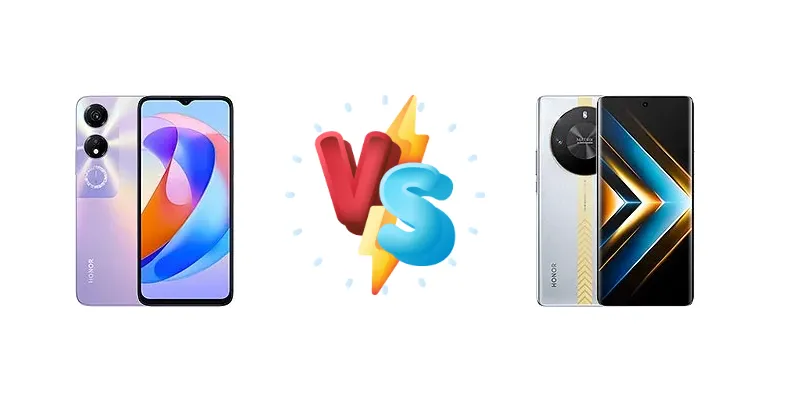
Honor offers a compelling range of smartphones, but the Play 40 and X50 GT represent distinctly different approaches. The Play 40 targets the budget-conscious 5G user, while the X50 GT aims for a more demanding audience seeking near-flagship performance. This comparison dissects the core differences between these two devices, focusing on where each excels and who will benefit most.
🏆 Quick Verdict
For the average user prioritizing affordability and basic 5G connectivity, the Honor Play 40 is a sensible choice. However, the Honor X50 GT delivers a significantly superior experience thanks to its Snapdragon 8+ Gen 1 chipset and 35W fast charging, making it the clear winner for gamers and power users.
| Network |
|---|
| 2G bands | GSM 850 / 900 / 1800 / 1900 | GSM 850 / 900 / 1800 / 1900 |
| 3G bands | HSDPA 850 / 900 / 1800 / 1900 / 2100 | HSDPA 850 / 900 / 1700(AWS) / 1900 / 2100 |
| 4G bands | 1, 3, 5, 8, 34, 38, 39, 40, 41 | LTE |
| 5G bands | 1, 5, 8, 28, 41, 78 SA/NSA | SA/NSA |
| Speed | HSPA, LTE, 5G | HSPA, LTE, 5G |
| Technology | GSM / CDMA / HSPA / CDMA2000 / LTE / 5G | GSM / CDMA / HSPA / CDMA2000 / LTE / 5G |
| Launch |
|---|
| Announced | 2023, July 05 | 2024, January 04 |
| Status | Available. Released 2023, July 05 | Available. Released 2024, January 09 |
| Body |
|---|
| Dimensions | 163.3 x 75.1 x 8.4 mm (6.43 x 2.96 x 0.33 in) | 163.6 x 75.5 x 8 mm (6.44 x 2.97 x 0.31 in) |
| SIM | Nano-SIM + Nano-SIM | Nano-SIM + Nano-SIM |
| Weight | 188 g (6.63 oz) | 192 g (6.77 oz) |
| Display |
|---|
| Resolution | 720 x 1612 pixels, 20:9 ratio (~269 ppi density) | 1220 x 2652 pixels, 19.5:9 ratio (~431 ppi density) |
| Size | 6.56 inches, 103.4 cm2 (~84.3% screen-to-body ratio) | 6.78 inches, 112.6 cm2 (~91.2% screen-to-body ratio) |
| Type | TFT LCD, 90Hz | AMOLED, 1B colors, 120Hz |
| Platform |
|---|
| CPU | Octa-core (2x2.2 GHz Kryo 460 & 6x1.9 GHz Kryo 460) | Octa-core (1x3.0 GHz Cortex-X2 & 3x2.5 GHz Cortex-A710 & 4x1.80 GHz Cortex-A510) |
| Chipset | Qualcomm SM4350-AC Snapdragon 480+ 5G (8 nm) | Qualcomm SM8475 Snapdragon 8+ Gen 1 (4 nm) |
| GPU | Adreno 619 | Adreno 730 |
| OS | Android 13, Magic OS 7.1 | Android 13, MagicOS 7.2 |
| Memory |
|---|
| Card slot | No | No |
| Internal | 128GB 6GB RAM, 128GB 8GB RAM, 256GB 8GB RAM | 256GB 12GB RAM, 256GB 16GB RAM, 512GB 16GB RAM, 1TB 16GB RAM |
| Main Camera |
|---|
| Dual | 13 MP, f/1.8, (wide), PDAF
Auxiliary lens | 108 MP, f/1.8, (wide), 1/1.67", PDAF
Auxiliary lens |
| Features | LED flash, HDR, panorama | LED flash, panorama, HDR |
| Video | 1080p@30fps | 4K@30fps, 1080p@30fps |
| Selfie camera |
|---|
| Single | 5 MP, f/2.2, (wide) | 8 MP, f/2.0, (wide) |
| Video | 1080p@30fps | 1080p@30fps |
| Sound |
|---|
| 35mm jack | Yes | No |
| Loudspeaker | Yes | Yes |
| Comms |
|---|
| Bluetooth | 5.1, A2DP, LE, aptX HD | 5.2, A2DP, LE, aptX HD |
| NFC | No | Yes |
| Positioning | GPS, GLONASS, GALILEO, BDS | GPS, GLONASS, GALILEO, BDS |
| Radio | No | No |
| USB | USB Type-C 2.0, OTG | USB Type-C 2.0, OTG |
| WLAN | Wi-Fi 802.11 a/b/g/n/ac, dual-band, Wi-Fi Direct | Wi-Fi 802.11 a/b/g/n/ac/6, dual-band, Wi-Fi Direct |
| Features |
|---|
| Sensors | Fingerprint (side-mounted), accelerometer, proximity, compass | Fingerprint (under display, optical), accelerometer, gyro, ultrasound proximity, compass |
| Battery |
|---|
| Charging | 10W wired | 35W wired
7.5W reverse wired |
| Type | Li-Po 5200 mAh | Li-Po 5800 mAh |
| Misc |
|---|
| Colors | Blue, Mint, Black, Purple | Black, Silver |
| Models | WDY-AN00 | ALP-AN00 |
| Price | About 180 EUR | About 260 EUR |
Honor Play 40
- More affordable price point
- Decent battery life for basic usage
- 5G connectivity for future-proofing
- Significantly slower performance
- Slow 10W charging
- Limited gaming capabilities
Honor X50 GT
- Flagship-level Snapdragon 8+ Gen 1 performance
- 35W fast charging for quick top-ups
- Superior gaming experience
- Higher price compared to the Play 40
- Potentially shorter battery life under heavy load
- May run warmer during extended gaming sessions
Display Comparison
While specific display details (resolution, panel type) are missing, the core difference lies in the processing power driving the visuals. Both phones likely utilize LCD panels given their price points. However, the Snapdragon 8+ Gen 1 in the X50 GT will enable smoother frame rates in games and faster rendering of complex interfaces. The Play 40’s Snapdragon 480+ will struggle with graphically intensive tasks, resulting in lower frame rates and potential stuttering. Bezels are likely comparable, but the X50 GT’s superior processing allows for more sophisticated image processing, potentially improving color accuracy and dynamic range.
Camera Comparison
Without detailed camera specifications, it’s difficult to make precise comparisons. However, the X50 GT’s more powerful ISP (Image Signal Processor) within the Snapdragon 8+ Gen 1 will provide superior image processing capabilities. This translates to better noise reduction, dynamic range, and overall image quality, especially in low-light conditions. While both phones may feature similar megapixel counts for the main sensor, the X50 GT’s processing power will likely result in sharper, more detailed photos. The Play 40 will likely rely more heavily on software processing to compensate for its less capable chipset.
Performance
The performance gap is substantial. The Honor X50 GT’s Snapdragon 8+ Gen 1 (4nm) is a flagship-level chipset, featuring a Cortex-X2 prime core clocked at 3.0 GHz, alongside three Cortex-A710 performance cores and four Cortex-A510 efficiency cores. This contrasts sharply with the Play 40’s Snapdragon 480+ (8nm), which uses a more modest Kryo 460 configuration. The 4nm process node of the 8+ Gen 1 offers significantly improved power efficiency and thermal performance, meaning the X50 GT can sustain peak performance for longer periods without throttling. The X50 GT will excel in demanding tasks like gaming and video editing, while the Play 40 is better suited for basic multitasking and app usage.
Battery Life
Battery capacity is not specified, but the X50 GT’s 35W wired charging is a major advantage over the Play 40’s 10W charging. This means the X50 GT can be rapidly topped up, minimizing downtime. While the Play 40 may offer slightly longer battery life due to its less power-hungry chipset, the convenience of fast charging on the X50 GT is a significant benefit. The X50 GT also features 7.5W reverse wired charging, allowing it to charge other devices, a feature absent on the Play 40.
Buying Guide
Buy the Honor Play 40 if you need a reliable, affordable 5G smartphone for everyday tasks like browsing, social media, and light communication. It’s ideal for users who prioritize battery life over raw performance. Buy the Honor X50 GT if you prefer a smoother, faster experience for gaming, demanding apps, and content creation, and if you value significantly quicker charging times. This phone is geared towards users who want a performance boost without the flagship price tag.
Frequently Asked Questions
❓ Will the Snapdragon 480+ in the Honor Play 40 struggle with demanding games like Genshin Impact?
Yes, the Snapdragon 480+ is not designed for graphically intensive games. While you might be able to run Genshin Impact at the lowest settings, expect significant frame rate drops and potential stuttering. The Honor X50 GT with its Snapdragon 8+ Gen 1 is far better suited for gaming.
❓ How long does it realistically take to charge the Honor X50 GT from 0% to 100% with the 35W charger?
With the 35W charger, the Honor X50 GT can typically charge from 0% to 100% in approximately 60-75 minutes, depending on usage during charging. This is a substantial improvement over the Play 40’s much slower 10W charging, which could take over 3 hours.
❓ Does the Honor X50 GT get excessively hot during prolonged gaming sessions?
The Snapdragon 8+ Gen 1 is efficient, but it can generate heat under sustained load. The X50 GT likely incorporates thermal management solutions to mitigate this, but some warmth is expected during extended gaming. It's unlikely to reach uncomfortable temperatures, but it's a factor to consider.
❓ Is the reverse wired charging on the X50 GT useful for charging accessories like earbuds?
Yes, the 7.5W reverse wired charging is convenient for topping up accessories like wireless earbuds or smartwatches. It's not a fast charging solution for these devices, but it's a handy feature to have when you're away from a power outlet.