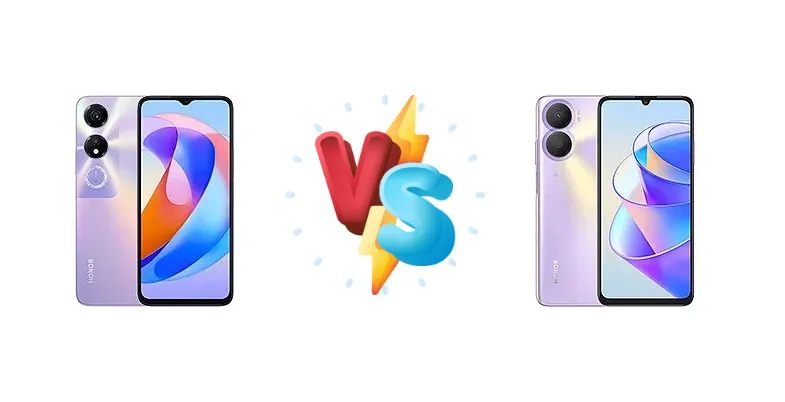
Honor's Play series consistently delivers compelling value in the budget smartphone space. The Play 40 and Play 40 Plus represent two distinct approaches to achieving that value: the Play 40 prioritizes efficiency with a Snapdragon chipset, while the Play 40 Plus aims for a performance boost with a MediaTek Dimensity processor. This comparison dissects the key differences to determine which device best suits your needs.
🏆 Quick Verdict
For the average user prioritizing consistent performance and faster charging, the Honor Play 40 Plus is the better choice. Its MediaTek Dimensity 700 chipset, coupled with 22.5W charging, offers a noticeable advantage over the Snapdragon 480+ and 10W charging of the Play 40, despite the slightly older 7nm process.
| Network |
|---|
| 2G bands | GSM 850 / 900 / 1800 / 1900 | GSM 850 / 900 / 1800 / 1900 |
| 3G bands | HSDPA 850 / 900 / 1800 / 1900 / 2100 | HSDPA 850 / 900 / 1900 / 2100 |
| 4G bands | 1, 3, 5, 8, 34, 38, 39, 40, 41 | LTE |
| 5G bands | 1, 5, 8, 28, 41, 78 SA/NSA | SA/NSA |
| Speed | HSPA, LTE, 5G | HSPA, LTE, 5G |
| Technology | GSM / CDMA / HSPA / CDMA2000 / LTE / 5G | GSM / CDMA / HSPA / EVDO / LTE / 5G |
| | - | CDMA2000 1xEV-DO |
| Launch |
|---|
| Announced | 2023, July 05 | 2022, October 20 |
| Status | Available. Released 2023, July 05 | Available. Released 2022, October 28 |
| Body |
|---|
| Dimensions | 163.3 x 75.1 x 8.4 mm (6.43 x 2.96 x 0.33 in) | 167.5 x 76.9 x 8.3 mm (6.59 x 3.03 x 0.33 in) |
| SIM | Nano-SIM + Nano-SIM | Nano-SIM + Nano-SIM |
| Weight | 188 g (6.63 oz) | 196 g (6.91 oz) |
| Display |
|---|
| Resolution | 720 x 1612 pixels, 20:9 ratio (~269 ppi density) | 720 x 1600 pixels, 20:9 ratio (~260 ppi density) |
| Size | 6.56 inches, 103.4 cm2 (~84.3% screen-to-body ratio) | 6.74 inches, 109.7 cm2 (~85.1% screen-to-body ratio) |
| Type | TFT LCD, 90Hz | TFT LCD, 90Hz |
| Platform |
|---|
| CPU | Octa-core (2x2.2 GHz Kryo 460 & 6x1.9 GHz Kryo 460) | Octa-core (2x2.2 GHz Cortex-A76 & 6x2.0 GHz Cortex-A55) |
| Chipset | Qualcomm SM4350-AC Snapdragon 480+ 5G (8 nm) | Mediatek Dimensity 700 (7 nm) |
| GPU | Adreno 619 | Mali-G57 MC2 |
| OS | Android 13, Magic OS 7.1 | Android 12, Magic UI 6.1 |
| Memory |
|---|
| Card slot | No | No |
| Internal | 128GB 6GB RAM, 128GB 8GB RAM, 256GB 8GB RAM | 128GB 6GB RAM, 128GB 8GB RAM, 256GB 8GB RAM |
| Main Camera |
|---|
| Dual | 13 MP, f/1.8, (wide), PDAF
Auxiliary lens | 50 MP, f/1.8, (wide), PDAF
Auxiliary lens |
| Features | LED flash, HDR, panorama | LED flash, HDR, panorama |
| Single | - | 5 MP, f/2.2, (wide) |
| Video | 1080p@30fps | 1080p@30fps |
| Selfie camera |
|---|
| Single | 5 MP, f/2.2, (wide) | 5 MP, f/2.2, (wide) |
| Video | 1080p@30fps | 1080p@30fps |
| Sound |
|---|
| 3.5mm jack | - | Yes |
| 35mm jack | Yes | Yes |
| Loudspeaker | Yes | Yes |
| Comms |
|---|
| Bluetooth | 5.1, A2DP, LE, aptX HD | 5.1, A2DP, LE |
| NFC | No | No |
| Positioning | GPS, GLONASS, GALILEO, BDS | GPS, GLONASS, GALILEO, BDS |
| Radio | No | No |
| USB | USB Type-C 2.0, OTG | USB Type-C 2.0, OTG |
| WLAN | Wi-Fi 802.11 a/b/g/n/ac, dual-band, Wi-Fi Direct | Wi-Fi 802.11 a/b/g/n/ac, dual-band, Wi-Fi Direct |
| Features |
|---|
| Sensors | Fingerprint (side-mounted), accelerometer, proximity, compass | Fingerprint (side-mounted), accelerometer, proximity, compass |
| Battery |
|---|
| Charging | 10W wired | 22.5W wired |
| Type | Li-Po 5200 mAh | Li-Po 6000 mAh |
| Misc |
|---|
| Colors | Blue, Mint, Black, Purple | Blue, Silver, Black, Purple |
| Models | WDY-AN00 | RKY-AN00 |
| Price | About 180 EUR | About 170 EUR |
Honor Play 40
- Potentially better power efficiency due to the 8nm Snapdragon 480+.
- Lower price point is likely.
- Reliable Qualcomm chipset with established software support.
- Significantly slower 10W charging.
- Less powerful CPU compared to the Dimensity 700.
- May struggle with demanding multitasking.
Honor Play 40 Plus
- Faster 22.5W wired charging for quicker top-ups.
- More powerful MediaTek Dimensity 700 chipset for smoother performance.
- 7nm process potentially offers better sustained performance.
- Potentially slightly lower battery efficiency compared to the Snapdragon.
- MediaTek chipsets sometimes have less consistent software updates.
- May be slightly more expensive.
Display Comparison
Both devices likely feature similar LCD panels, given their price point. However, detailed display specs (resolution, brightness, color gamut) are unavailable. The focus here is on internal performance. The absence of high refresh rate panels is expected in this segment, meaning smooth scrolling will rely more on chipset responsiveness than panel capabilities.
Camera Comparison
Without detailed camera specifications, a direct comparison is difficult. Both phones likely feature a multi-camera setup, but the quality will heavily depend on the main sensor and image processing algorithms. It's reasonable to assume both will include a standard wide lens and potentially a depth sensor. The presence of Optical Image Stabilization (OIS) is unlikely in this price bracket. Image processing will likely be tuned for vibrant colors and social media sharing, rather than natural accuracy.
Performance
The core difference lies in the chipsets. The Honor Play 40 utilizes the Qualcomm Snapdragon 480+ 5G, fabricated on an 8nm process. Its octa-core CPU configuration (2x2.2 GHz Kryo 460 & 6x1.9 GHz Kryo 460) provides a balanced approach to power and efficiency. The Play 40 Plus, however, features the MediaTek Dimensity 700, built on a 7nm process. While also an octa-core CPU (2x2.2 GHz Cortex-A76 & 6x2.0 GHz Cortex-A55), the Cortex-A76 cores in the Dimensity 700 offer a performance edge over the Kryo 460 cores in the Snapdragon 480+. This translates to snappier app launches and smoother multitasking. The 7nm process, despite being older, can contribute to better sustained performance under load, though thermal management will ultimately dictate real-world results.
Battery Life
Battery capacity is not specified, but both phones likely house similar-sized batteries (around 5000mAh is typical for this segment). The critical difference is charging speed. The Honor Play 40 is limited to 10W wired charging, resulting in a significantly longer charge time. The Play 40 Plus, with its 22.5W wired charging, offers a much faster charging experience, potentially reducing 0-100% charge time by over an hour. This makes the Play 40 Plus more convenient for users who frequently need to top up their battery.
Buying Guide
Buy the Honor Play 40 if you prioritize long-term efficiency and are comfortable with slower charging speeds. It’s ideal for users who primarily browse, use social media, and make occasional calls. Buy the Honor Play 40 Plus if you prefer a more responsive experience for multitasking, light gaming, and appreciate the convenience of significantly faster 22.5W wired charging, making it better suited for power users on the go.
Frequently Asked Questions
❓ Will the Dimensity 700 in the Play 40 Plus overheat during extended gaming sessions?
While the Dimensity 700 is more powerful, sustained performance will depend on Honor's thermal management implementation. The 7nm process generally offers better thermal efficiency than the 8nm Snapdragon 480+, but demanding games may still cause some throttling. Expect playable frame rates, but not necessarily peak performance for prolonged periods.
❓ Is the 10W charging on the Honor Play 40 realistically usable in 2024?
10W charging is undeniably slow by modern standards. Expect a full charge to take well over 3 hours, potentially closer to 4. It's suitable for overnight charging, but inconvenient for quick top-ups. The Play 40 Plus's 22.5W charging is a significant upgrade in this regard.
❓ Does either phone support VoLTE or 5G carrier aggregation for improved network performance?
Given both phones target budget 5G connectivity, support for VoLTE is highly probable. However, the extent of 5G carrier aggregation support is unknown without specific regional specifications. Carrier aggregation allows for faster and more stable 5G connections, but its availability varies by carrier and region.