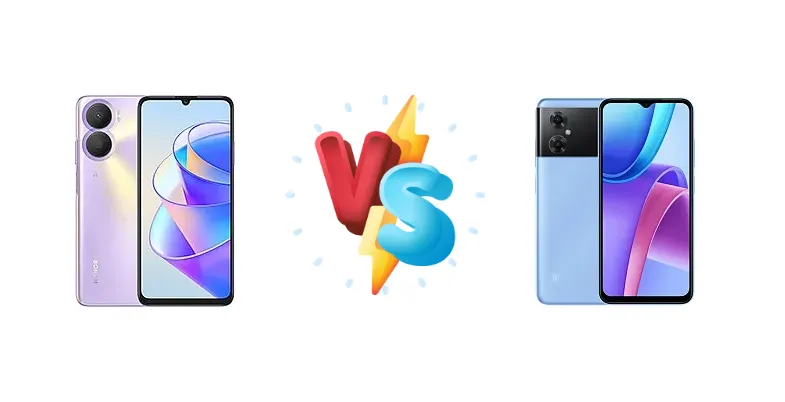
The mid-range smartphone market is packed with options, making it tough to choose. Today, we're pitting the Honor Play 40 Plus against the Xiaomi Redmi Note 11R, two contenders offering similar specs but with distinct strengths. Let's dive in and see which one comes out on top.
🏆 Quick Verdict
The Honor Play 40 Plus edges out the Redmi Note 11R thanks to its faster charging speed. Both phones share the same Dimensity 700 chipset, but the Honor's 22.5W charging offers a noticeable advantage. Ultimately, the best choice depends on your priorities and budget.
| Network |
|---|
| 2G bands | GSM 850 / 900 / 1800 / 1900 | GSM 850 / 900 / 1800 / 1900 |
| 3G bands | HSDPA 850 / 900 / 1900 / 2100 | HSDPA 850 / 900 / 1900 / 2100 |
| 4G bands | LTE | 1, 3, 5, 7, 8, 34, 38, 39, 40, 41 |
| 5G bands | SA/NSA | 1, 5, 8, 28, 41, 78 |
| Speed | HSPA, LTE, 5G | HSPA, LTE, 5G |
| Technology | GSM / CDMA / HSPA / EVDO / LTE / 5G | GSM / CDMA / HSPA / LTE / 5G |
| | CDMA2000 1xEV-DO | CDMA 800 |
| Launch |
|---|
| Announced | 2022, October 20 | 2022, September 30 |
| Status | Available. Released 2022, October 28 | Available. Released 2022, September 30 |
| Body |
|---|
| Build | - | Glass front, plastic frame, plastic back |
| Dimensions | 167.5 x 76.9 x 8.3 mm (6.59 x 3.03 x 0.33 in) | 164 x 76.1 x 8.9 mm (6.46 x 3.00 x 0.35 in) |
| SIM | Nano-SIM + Nano-SIM | Nano-SIM + Nano-SIM |
| Weight | 196 g (6.91 oz) | 201 g (7.09 oz) |
| Display |
|---|
| Resolution | 720 x 1600 pixels, 20:9 ratio (~260 ppi density) | 1080 x 2408 pixels, 20:9 ratio (~401 ppi density) |
| Size | 6.74 inches, 109.7 cm2 (~85.1% screen-to-body ratio) | 6.58 inches, 104.3 cm2 (~83.6% screen-to-body ratio) |
| Type | TFT LCD, 90Hz | IPS LCD, 90Hz, 400 nits (typ) |
| Platform |
|---|
| CPU | Octa-core (2x2.2 GHz Cortex-A76 & 6x2.0 GHz Cortex-A55) | Octa-core (2x2.2 GHz Cortex-A76 & 6x2.0 GHz Cortex-A55) |
| Chipset | Mediatek Dimensity 700 (7 nm) | Mediatek Dimensity 700 (7 nm) |
| GPU | Mali-G57 MC2 | Mali-G57 MC2 |
| OS | Android 12, Magic UI 6.1 | Android 12, MIUI 13 |
| Memory |
|---|
| Card slot | No | microSDXC (dedicated slot) |
| Internal | 128GB 6GB RAM, 128GB 8GB RAM, 256GB 8GB RAM | 128GB 4GB RAM, 128GB 6GB RAM, 128GB 8GB RAM |
| | - | UFS 2.2 |
| Main Camera |
|---|
| Dual | 50 MP, f/1.8, (wide), PDAF
Auxiliary lens | 13 MP, f/2.2, (wide), PDAF
Auxiliary lens |
| Features | LED flash, HDR, panorama | LED flash, HDR, panorama |
| Single | 5 MP, f/2.2, (wide) | - |
| Video | 1080p@30fps | 1080p@30fps |
| Selfie camera |
|---|
| Features | - | HDR |
| Single | 5 MP, f/2.2, (wide) | 5 MP, f/2.2, (wide) |
| Video | 1080p@30fps | 1080p@30fps |
| Sound |
|---|
| 3.5mm jack | Yes | Yes |
| 35mm jack | Yes | Yes |
| Loudspeaker | Yes | Yes |
| | - | 24-bit/192kHz audio |
| Comms |
|---|
| Bluetooth | 5.1, A2DP, LE | 5.1, A2DP, LE |
| Infrared port | - | Yes |
| NFC | No | No |
| Positioning | GPS, GLONASS, GALILEO, BDS | GPS, GLONASS, GALILEO, BDS |
| Radio | No | No |
| USB | USB Type-C 2.0, OTG | USB Type-C 2.0, OTG |
| WLAN | Wi-Fi 802.11 a/b/g/n/ac, dual-band, Wi-Fi Direct | Wi-Fi 802.11 a/b/g/n/ac, dual-band, Wi-Fi Direct |
| Features |
|---|
| Sensors | Fingerprint (side-mounted), accelerometer, proximity, compass | Fingerprint (side-mounted), accelerometer, proximity, compass |
| Battery |
|---|
| Charging | 22.5W wired | 18W wired |
| Type | Li-Po 6000 mAh | Li-Po 5000 mAh |
| Misc |
|---|
| Colors | Blue, Silver, Black, Purple | Black, Blue, Gray |
| Models | RKY-AN00 | 22095RA98C |
| Price | About 170 EUR | About 160 EUR |
Honor Play 40 Plus
- Faster 22.5W Charging
- Potentially better camera processing
- Sleek design (typical of Honor)
- Good value for money
- Software updates might be slower compared to Xiaomi
- Availability may be limited in some regions
Xiaomi Redmi Note 11R
- Xiaomi's MIUI software (feature-rich)
- Strong ecosystem integration
- Competitive price
- Good battery life
- Slower 18W charging
- Camera performance might be slightly behind Honor
- Potential for bloatware
Display Comparison
Both phones likely feature a 6.67-inch FHD+ display, potentially with a 120Hz refresh rate. While specific panel types (LCD vs. AMOLED) aren't explicitly stated, expect similar visual quality. The Honor might have slightly better color accuracy based on past Honor displays, but this is speculative.
Camera Comparison
The Honor Play 40 Plus is expected to have a 48MP main camera, potentially with improved image processing algorithms compared to the Redmi Note 11R's likely 50MP main camera. Low-light performance and video recording quality will be crucial differentiators. Xiaomi's MIUI often offers more camera features and customization options.
Performance
Powered by the same Mediatek Dimensity 700 chipset and CPU configuration, performance should be virtually identical in everyday tasks and gaming. Expect smooth multitasking and decent gaming performance at medium settings. Thermal management will be a key factor in sustained performance.
Battery Life
Both phones likely pack a 5000mAh battery, providing all-day battery life. However, the Honor Play 40 Plus's 22.5W charging significantly reduces charging times compared to the Redmi Note 11R's 18W charging.
Buying Guide
The Honor Play 40 Plus is ideal for users who prioritize faster charging and potentially a slightly better camera experience (based on typical Honor camera tuning). The Xiaomi Redmi Note 11R is a great pick for budget-conscious buyers who value Xiaomi's MIUI software and ecosystem.
Frequently Asked Questions
❓ Which phone has better software support?
Xiaomi generally offers more frequent and longer-term software updates due to their larger user base and established update infrastructure.
❓ Is the Dimensity 700 chipset good for gaming?
The Dimensity 700 is capable of handling most mobile games at medium settings. Don't expect flagship-level performance, but it's sufficient for casual and moderate gaming.