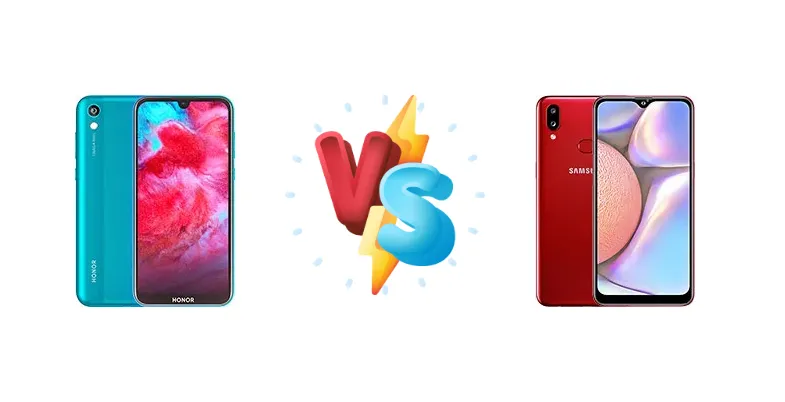
The Honor Play 3e and Samsung Galaxy A10s represent the entry point for many into the Android ecosystem. Both devices target the ultra-budget segment, aiming to deliver essential smartphone functionality at the lowest possible price. This comparison dissects their similarities and subtle differences to help you determine which offers the best value.
🏆 Quick Verdict
For the average user prioritizing basic functionality, the Samsung Galaxy A10s is a slightly safer bet due to Samsung's established software support and brand recognition. However, the Honor Play 3e's marginally faster CPU clock speed could provide a small performance edge in demanding tasks, making it a viable option for those seeking maximum performance within this price bracket.
| Network |
|---|
| 2G bands | GSM 850 / 900 / 1800 / 1900 | GSM 850 / 900 / 1800 / 1900 |
| 3G bands | HSDPA 850 / 900 / 2100 | HSDPA 850 / 900 / 1900 / 2100 |
| 4G bands | 1, 3, 5, 8, 38, 39, 40, 41 | 1, 2, 3, 5, 7, 8, 20, 38, 40, 41 |
| Speed | HSPA, LTE | HSPA 42.2/5.76 Mbps, LTE Cat4 150/50 Mbps |
| Technology | GSM / CDMA / HSPA / LTE | GSM / HSPA / LTE |
| | CDMA 800 & TD-SCDMA | 1, 2, 3, 5, 7, 8, 12, 17, 28 - SM-A107M/DS |
| Launch |
|---|
| Announced | 2019, September. Released 2019, September | 2019, August 12. Released 2019, August 27 |
| Status | Discontinued | Discontinued |
| Body |
|---|
| Build | - | Glass front, plastic back, plastic frame |
| Dimensions | 147.1 x 70.8 x 8.5 mm (5.79 x 2.79 x 0.33 in) | 156.9 x 75.8 x 7.8 mm (6.18 x 2.98 x 0.31 in) |
| SIM | Nano-SIM + Nano-SIM | · Nano-SIM· Nano-SIM + Nano-SIM |
| Weight | 146 g (5.15 oz) | 168 g (5.93 oz) |
| Display |
|---|
| Resolution | 720 x 1520 pixels, 19:9 ratio (~295 ppi density) | 720 x 1520 pixels, 19:9 ratio (~271 ppi density) |
| Size | 5.71 inches, 81.4 cm2 (~78.1% screen-to-body ratio) | 6.2 inches, 95.9 cm2 (~80.7% screen-to-body ratio) |
| Type | IPS LCD | PLS LCD |
| Platform |
|---|
| CPU | Octa-core (4x2.0 GHz Cortex-A53 & 4x1.5 GHz Cortex-A53) | Octa-core 2.0 GHz Cortex-A53 |
| Chipset | Mediatek MT6762R Helio P22 (12 nm) | Mediatek MT6762 Helio P22 (12 nm) |
| GPU | PowerVR GE8320 | PowerVR GE8320 |
| OS | Android 9.0 (Pie), EMUI 9.1 | Android 9.0 (Pie), upgradable to Android 11, One UI 3.1 |
| Memory |
|---|
| Card slot | microSDXC (dedicated slot) | microSDXC (dedicated slot) |
| Internal | 32GB 2GB RAM, 64GB 3GB RAM | 32GB 2GB RAM, 32GB 3GB RAM |
| | eMMC 5.1 | eMMC 5.1 |
| Main Camera |
|---|
| Dual | - | 13 MP, f/1.8, 28mm (wide), AF
Auxiliary lens |
| Features | LED flash, HDR, panorama | LED flash, panorama, HDR |
| Single | 13 MP, f/1.8, PDAF | - |
| Video | 1080p@30fps | 1080p@30fps |
| Selfie camera |
|---|
| Single | 5 MP, f/2.2 | 8 MP, f/2.0 |
| Video | 1080p@30fps | 1080p@30fps |
| Sound |
|---|
| 3.5mm jack | Yes | Yes |
| 35mm jack | Yes | Yes |
| Loudspeaker | Yes | Yes |
| Comms |
|---|
| Bluetooth | 5.0, A2DP, LE | 4.2, A2DP, LE |
| NFC | No | No |
| Positioning | GPS, GLONASS, BDS | GPS, GLONASS, GALILEO |
| Radio | FM radio | FM radio |
| USB | microUSB 2.0, OTG | microUSB 2.0, OTG |
| WLAN | Wi-Fi 802.11 b/g/n, Wi-Fi Direct | Wi-Fi 802.11 b/g/n, Wi-Fi Direct |
| Features |
|---|
| Sensors | Accelerometer, proximity | Fingerprint (rear-mounted), accelerometer, proximity |
| Battery |
|---|
| Stand-by | Up to 168 h | - |
| Talk time | Up to 5 h | - |
| Type | Li-Po 3020 mAh, non-removable | Li-Po 4000 mAh, non-removable |
| Misc |
|---|
| Colors | Magic Night Black, Platinum Gold, Aurora Blue | Blue, Green, Red, Black |
| Models | - | SM-A107F, SM-A107M |
| Price | About 90 EUR | About 180 EUR |
| SAR | - | 0.25 W/kg (head) 1.06 W/kg (body) |
Honor Play 3e
- Potentially slightly better CPU efficiency due to split core configuration.
- May offer a marginally faster experience in CPU-intensive tasks.
- Competitive pricing within the budget segment.
- Honor's software update track record is less consistent than Samsung's.
- Brand recognition is lower than Samsung's.
Samsung Galaxy A10s
- Samsung's established brand reputation and software support.
- Wider availability of accessories and repair services.
- Generally more predictable user experience.
- CPU configuration is slightly less nuanced than the Honor Play 3e.
- May be slightly more expensive for comparable specifications.
Display Comparison
Both the Honor Play 3e and Samsung Galaxy A10s likely feature LCD panels, typical for this price point. Specific details like resolution and brightness are not provided, but we can assume they are similar, aiming for a 720p+ resolution. Bezels are expected to be noticeable on both devices, as minimizing them is a cost-saving measure reserved for higher-tier phones. Color accuracy will likely be standard for budget displays, prioritizing power efficiency over color fidelity.
Camera Comparison
Camera specifications are not detailed enough to draw significant conclusions. Both phones likely feature a primary camera and potentially a depth sensor. The absence of information regarding sensor size and aperture makes it difficult to assess image quality. It's safe to assume that image processing will be heavily reliant on software algorithms to enhance photos, and low-light performance will be limited on both devices. Any 2MP macro or depth sensors present should be considered supplementary features rather than core components of the camera system.
Performance
Both devices are powered by the Mediatek MT6762R Helio P22 (12 nm) chipset. However, the Honor Play 3e features a CPU configuration of Octa-core (4x2.0 GHz Cortex-A53 & 4x1.5 GHz Cortex-A53), while the Samsung Galaxy A10s has an Octa-core 2.0 GHz Cortex-A53. The Play 3e's split core configuration *could* offer slightly better efficiency by allowing it to utilize the lower-clocked cores for less demanding tasks. However, the real-world difference will be minimal. Both rely on the Mali-G72 MP3 GPU, meaning graphics performance will be nearly identical. RAM configurations are not specified, but both will likely offer options around 2-3GB, which is sufficient for basic Android operation.
Battery Life
Battery capacity is not specified for either device. However, given their budget nature, we can expect capacities around 3000-4000 mAh. Charging wattage is also unknown, but likely falls in the 10W-15W range. Real-world battery life will depend heavily on usage patterns, but both phones should comfortably last a full day with moderate use. The lack of fast charging support means 0-100% charging times will likely exceed 2 hours.
Buying Guide
Buy the Honor Play 3e if you need a device for light gaming and multitasking, and are comfortable with potentially less frequent software updates. Its slightly faster CPU clock speed offers a marginal performance advantage. Buy the Samsung Galaxy A10s if you prioritize a well-established brand with a more predictable software experience and a wider support network, even if it means sacrificing a tiny bit of raw processing power.
Frequently Asked Questions
❓ Will the Helio P22 chipset struggle with modern apps?
The Helio P22 is an entry-level chipset, and while it can handle basic apps like social media, messaging, and web browsing, it will likely struggle with demanding games or multitasking with numerous apps open simultaneously. Expect some lag and slowdowns in these scenarios.
❓ How important is the difference in CPU core configuration between the Play 3e and A10s?
The Honor Play 3e's split core configuration (2.0GHz & 1.5GHz) *could* offer slightly better power efficiency by utilizing the slower cores for less intensive tasks. However, the real-world impact will be minimal and unlikely to be noticeable during everyday use. Both phones share the same overall CPU architecture.
❓ Can either of these phones handle popular games like PUBG Mobile?
Both the Honor Play 3e and Samsung Galaxy A10s can *run* PUBG Mobile, but not at high settings. Expect to play at the lowest graphics settings and potentially with a lower frame rate to maintain a playable experience. Frame drops and stuttering are likely to occur.
❓ What about software updates? Which phone will receive updates for longer?
Samsung generally provides more consistent and longer-term software support than Honor. While neither phone is guaranteed to receive major Android version updates, the Galaxy A10s is more likely to receive security patches for a longer period.