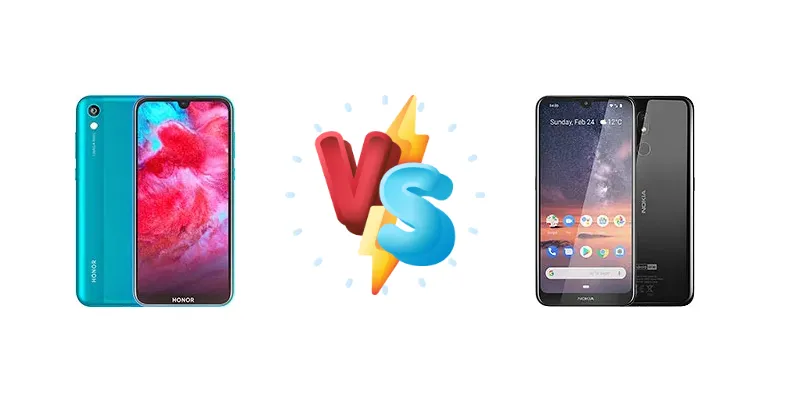
The Honor Play 3e and Nokia 3.2 represent the lower end of the smartphone market, targeting users prioritizing affordability. However, beneath the similar price points lie significant differences in processing power and overall user experience. This comparison dissects these differences to determine which device offers the best value for your money.
🏆 Quick Verdict
For the average user seeking a responsive experience, the Honor Play 3e is the better choice. Its Mediatek Helio P22 chipset, with its octa-core configuration, provides a noticeable performance advantage over the Nokia 3.2’s quad-core Snapdragon 429, making it more suitable for multitasking and light gaming.
| Network |
|---|
| 2G bands | GSM 850 / 900 / 1800 / 1900 | GSM 850 / 900 / 1800 / 1900 |
| 3G bands | HSDPA 850 / 900 / 2100 | HSDPA 850 / 900 / 2100 |
| 4G bands | 1, 3, 5, 8, 38, 39, 40, 41 | 1, 3, 5, 7, 8, 20, 28, 38, 40 - EMEA, APAC, MENA |
| Speed | HSPA, LTE | HSPA 42.2/5.76 Mbps, LTE Cat4 150/50 Mbps |
| Technology | GSM / CDMA / HSPA / LTE | GSM / HSPA / LTE |
| | CDMA 800 & TD-SCDMA | 1, 3, 5, 8, 40, 41 - India |
| Launch |
|---|
| Announced | 2019, September. Released 2019, September | 2019, February 24. Released 2019, May 22 |
| Status | Discontinued | Discontinued |
| Body |
|---|
| Build | - | Glass front, plastic back, plastic frame |
| Dimensions | 147.1 x 70.8 x 8.5 mm (5.79 x 2.79 x 0.33 in) | 159.4 x 76.2 x 8.6 mm (6.28 x 3.00 x 0.34 in) |
| SIM | Nano-SIM + Nano-SIM | Nano-SIM + Nano-SIM |
| Weight | 146 g (5.15 oz) | 181 g (6.38 oz) |
| Display |
|---|
| Resolution | 720 x 1520 pixels, 19:9 ratio (~295 ppi density) | 720 x 1520 pixels, 19:9 ratio (~269 ppi density) |
| Size | 5.71 inches, 81.4 cm2 (~78.1% screen-to-body ratio) | 6.26 inches, 97.8 cm2 (~80.5% screen-to-body ratio) |
| Type | IPS LCD | IPS LCD |
| Platform |
|---|
| CPU | Octa-core (4x2.0 GHz Cortex-A53 & 4x1.5 GHz Cortex-A53) | Quad-core 1.8 GHz Cortex-A53 |
| Chipset | Mediatek MT6762R Helio P22 (12 nm) | Qualcomm SDM429 Snapdragon 429 (12 nm) |
| GPU | PowerVR GE8320 | Adreno 504 |
| OS | Android 9.0 (Pie), EMUI 9.1 | Android 9.0 (Pie), upgradable to Android 11, Android One |
| Memory |
|---|
| Card slot | microSDXC (dedicated slot) | microSDXC (dedicated slot) |
| Internal | 32GB 2GB RAM, 64GB 3GB RAM | 16GB 2GB RAM, 32GB 3GB RAM, 64GB 3GB RAM |
| | eMMC 5.1 | eMMC 5.1 |
| Main Camera |
|---|
| Features | LED flash, HDR, panorama | LED flash |
| Single | 13 MP, f/1.8, PDAF | 13 MP, f/2.2, 1/3.1", 1.12µm, AF |
| Video | 1080p@30fps | 1080p@30fps |
| Selfie camera |
|---|
| Single | 5 MP, f/2.2 | 5 MP, f/2.2, 27mm (wide), 1/5.0", 1.12µm |
| Video | 1080p@30fps | - |
| Sound |
|---|
| 3.5mm jack | Yes | Yes |
| 35mm jack | Yes | Yes |
| Loudspeaker | Yes | Yes |
| Comms |
|---|
| Bluetooth | 5.0, A2DP, LE | 4.2, A2DP, LE, aptX |
| NFC | No | No |
| Positioning | GPS, GLONASS, BDS | GPS, GLONASS, BDS |
| Radio | FM radio | FM radio |
| USB | microUSB 2.0, OTG | microUSB 2.0, OTG |
| WLAN | Wi-Fi 802.11 b/g/n, Wi-Fi Direct | Wi-Fi 802.11 b/g/n |
| Features |
|---|
| Sensors | Accelerometer, proximity | Fingerprint (rear-mounted, 32/3GB only), accelerometer, proximity |
| Battery |
|---|
| Charging | - | 10W wired |
| Stand-by | Up to 168 h | - |
| Talk time | Up to 5 h | - |
| Type | Li-Po 3020 mAh, non-removable | Li-Ion 4000 mAh, non-removable |
| Misc |
|---|
| Colors | Magic Night Black, Platinum Gold, Aurora Blue | Black, Steel |
| Models | - | TA-1156, TA-1159, TA-1164 |
| Price | About 90 EUR | About 140 EUR |
| SAR EU | - | 0.24 W/kg (head) 1.63 W/kg (body) |
Honor Play 3e
- More powerful octa-core processor for smoother performance.
- Potentially better multitasking capabilities.
- Likely better gaming performance compared to the Nokia 3.2.
- Software experience may not be as clean as Nokia's.
- Charging speed is unknown and potentially slow.
Nokia 3.2
- Clean Android experience with potential for timely updates.
- Reliable brand reputation for software support.
- 10W charging provides a baseline charging experience.
- Significantly weaker processor for demanding tasks.
- Limited multitasking capabilities.
- Slower app launch times.
Display Comparison
Neither device boasts a standout display. Both are likely utilizing LCD panels, common in this price bracket. Specifics like resolution and brightness are not provided, but we can assume they are similar – around 720p and moderate brightness levels. The focus here isn’t on visual fidelity, but rather basic usability. Bezels are likely to be noticeable on both, contributing to a larger overall footprint for the screen size.
Camera Comparison
Camera performance is likely to be similar and unremarkable on both devices. Without sensor size or aperture information, it’s difficult to make a definitive statement. However, given the price point, both will likely feature basic camera modules suitable for casual snapshots in good lighting conditions. The Nokia 3.2 may benefit from Qualcomm’s image processing algorithms, but the difference will likely be minimal. Expect limited low-light performance from both.
Performance
The core difference lies in the chipsets. The Honor Play 3e’s Mediatek Helio P22 is an octa-core processor, featuring four Cortex-A53 cores clocked at 2.0 GHz and another four at 1.5 GHz. This contrasts sharply with the Nokia 3.2’s Qualcomm Snapdragon 429, a quad-core processor clocked at 1.8 GHz, also using Cortex-A53 cores. The higher core count and clock speed of the Helio P22 translate to significantly better multi-tasking and application launch speeds. While both are 12nm chips, the architectural advantage of the octa-core setup gives the Honor Play 3e a clear edge in performance. The Nokia 3.2 will likely struggle with more demanding applications.
Battery Life
Battery capacity isn’t specified for either device, but both likely house batteries in the 3000-4000 mAh range. The Nokia 3.2 includes 10W wired charging, which is relatively slow by today’s standards. The Honor Play 3e’s charging speed is not specified, but it’s unlikely to be significantly faster. Real-world battery life will depend heavily on usage patterns, but the more efficient Helio P22 in the Honor Play 3e *could* offset a slightly smaller battery capacity, providing comparable or even better endurance.
Buying Guide
Buy the Honor Play 3e if you need a phone capable of handling more than basic tasks, such as social media, streaming, and occasional gaming. Its more powerful processor will provide a smoother experience. Buy the Nokia 3.2 if you prioritize a clean Android experience and a brand known for software support, and your usage is limited to calls, texts, and very light app usage. The Nokia 3.2’s simplicity may appeal to those less comfortable with more complex interfaces.
Frequently Asked Questions
❓ Will the Honor Play 3e struggle with popular apps like Facebook or WhatsApp?
While the Helio P22 can handle these apps, expect some occasional lag or slowdown when multitasking or using the apps extensively. It's not a flagship processor, so demanding features within these apps might not run flawlessly.
❓ Is the Snapdragon 429 in the Nokia 3.2 sufficient for basic email and web browsing?
Yes, the Snapdragon 429 is perfectly adequate for basic tasks like email, web browsing, and making calls. However, it will struggle with more demanding applications or running multiple apps simultaneously.
❓ Can either of these phones play PUBG Mobile?
PUBG Mobile is likely playable on the Honor Play 3e at the lowest settings, but expect a choppy experience. The Nokia 3.2 will likely struggle to run the game at all, or offer an unplayable framerate even at the lowest settings.
❓ Which phone is likely to receive more software updates?
Nokia generally has a better track record for providing software updates, even for their budget devices. Honor's update schedule can be less predictable, though they have improved in recent years.