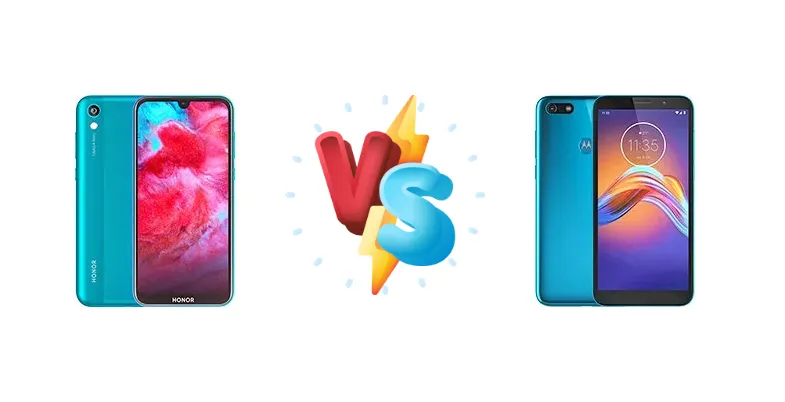
The Honor Play 3e and Motorola Moto E6 Play represent the absolute bottom end of the smartphone market, targeting users prioritizing affordability above all else. Both devices aim to deliver basic smartphone functionality at the lowest possible price point, but significant differences in their underlying hardware dictate vastly different user experiences. This comparison dissects those differences to determine which phone offers the best value.
🏆 Quick Verdict
For the average user, the Honor Play 3e emerges as the superior choice. Its Mediatek Helio P22 chipset, built on a more modern 12nm process, provides a noticeable performance advantage over the Motorola Moto E6 Play’s aging MT6739. While neither phone excels, the Play 3e offers a smoother, more responsive experience for everyday tasks.
| Network |
|---|
| 2G bands | GSM 850 / 900 / 1800 / 1900 | GSM 850 / 900 / 1800 / 1900 |
| 3G bands | HSDPA 850 / 900 / 2100 | HSDPA 850 / 900 / 1900 / 2100 |
| 4G bands | 1, 3, 5, 8, 38, 39, 40, 41 | 1, 3, 5, 7, 8, 20, 38, 40, 41 |
| Speed | HSPA, LTE | HSPA, LTE |
| Technology | GSM / CDMA / HSPA / LTE | GSM / HSPA / LTE |
| | CDMA 800 & TD-SCDMA | - |
| Launch |
|---|
| Announced | 2019, September. Released 2019, September | 2019, October. Released 2019, November |
| Status | Discontinued | Discontinued |
| Body |
|---|
| Build | - | Glass front, plastic back, plastic frame |
| Dimensions | 147.1 x 70.8 x 8.5 mm (5.79 x 2.79 x 0.33 in) | 146.5 x 70.9 x 8.3 mm (5.77 x 2.79 x 0.33 in) |
| SIM | Nano-SIM + Nano-SIM | Nano-SIM + Nano-SIM |
| Weight | 146 g (5.15 oz) | 140 g (4.94 oz) |
| Display |
|---|
| Resolution | 720 x 1520 pixels, 19:9 ratio (~295 ppi density) | 720 x 1440 pixels, 18:9 ratio (~295 ppi density) |
| Size | 5.71 inches, 81.4 cm2 (~78.1% screen-to-body ratio) | 5.5 inches, 77.0 cm2 (~74.1% screen-to-body ratio) |
| Type | IPS LCD | IPS LCD |
| Platform |
|---|
| CPU | Octa-core (4x2.0 GHz Cortex-A53 & 4x1.5 GHz Cortex-A53) | Quad-core 1.5 GHz Cortex-A53 |
| Chipset | Mediatek MT6762R Helio P22 (12 nm) | Mediatek MT6739 (28 nm) |
| GPU | PowerVR GE8320 | PowerVR GE8100 |
| OS | Android 9.0 (Pie), EMUI 9.1 | Android 9.0 (Pie) |
| Memory |
|---|
| Card slot | microSDXC (dedicated slot) | microSDXC (dedicated slot) |
| Internal | 32GB 2GB RAM, 64GB 3GB RAM | 32GB 2GB RAM |
| | eMMC 5.1 | eMMC 5.1 |
| Main Camera |
|---|
| Features | LED flash, HDR, panorama | LED flash, HDR, panorama |
| Single | 13 MP, f/1.8, PDAF | 13 MP, f/2.2, 1/3.1", 1.12µm, PDAF |
| Video | 1080p@30fps | 1080p@30fps |
| Selfie camera |
|---|
| Features | - | HDR |
| Single | 5 MP, f/2.2 | 5 MP, f/2.2, 1/5.0", 1.12µm |
| Video | 1080p@30fps | 1080p@30fps |
| Sound |
|---|
| 3.5mm jack | Yes | Yes |
| 35mm jack | Yes | Yes |
| Loudspeaker | Yes | Yes |
| Comms |
|---|
| Bluetooth | 5.0, A2DP, LE | 4.2, A2DP, LE |
| NFC | No | No |
| Positioning | GPS, GLONASS, BDS | GPS, GLONASS |
| Radio | FM radio | FM radio |
| USB | microUSB 2.0, OTG | microUSB 2.0, OTG |
| WLAN | Wi-Fi 802.11 b/g/n, Wi-Fi Direct | Wi-Fi 802.11 b/g/n |
| Features |
|---|
| Sensors | Accelerometer, proximity | Fingerprint (rear-mounted), accelerometer, proximity |
| Battery |
|---|
| Stand-by | Up to 168 h | - |
| Talk time | Up to 5 h | - |
| Type | Li-Po 3020 mAh, non-removable | Li-Po 3000 mAh, non-removable |
| Misc |
|---|
| Colors | Magic Night Black, Platinum Gold, Aurora Blue | Turquoise Blue, Anthracite |
| Models | - | XT2029, XT2029-1 |
| Price | About 90 EUR | About 160 EUR |
| SAR EU | - | 0.55 W/kg (head) 1.78 W/kg (body) |
Honor Play 3e
- Significantly faster processor for smoother performance
- More efficient 12nm chipset for better thermal management
- Potentially better camera image processing
- Battery life may be slightly shorter than the Moto E6 Play
- Display details are unknown, potentially similar to Moto E6 Play
Motorola Moto E6 Play
- Potentially longer battery life under light usage
- Extremely affordable price point
- Simple and straightforward user experience
- Slow and sluggish performance with the outdated MT6739 chipset
- 28nm process leads to higher power consumption and heat
- Limited multitasking capabilities
Display Comparison
Neither Honor nor Motorola provide detailed display specifications for these models. However, both are expected to utilize LCD panels typical of this price bracket. The key difference lies in the processing power available to drive the display. The Helio P22 in the Play 3e has a more capable integrated GPU, potentially leading to smoother scrolling and animations. The Moto E6 Play, with its older chipset, may exhibit more noticeable stuttering during UI navigation. Bezels are likely to be substantial on both devices, reflecting their budget nature.
Camera Comparison
Camera performance on both devices is expected to be basic. Detailed sensor information is unavailable, but both likely feature a primary camera and potentially a secondary depth sensor. Given the price point, image quality will be heavily reliant on software processing. The Helio P22’s image signal processor (ISP) in the Honor Play 3e is more advanced than the MT6739’s, potentially resulting in slightly better dynamic range and noise reduction. However, don't expect flagship-level results from either device. Focusing on the primary sensor resolution is key, as any secondary sensors are likely to be low-resolution and of limited utility.
Performance
The performance gap is the most significant differentiator. The Honor Play 3e’s Mediatek Helio P22, featuring an octa-core CPU (4x2.0 GHz Cortex-A53 & 4x1.5 GHz Cortex-A53), dramatically outperforms the Motorola Moto E6 Play’s quad-core 1.5 GHz Cortex-A53 processor. The Helio P22’s 12nm manufacturing process is a crucial advantage, offering improved power efficiency and thermal management compared to the Moto E6 Play’s 28nm MT6739. This translates to faster app loading times, smoother multitasking, and a more responsive user interface on the Honor Play 3e. The older chipset in the Moto E6 Play will struggle with even moderately demanding applications.
Battery Life
Battery capacity details are not provided. However, the Motorola Moto E6 Play’s less powerful MT6739 chipset, built on a larger 28nm process, *could* translate to slightly better battery life under light usage. The Honor Play 3e’s more powerful Helio P22 will consume more power, but the difference may be negligible with typical usage patterns. Charging speeds are also unknown, but both are likely to support standard 5W or 10W charging, resulting in relatively slow 0-100% charge times.
Buying Guide
Buy the Honor Play 3e if you need a phone capable of handling basic multitasking, social media, and light app usage without significant lag. Its more powerful processor makes it suitable for users who occasionally play less demanding mobile games. Buy the Motorola Moto E6 Play if your primary needs are limited to calls, texts, and very basic app usage, and you prioritize a potentially longer battery life due to the less power-hungry chipset, accepting a slower overall experience.
Frequently Asked Questions
❓ Will the Honor Play 3e handle popular social media apps like Facebook and Instagram without lagging?
Yes, the Honor Play 3e’s Mediatek Helio P22 chipset is sufficiently powerful to run Facebook, Instagram, and other common social media apps without significant lag. While it won’t offer a blazing-fast experience, it will be noticeably smoother than the Moto E6 Play, especially when switching between apps.
❓ Is the Motorola Moto E6 Play a good option for someone who primarily uses their phone for calls and texts?
Yes, the Motorola Moto E6 Play is a perfectly adequate option for basic communication. Its primary strength lies in its affordability. If your needs are limited to calls, texts, and occasional light web browsing, the Moto E6 Play will fulfill those requirements. However, be prepared for a slower and less responsive experience compared to more modern smartphones.
❓ Can either of these phones run PUBG Mobile, and if so, at what settings?
While technically possible to launch PUBG Mobile on both devices, the experience will be severely compromised. The Honor Play 3e might be able to run the game at the lowest possible settings (minimum graphics, low frame rate) with significant stuttering. The Motorola Moto E6 Play is unlikely to provide a playable experience due to its significantly weaker processor.