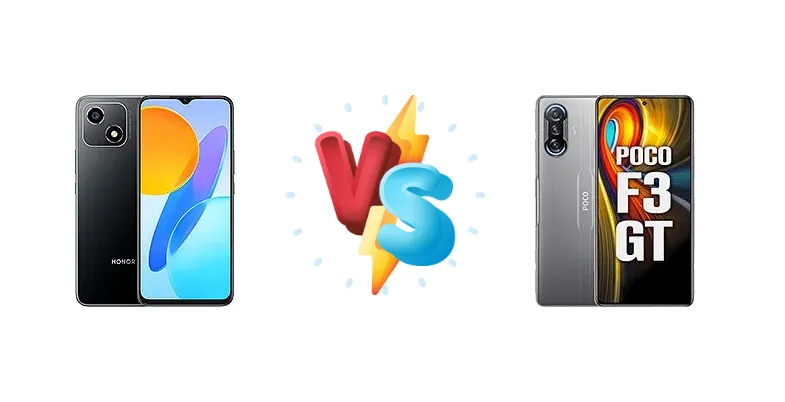
The smartphone market is brimming with options, making it tough to choose. Today, we're pitting the budget-friendly Honor Play 30 against the performance-focused Xiaomi Poco F3 GT. Both offer compelling features, but cater to different user needs. Let's dive into a detailed comparison to help you decide which one is right for you.
🏆 Quick Verdict
The Poco F3 GT is the clear winner, boasting significantly superior performance thanks to its Dimensity 1200 chipset and blazing-fast 67W charging. While the Honor Play 30 offers a more affordable entry point, the F3 GT's power and charging speed make it a more compelling overall package.
| Network |
|---|
| 2G bands | GSM 850 / 900 / 1800 / 1900 | GSM 850 / 900 / 1800 / 1900 |
| 3G bands | HSDPA 850 / 900 / 1900 / 2100 | HSDPA 850 / 900 / 1900 / 2100 |
| 4G bands | LTE | 1, 3, 5, 8, 40, 41 |
| 5G bands | SA/NSA | 77, 78 SA/NSA |
| Speed | HSPA, LTE, 5G | HSPA, LTE, 5G |
| Technology | GSM / CDMA / HSPA / CDMA2000 / LTE / 5G | GSM / HSPA / LTE / 5G |
| | CDMA2000 1x | - |
| Launch |
|---|
| Announced | 2022, May 10 | 2021, July 23 |
| Status | Available. Released 2022, May 27 | Available. Released 2021, July 26 |
| Body |
|---|
| Build | - | Glass front (Gorilla Glass 5), glass back (Gorilla Glass 5) |
| Dimensions | 163.7 x 75.1 x 8.7 mm (6.44 x 2.96 x 0.34 in) | 161.9 x 76.9 x 8.3 mm (6.37 x 3.03 x 0.33 in) |
| SIM | Nano-SIM + Nano-SIM | Nano-SIM + Nano-SIM |
| Weight | 194 g (6.84 oz) | 205 g (7.23 oz) |
| | - | Physical pop-up gaming triggers
IP53, dust and splash resistant |
| Display |
|---|
| Protection | Aluminosilicate glass | Corning Gorilla Glass 5 |
| Resolution | 720 x 1600 pixels, 20:9 ratio (~270 ppi density) | 1080 x 2400 pixels, 20:9 ratio (~395 ppi density) |
| Size | 6.5 inches, 102.0 cm2 (~83.0% screen-to-body ratio) | 6.67 inches, 107.4 cm2 (~86.3% screen-to-body ratio) |
| Type | TFT LCD, 90Hz | AMOLED, 1B colors, 120Hz, HDR10+, 500 nits (typ) |
| Platform |
|---|
| CPU | Octa-core (2x2.2 GHz Kryo 460 & 6x1.9 GHz Kryo 460) | Octa-core (1x3.0 GHz Cortex-A78 & 3x2.6 GHz Cortex-A78 & 4x2.0 GHz Cortex-A55) |
| Chipset | Qualcomm SM4350-AC Snapdragon 480+ 5G (8 nm) | Mediatek Dimensity 1200 (6 nm) |
| GPU | Adreno 619 | Mali-G77 MC9 |
| OS | Android 11, Magic UI 5.0 | Android 11, upgradable to Android 12, MIUI 13 for POCO |
| Memory |
|---|
| Card slot | microSDXC (uses shared SIM slot) | No |
| Internal | 128GB 4GB RAM, 128GB 8GB RAM | 128GB 6GB RAM, 128GB 8GB RAM, 256GB 8GB RAM |
| | - | UFS 3.1 |
| Main Camera |
|---|
| Features | LED flash, HDR, panorama | Dual-LED flash, HDR, panorama |
| Single | 13 MP, f/1.8, (wide), AF | 16 MP, f/2.5, (wide), 1/3.06" 1.0µm |
| Triple | - | 64 MP, f/1.7, 26mm (wide), 1/2.0", 0.7µm, PDAF
8 MP, f/2.2, 120˚ (ultrawide)
2 MP (macro) |
| Video | 1080p@30fps | 4K@30fps, 1080p@30/60/120fps, 720p@960fps, HDR |
| Selfie camera |
|---|
| Features | - | HDR, panorama |
| Single | 5 MP, f/2.2, (wide) | 16 MP, f/2.5, (wide), 1/3.06" 1.0µm |
| Video | 1080p@30fps | 1080p@30fps, HDR |
| Sound |
|---|
| 3.5mm jack | Yes | No |
| 35mm jack | Yes | No |
| Loudspeaker | Yes | Yes, with stereo speakers |
| | 24-bit/192kHz audio | 24-bit/192kHz audio
Tuned by JBL |
| Comms |
|---|
| Bluetooth | 5.1, A2DP, LE | 5.1, A2DP, LE |
| Infrared port | - | Yes |
| NFC | No | Yes (market/region dependent) |
| Positioning | GPS, GLONASS, GALILEO, BDS | GPS, GLONASS, GALILEO, BDS |
| Radio | FM radio | No |
| USB | USB Type-C 2.0 | USB Type-C 2.0, OTG |
| WLAN | Wi-Fi 802.11 a/b/g/n/ac, dual-band, Wi-Fi Direct, DLNA | Wi-Fi 802.11 a/b/g/n/ac/6, dual-band, Wi-Fi Direct |
| Features |
|---|
| Sensors | Accelerometer, proximity, compass | Fingerprint (side-mounted), accelerometer, gyro, proximity, compass |
| Battery |
|---|
| Charging | 10W wired | 67W wired, PD3.0, QC3, 100% in 42 min |
| Type | Li-Po 5000 mAh | Li-Po 5065 mAh |
| Misc |
|---|
| Colors | Black, Blue, Gold, Gradient | Predator Black, Gunmetal Silver |
| Models | VNE-AN00 | MZB09C6IN, M2104K10I |
| Price | About 150 EUR | About 300 EUR |
| SAR | - | 0.81 W/kg (head) 0.48 W/kg (body) |
Honor Play 30
- Affordable
- Decent battery life (estimated)
- Good for basic tasks
- Lower performance
- Slow charging
- Likely LCD display
- Less versatile camera
Xiaomi Poco F3 GT
- High performance Dimensity 1200 chipset
- Blazing-fast 67W charging
- Excellent display (AMOLED, 120Hz)
- Versatile camera system
- Potentially higher price
- May lack some premium features
Display Comparison
The Poco F3 GT typically features an AMOLED display with a high refresh rate (120Hz), offering vibrant colors and smooth scrolling. The Honor Play 30 likely has an LCD display, which is generally less vibrant and may have a lower refresh rate. Expect a noticeably better visual experience on the Poco F3 GT.
Camera Comparison
While specific camera specs are needed for a precise comparison, the Poco F3 GT generally offers a more versatile and higher-quality camera system. Expect better low-light performance and more detailed photos. The Honor Play 30's camera is likely adequate for casual snapshots.
Performance
This is where the Poco F3 GT truly shines. The Dimensity 1200 chipset is significantly more powerful than the Snapdragon 480+. Expect smoother multitasking, faster app loading times, and a much better gaming experience on the F3 GT. The Honor Play 30 will handle basic tasks adequately, but will struggle with demanding games or applications.
Battery Life
The Poco F3 GT's 67W charging is a game-changer. It can charge the phone from 0% to 100% in around 42 minutes. The Honor Play 30's 10W charging is considerably slower. Both phones likely have similar battery capacities (around 4000-5000mAh), but the F3 GT's charging speed provides a significant advantage.
Buying Guide
The Honor Play 30 is ideal for users prioritizing affordability and basic smartphone functionality. It's a good choice for light users who primarily browse the web, use social media, and make calls. The Xiaomi Poco F3 GT is perfect for gamers, content creators, and anyone who demands high performance and rapid charging. It's a powerhouse for demanding tasks.
Frequently Asked Questions
❓ Is the Honor Play 30 good for gaming?
The Honor Play 30 can handle basic games, but it will struggle with demanding titles. The Poco F3 GT is a much better choice for gamers.
❓ How long does it take to charge the Poco F3 GT?
The Poco F3 GT charges incredibly fast with its 67W charger, typically reaching 100% in around 42 minutes.