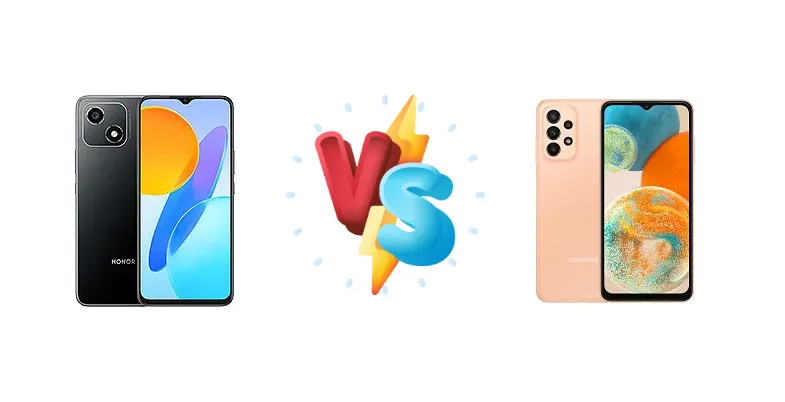
The Honor Play 30 and Samsung Galaxy A23 5G represent compelling options in the increasingly competitive sub-$250 5G smartphone market. While both aim to deliver 5G connectivity at an accessible price, they take different approaches to achieving this, particularly in chipset choice and charging capabilities. This comparison dissects their key specifications to determine which device offers the best value for your money.
🏆 Quick Verdict
For the average user prioritizing faster charging and a slightly brighter display, the Samsung Galaxy A23 5G is the better choice. However, the Honor Play 30’s more efficient Snapdragon 480+ chipset and potentially lower price point make it a strong contender for those seeking maximum battery life and value.
| Network |
|---|
| 2G bands | GSM 850 / 900 / 1800 / 1900 | GSM 850 / 900 / 1800 / 1900 |
| 3G bands | HSDPA 850 / 900 / 1900 / 2100 | HSDPA 850 / 900 / 1700(AWS) / 1900 / 2100 |
| 4G bands | LTE | 1, 2, 3, 4, 5, 7, 8, 12, 17, 20, 26, 28, 32, 38, 40, 41, 66 - International |
| 5G bands | SA/NSA | 1, 3, 7, 8, 20, 28, 38, 40, 41, 77, 78 SA/NSA/Sub6 - International |
| Speed | HSPA, LTE, 5G | HSPA, LTE, 5G |
| Technology | GSM / CDMA / HSPA / CDMA2000 / LTE / 5G | GSM / HSPA / LTE / 5G |
| | CDMA2000 1x | 2, 5, 30, 66, 77 SA/NSA/Sub6/mmWave - USA |
| Launch |
|---|
| Announced | 2022, May 10 | 2022, August 05 |
| Status | Available. Released 2022, May 27 | Available. Released 2022, September 02 |
| Body |
|---|
| Build | - | Glass front (Gorilla Glass 5), plastic frame, plastic back |
| Dimensions | 163.7 x 75.1 x 8.7 mm (6.44 x 2.96 x 0.34 in) | 165.4 x 76.9 x 8.4 mm (6.51 x 3.03 x 0.33 in) |
| SIM | Nano-SIM + Nano-SIM | · Nano-SIM· Nano-SIM + Nano-SIM |
| Weight | 194 g (6.84 oz) | 197 g (6.95 oz) |
| Display |
|---|
| Protection | Aluminosilicate glass | Corning Gorilla Glass 5 |
| Resolution | 720 x 1600 pixels, 20:9 ratio (~270 ppi density) | 1080 x 2408 pixels, 20:9 ratio (~400 ppi density) |
| Size | 6.5 inches, 102.0 cm2 (~83.0% screen-to-body ratio) | 6.6 inches, 104.9 cm2 (~82.5% screen-to-body ratio) |
| Type | TFT LCD, 90Hz | PLS LCD, 120Hz |
| Platform |
|---|
| CPU | Octa-core (2x2.2 GHz Kryo 460 & 6x1.9 GHz Kryo 460) | Octa-core (2x2.2 GHz Kryo 660 Gold & 6x1.7 GHz Kryo 660 Silver) |
| Chipset | Qualcomm SM4350-AC Snapdragon 480+ 5G (8 nm) | Qualcomm SM6375 Snapdragon 695 5G (6 nm) |
| GPU | Adreno 619 | Adreno 619 |
| OS | Android 11, Magic UI 5.0 | Android 12, upgradable to Android 14, One UI 6 |
| Memory |
|---|
| Card slot | microSDXC (uses shared SIM slot) | microSDXC (dedicated slot) |
| Internal | 128GB 4GB RAM, 128GB 8GB RAM | 64GB 4GB RAM, 64GB 6GB RAM, 128GB 4GB RAM, 128GB 6GB RAM, 128GB 8GB RAM |
| Main Camera |
|---|
| Features | LED flash, HDR, panorama | LED flash, panorama, HDR |
| Quad | - | 50 MP, f/1.8, 26mm (wide), 1/2.76", 0.64µm, PDAF, OIS
5 MP, f/2.2, 13mm, 123˚ (ultrawide), 1/5.0", 1.12µm
2 MP (macro)
Auxiliary lens |
| Single | 13 MP, f/1.8, (wide), AF | - |
| Video | 1080p@30fps | 1080p@30fps |
| Selfie camera |
|---|
| Single | 5 MP, f/2.2, (wide) | 8 MP, f/2.0, 25mm (wide), 1/4.0", 1.12µm - USA
8 MP, f/2.2, 25mm (wide), 1/4.0", 1.12µm - International |
| Video | 1080p@30fps | 1080p@30fps |
| Sound |
|---|
| 3.5mm jack | Yes | Yes |
| 35mm jack | Yes | Yes |
| Loudspeaker | Yes | Yes |
| | 24-bit/192kHz audio | - |
| Comms |
|---|
| Bluetooth | 5.1, A2DP, LE | 5.1, A2DP, LE |
| NFC | No | Yes |
| Positioning | GPS, GLONASS, GALILEO, BDS | GPS, GLONASS, GALILEO, BDS |
| Radio | FM radio | FM radio (market/region dependent) |
| USB | USB Type-C 2.0 | USB Type-C 2.0 |
| WLAN | Wi-Fi 802.11 a/b/g/n/ac, dual-band, Wi-Fi Direct, DLNA | Wi-Fi 802.11 a/b/g/n/ac, dual-band, Wi-Fi Direct |
| Features |
|---|
| Sensors | Accelerometer, proximity, compass | Fingerprint (side-mounted), accelerometer, gyro, compass, barometer (USA only) |
| | - | Virtual proximity sensing |
| Battery |
|---|
| Charging | 10W wired | 25W wired |
| Type | Li-Po 5000 mAh | Li-Po 5000 mAh |
| Misc |
|---|
| Colors | Black, Blue, Gold, Gradient | Black, White, Peach, Blue |
| Models | VNE-AN00 | SM-A236U, SM-A236U1, SM-A236B, SM-A236B/DS, SM-A236B/DSN, SM-A236E, SM-S236DL |
| Price | About 150 EUR | $ 84.44 / £ 129.00 / € 125.28 / ₹ 21,000 |
| SAR | - | 0.68 W/kg (head) 0.57 W/kg (body) |
| SAR EU | - | 1.49 W/kg (head) 1.25 W/kg (body) |
| Tests |
|---|
| Battery life | - |
Endurance rating 138h
|
| Camera | - |
Photo / Video |
| Display | - |
Contrast ratio: 1328:1 (nominal) |
| Loudspeaker | - |
-25.9 LUFS (Very good)
|
| Performance | - |
AnTuTu: 318821 (v9)
GeekBench: 1940 (v5.1)
GFXBench: 16fps (ES 3.1 onscreen) |
Honor Play 30
- Potentially lower price point
- More power-efficient chipset (Snapdragon 480+)
- Similar battery endurance to A23 5G
- Significantly slower 10W charging
- Less powerful chipset (Snapdragon 480+)
- Display brightness data unavailable
Samsung Galaxy A23 5G
- Faster 25W wired charging
- More powerful chipset (Snapdragon 695)
- Brighter display (508 nits)
- Potentially higher price
- Slightly less power-efficient chipset
- Similar battery endurance to Play 30
Display Comparison
The Samsung Galaxy A23 5G boasts a display capable of reaching 508 nits of peak brightness, offering a more visible experience outdoors compared to the Honor Play 30 (brightness data unavailable). Both displays share a 1328:1 contrast ratio, suggesting similar levels of black depth and color vibrancy. However, without knowing the panel technology used in the Play 30, it’s difficult to assess potential differences in color accuracy or viewing angles. The A23 5G’s higher brightness is a tangible benefit for outdoor usability.
Camera Comparison
Both phones are listed as having Photo/Video capabilities, but detailed camera specifications are absent. Without sensor size, aperture, or image processing details, a direct comparison is impossible. It’s reasonable to assume the Galaxy A23 5G, being the slightly more premium device, may offer a more refined camera experience, but this is speculative. The presence of a 2MP macro camera on many phones in this price range is often a marketing tactic, offering limited real-world benefit due to the small sensor size and lack of optical image stabilization (OIS).
Performance
The core difference lies in the chipsets: the Honor Play 30 utilizes the Qualcomm Snapdragon 480+ 5G (8nm), while the Galaxy A23 5G features the Snapdragon 695 5G (6nm). The 6nm process node of the 695 generally translates to improved power efficiency and thermal performance compared to the 8nm 480+. The A23 5G’s CPU configuration – 2x2.2 GHz Kryo 660 Gold & 6x1.7 GHz Kryo 660 Silver – is architecturally more advanced than the Play 30’s 2x2.2 GHz Kryo 460 & 6x1.9 GHz Kryo 460, suggesting better multi-core performance. This will be noticeable in app loading times and multitasking. While both have 2x2.2GHz cores, the 'Gold' designation on the A23's cores indicates higher performance.
Battery Life
Both devices achieve an endurance rating of 138 hours, indicating similar overall battery life under typical usage. However, the Galaxy A23 5G’s 25W wired charging significantly outperforms the Honor Play 30’s 10W charging. This translates to a much faster 0-100% charge time for the A23 5G. While the Play 30’s more efficient Snapdragon 480+ might stretch a single charge slightly further, the convenience of rapid charging offered by the A23 5G is a significant advantage.
Buying Guide
Buy the Honor Play 30 if you prioritize long battery life and are comfortable with slower 10W charging. This phone is ideal for users who primarily browse, use social media, and make calls, and don't require intensive gaming or demanding applications. Buy the Samsung Galaxy A23 5G if you value faster 25W charging, a slightly brighter display, and a more established brand ecosystem. This phone suits users who frequently consume media, take photos, and appreciate quicker power-ups.
Frequently Asked Questions
❓ Does the Snapdragon 695 in the Galaxy A23 5G get hot during extended gaming sessions?
The Snapdragon 695, built on a 6nm process, generally manages thermals well for its class. While it may warm up during prolonged gaming, it's unlikely to experience significant throttling compared to older or less efficient chipsets. However, sustained peak performance will inevitably generate heat.
❓ Is the 10W charging on the Honor Play 30 realistically usable in 2024?
10W charging is undeniably slow by modern standards, taking over 3 hours for a full charge. While usable, it requires overnight charging and may be inconvenient for users accustomed to faster charging speeds. It's a significant trade-off for the potentially lower price.
❓ How does the Snapdragon 480+ in the Honor Play 30 compare to the Snapdragon 695 in terms of gaming performance?
The Snapdragon 695 offers a noticeable performance advantage in gaming. Its more powerful CPU and GPU will deliver higher frame rates and smoother gameplay in demanding titles compared to the Snapdragon 480+. While both can handle casual games, the 695 is better suited for more graphically intensive experiences.