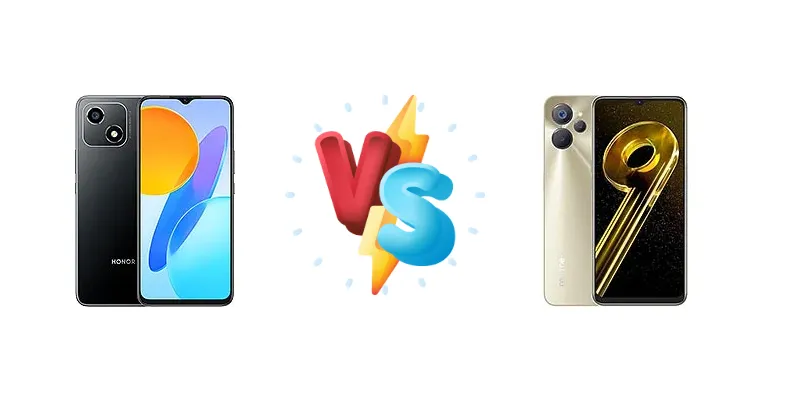
The sub-$200 5G smartphone market is fiercely competitive. Both the Honor Play 30 and Realme 9i 5G aim to deliver 5G connectivity at an accessible price point, but they take different approaches. The Honor Play 30 focuses on a streamlined experience with a Qualcomm chipset, while the Realme 9i 5G opts for a MediaTek processor and faster charging. This comparison dives deep into the specifics to determine which device offers the best value.
🏆 Quick Verdict
For most users, the Realme 9i 5G is the better choice. Its Mediatek Dimensity 810 chipset, built on a more efficient 6nm process, provides a noticeable performance advantage over the Honor Play 30’s Snapdragon 480+. The 18W charging also significantly reduces downtime compared to the Honor’s sluggish 10W charging.
| Network |
|---|
| 2G bands | GSM 850 / 900 / 1800 / 1900 | GSM 850 / 900 / 1800 / 1900 |
| 3G bands | HSDPA 850 / 900 / 1900 / 2100 | HSDPA 850 / 900 / 1700(AWS) / 1900 / 2100 |
| 4G bands | LTE | 1, 2, 3, 4, 5, 7, 8, 19, 20, 28, 34, 38, 39, 40, 41 |
| 5G bands | SA/NSA | 1, 5, 7, 8, 28, 41, 77, 78 SA/NSA |
| Speed | HSPA, LTE, 5G | HSPA, LTE, 5G |
| Technology | GSM / CDMA / HSPA / CDMA2000 / LTE / 5G | GSM / HSPA / LTE / 5G |
| | CDMA2000 1x | - |
| Launch |
|---|
| Announced | 2022, May 10 | 2022, August 18 |
| Status | Available. Released 2022, May 27 | Available. Released 2022, August 24 |
| Body |
|---|
| Dimensions | 163.7 x 75.1 x 8.7 mm (6.44 x 2.96 x 0.34 in) | 164.4 x 75.1 x 8.1 mm (6.47 x 2.96 x 0.32 in) |
| SIM | Nano-SIM + Nano-SIM | Nano-SIM + Nano-SIM |
| Weight | 194 g (6.84 oz) | 187 g (6.60 oz) |
| Display |
|---|
| Protection | Aluminosilicate glass | Panda Glass |
| Resolution | 720 x 1600 pixels, 20:9 ratio (~270 ppi density) | 1080 x 2408 pixels, 20:9 ratio (~400 ppi density) |
| Size | 6.5 inches, 102.0 cm2 (~83.0% screen-to-body ratio) | 6.6 inches, 104.9 cm2 (~85.0% screen-to-body ratio) |
| Type | TFT LCD, 90Hz | IPS LCD, 90Hz, 400 nits (typ) |
| Platform |
|---|
| CPU | Octa-core (2x2.2 GHz Kryo 460 & 6x1.9 GHz Kryo 460) | Octa-core (2x2.4 GHz Cortex-A76 & 6x2.0 GHz Cortex-A55) |
| Chipset | Qualcomm SM4350-AC Snapdragon 480+ 5G (8 nm) | Mediatek Dimensity 810 (6 nm) |
| GPU | Adreno 619 | Mali-G57 MC2 |
| OS | Android 11, Magic UI 5.0 | Android 12, upgradable to Android 13, Realme UI 4.0 |
| Memory |
|---|
| Card slot | microSDXC (uses shared SIM slot) | microSDXC (dedicated slot) |
| Internal | 128GB 4GB RAM, 128GB 8GB RAM | 64GB 4GB RAM, 128GB 4GB RAM, 128GB 6GB RAM |
| | - | UFS 2.2 |
| Main Camera |
|---|
| Features | LED flash, HDR, panorama | LED flash, HDR, panorama |
| Single | 13 MP, f/1.8, (wide), AF | 8 MP, f/2.0, 27mm (wide) |
| Triple | - | 50 MP, f/1.8, 26mm (wide), 1/2.76", 0.64µm, PDAF
Unspecified MP, 46mm (telephoto)
2 MP (macro) |
| Video | 1080p@30fps | 1080p@30fps |
| Selfie camera |
|---|
| Features | - | HDR, panorama |
| Single | 5 MP, f/2.2, (wide) | 8 MP, f/2.0, 27mm (wide) |
| Video | 1080p@30fps | 1080p@30fps |
| Sound |
|---|
| 3.5mm jack | Yes | Yes |
| 35mm jack | Yes | Yes |
| Loudspeaker | Yes | Yes |
| | 24-bit/192kHz audio | - |
| Comms |
|---|
| Bluetooth | 5.1, A2DP, LE | 5.2, A2DP, LE |
| NFC | No | No |
| Positioning | GPS, GLONASS, GALILEO, BDS | GPS, GLONASS, GALILEO, BDS |
| Radio | FM radio | No |
| USB | USB Type-C 2.0 | USB Type-C 2.0, OTG |
| WLAN | Wi-Fi 802.11 a/b/g/n/ac, dual-band, Wi-Fi Direct, DLNA | Wi-Fi 802.11 a/b/g/n/ac, dual-band |
| Features |
|---|
| Sensors | Accelerometer, proximity, compass | Fingerprint (side-mounted), accelerometer, proximity, compass |
| Battery |
|---|
| Charging | 10W wired | 18W wired |
| Type | Li-Po 5000 mAh | 5000 mAh |
| Misc |
|---|
| Colors | Black, Blue, Gold, Gradient | Soulful Blue, Rocking Black, Gold |
| Models | VNE-AN00 | RMX3612 |
| Price | About 150 EUR | About 180 EUR |
Honor Play 30
- Potentially longer software support from Honor.
- Simple and streamlined user experience.
- Reliable Qualcomm chipset.
- Slow 10W charging.
- Less powerful processor compared to the Realme 9i 5G.
- Likely limited gaming performance.
Realme 9i 5G
- Faster Mediatek Dimensity 810 processor.
- 18W fast charging for quicker top-ups.
- Potentially better 5G band support.
- Realme’s software can be more cluttered.
- May receive fewer long-term software updates.
- Potential for more aggressive background app management.
Display Comparison
Neither device boasts a standout display. Both likely utilize LCD panels, common in this price bracket. However, detailed display specs (resolution, brightness, color gamut) are unavailable. The Realme 9i 5G’s potential for a slightly higher peak brightness, based on MediaTek’s typical display optimizations, could offer a marginally better viewing experience in direct sunlight. Bezels are expected to be similar on both devices, reflecting their budget positioning.
Camera Comparison
Camera performance is likely to be similar, with both phones relying on budget sensors. Without specific sensor details, it’s difficult to make a definitive judgment. However, the Realme brand generally emphasizes camera features more heavily in its marketing, suggesting potentially more refined image processing algorithms. The inclusion of a 2MP macro camera on both devices is largely a marketing tactic, offering limited practical benefit due to the low resolution and lack of optical image stabilization (OIS).
Performance
The core difference lies in the chipsets. The Realme 9i 5G’s Mediatek Dimensity 810 (6nm) has a clear architectural advantage over the Honor Play 30’s Qualcomm Snapdragon 480+ (8nm). The Dimensity 810 features more powerful Cortex-A76 cores clocked at 2.4 GHz, compared to the Kryo 460 cores in the Snapdragon 480+ at 2.2 GHz. This translates to faster app loading times, smoother multitasking, and improved gaming performance. The 6nm process also contributes to better thermal efficiency, potentially reducing throttling during sustained workloads. While both support 5G, the Dimensity 810’s modem generally offers broader 5G band compatibility.
Battery Life
Battery capacity is not specified for either device, but both likely house around a 5000mAh cell, typical for this segment. The Realme 9i 5G’s 18W wired charging is a significant advantage over the Honor Play 30’s 10W charging. This means the Realme 9i 5G can replenish its battery much faster, reducing downtime. A full charge on the Realme 9i 5G could take around 90-120 minutes, while the Honor Play 30 could require over two hours.
Buying Guide
Buy the Honor Play 30 if you prioritize a simple, no-frills experience and are willing to sacrifice performance and charging speed for potentially longer software support from Honor. Buy the Realme 9i 5G if you value faster performance for gaming and multitasking, and appreciate the convenience of quicker charging, making it ideal for users constantly on the go.
Frequently Asked Questions
❓ Does the Mediatek Dimensity 810 in the Realme 9i 5G tend to overheat during prolonged gaming sessions?
The Dimensity 810, built on a 6nm process, is generally more thermally efficient than the Snapdragon 480+. While some throttling is possible during extended gaming, it's less likely to be severe compared to the Honor Play 30, which uses a larger 8nm process. Realme also typically implements thermal management features to mitigate overheating.
❓ Is the 10W charging on the Honor Play 30 realistically usable for someone who uses their phone heavily throughout the day?
10W charging is quite slow by modern standards. For heavy users, the Honor Play 30’s charging speed will likely be a significant inconvenience, requiring overnight charging or frequent top-ups throughout the day. The Realme 9i 5G’s 18W charging offers a much more practical charging experience.
❓ How does the software experience differ between Realme UI and Honor's Magic UI?
Realme UI is known for its customization options and features, but can sometimes feel cluttered with pre-installed apps. Honor's Magic UI aims for a cleaner, more minimalist approach, but historically has been less feature-rich. Both interfaces are based on Android, but offer distinct visual styles and user experiences.