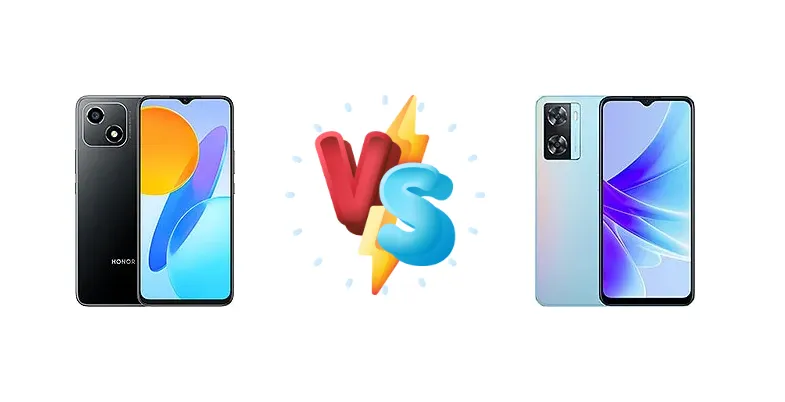
The Honor Play 30 and Oppo A57s represent two distinct approaches to the budget smartphone market. The Honor Play 30 prioritizes 5G connectivity with a Qualcomm Snapdragon chipset, while the Oppo A57s focuses on a faster charging experience with a MediaTek Helio processor. This comparison dissects their key differences to help you determine which device best suits your needs.
🏆 Quick Verdict
For users prioritizing 5G access and a more modern chipset architecture, the Honor Play 30 is the better choice. While its charging is slower, the Snapdragon 480+ offers a performance edge and future-proofing. However, the Oppo A57s is compelling for those who value rapid charging and don't require 5G.
| Network |
|---|
| 2G bands | GSM 850 / 900 / 1800 / 1900 | GSM 850 / 900 / 1800 / 1900 |
| 3G bands | HSDPA 850 / 900 / 1900 / 2100 | HSDPA 850 / 900 / 2100 |
| 4G bands | LTE | 1, 3, 5, 7, 8, 20, 28, 38, 40, 41 |
| 5G bands | SA/NSA | - |
| Speed | HSPA, LTE, 5G | HSPA, LTE |
| Technology | GSM / CDMA / HSPA / CDMA2000 / LTE / 5G | GSM / HSPA / LTE |
| | CDMA2000 1x | - |
| Launch |
|---|
| Announced | 2022, May 10 | 2022, August 31 |
| Status | Available. Released 2022, May 27 | Available. Released 2022, September 12 |
| Body |
|---|
| Build | - | Glass front (Panda Glass), plastic frame, plastic back |
| Dimensions | 163.7 x 75.1 x 8.7 mm (6.44 x 2.96 x 0.34 in) | 163.8 x 75 x 8 mm (6.45 x 2.95 x 0.31 in) |
| SIM | Nano-SIM + Nano-SIM | Nano-SIM + Nano-SIM |
| Weight | 194 g (6.84 oz) | 187 g (6.60 oz) |
| | - | IP5X (dust), IPX4 (water) resistance |
| Display |
|---|
| Protection | Aluminosilicate glass | Panda Glass |
| Resolution | 720 x 1600 pixels, 20:9 ratio (~270 ppi density) | 720 x 1612 pixels, 20:9 ratio (~269 ppi density) |
| Size | 6.5 inches, 102.0 cm2 (~83.0% screen-to-body ratio) | 6.56 inches, 103.4 cm2 (~84.2% screen-to-body ratio) |
| Type | TFT LCD, 90Hz | IPS LCD, 480 nits (typ), 600 nits (HBM) |
| Platform |
|---|
| CPU | Octa-core (2x2.2 GHz Kryo 460 & 6x1.9 GHz Kryo 460) | Octa-core (4x2.3 GHz Cortex-A53 & 4x1.8 GHz Cortex-A53) |
| Chipset | Qualcomm SM4350-AC Snapdragon 480+ 5G (8 nm) | Mediatek MT6765G Helio G35 (12 nm) |
| GPU | Adreno 619 | PowerVR GE8320 |
| OS | Android 11, Magic UI 5.0 | Android 12, ColorOS 12.1 |
| Memory |
|---|
| Card slot | microSDXC (uses shared SIM slot) | microSDXC |
| Internal | 128GB 4GB RAM, 128GB 8GB RAM | 64GB 4GB RAM, 128GB 4GB RAM |
| | - | eMMC 5.1 |
| Main Camera |
|---|
| Dual | - | 50 MP, f/1.8, 27mm (wide), PDAF
Auxiliary lens |
| Features | LED flash, HDR, panorama | LED flash, HDR, panorama |
| Single | 13 MP, f/1.8, (wide), AF | 8 MP, f/2.0, 26mm (wide) |
| Video | 1080p@30fps | 1080p@30fps |
| Selfie camera |
|---|
| Features | - | Panorama |
| Single | 5 MP, f/2.2, (wide) | 8 MP, f/2.0, 26mm (wide) |
| Video | 1080p@30fps | 1080p@30fps |
| Sound |
|---|
| 3.5mm jack | Yes | Yes |
| 35mm jack | Yes | Yes |
| Loudspeaker | Yes | Yes, with stereo speakers |
| | 24-bit/192kHz audio | - |
| Comms |
|---|
| Bluetooth | 5.1, A2DP, LE | 5.3, A2DP, LE, aptX HD |
| NFC | No | Yes |
| Positioning | GPS, GLONASS, GALILEO, BDS | GPS, GLONASS, BDS, GALILEO, QZSS |
| Radio | FM radio | No |
| USB | USB Type-C 2.0 | USB Type-C 2.0, OTG |
| WLAN | Wi-Fi 802.11 a/b/g/n/ac, dual-band, Wi-Fi Direct, DLNA | Wi-Fi 802.11 a/b/g/n/ac, dual-band, Wi-Fi Direct |
| Features |
|---|
| Sensors | Accelerometer, proximity, compass | Fingerprint (side-mounted), accelerometer, proximity, compass |
| Battery |
|---|
| Charging | 10W wired | 33W wired, 100% in 69 min |
| Type | Li-Po 5000 mAh | Li-Po 5000 mAh |
| Misc |
|---|
| Colors | Black, Blue, Gold, Gradient | Starry Black, Sky Blue |
| Models | VNE-AN00 | CPH2385 |
| Price | About 150 EUR | - |
Honor Play 30
- 5G Connectivity for faster data speeds
- More efficient Snapdragon 480+ chipset
- Modern 8nm process for better thermal management
- Significantly slower 10W charging
- Likely basic camera system
Oppo A57s
- Rapid 33W wired charging (69 min to 100%)
- Potentially lower price point
- Sufficient for basic smartphone tasks
- Less efficient Helio G35 chipset
- Lacks 5G connectivity
- Older 12nm process
Display Comparison
Neither device boasts a standout display. Details regarding panel type (IPS vs. AMOLED), resolution, and refresh rate are absent from the provided data, suggesting both likely utilize standard LCD panels common in this price bracket. The focus here shifts to internal performance. Bezels are likely comparable, given the similar target market. Color accuracy is also expected to be standard for the price point, prioritizing cost over color calibration.
Camera Comparison
Without detailed sensor information, a direct camera comparison is difficult. However, the market segment suggests both phones will feature basic camera setups. The absence of any mention of OIS or advanced features indicates a focus on affordability over image quality. Lens apertures are likely similar, around f/2.0 or f/2.2. Image processing will likely be geared towards social media sharing, prioritizing vibrant colors over accuracy. Any 2MP macro or depth sensors on either device should be considered supplementary and not relied upon for high-quality images.
Performance
The core difference lies in the chipsets. The Honor Play 30’s Qualcomm Snapdragon 480+ 5G, built on an 8nm process, offers a significant architectural advantage over the Oppo A57s’ MediaTek Helio G35 (12nm). The Snapdragon’s Kryo 460 cores, with a 2.2 GHz peak clock speed, are more efficient and deliver better sustained performance than the Helio G35’s Cortex-A53 cores peaking at 2.3 GHz. While the Helio G35’s higher clock speed *appears* advantageous, the older architecture and larger process node result in lower instructions per clock (IPC) and increased power consumption. This translates to potentially more noticeable throttling under sustained load on the Oppo A57s. The 5G modem integrated into the Snapdragon 480+ is a key differentiator, offering connectivity the Helio G35 lacks.
Battery Life
The Oppo A57s’ 33W wired charging is a clear advantage, promising a full charge in just 69 minutes. The Honor Play 30’s 10W charging is significantly slower, requiring considerably longer to reach 100%. While battery capacity isn’t specified, the Snapdragon 480+’s 8nm efficiency could partially offset the slower charging, potentially offering comparable real-world battery life despite a potentially smaller battery size. However, users who frequently need to top up their phones will greatly benefit from the Oppo A57s’ faster charging capabilities.
Buying Guide
Buy the Honor Play 30 if you need 5G connectivity for streaming, downloading, or mobile gaming, and value a chipset built on a more efficient 8nm process. Buy the Oppo A57s if you prioritize minimizing downtime with its significantly faster 33W charging, and your usage primarily revolves around everyday tasks like calls, messaging, and social media where 5G isn't critical.
Frequently Asked Questions
❓ Will the Snapdragon 480+ in the Honor Play 30 handle demanding games like PUBG Mobile?
The Snapdragon 480+ is capable of running PUBG Mobile, but likely at medium settings to maintain a stable frame rate. The 8nm process helps with thermal throttling, but it's not a gaming-focused chipset. Expect a playable experience, but not at maximum graphical fidelity.
❓ How much faster is the 33W charging on the Oppo A57s compared to the 10W charging on the Honor Play 30 in real-world use?
The 33W charging on the Oppo A57s will provide a significantly faster top-up. While a full charge takes 69 minutes, even a 30-minute charge will yield a substantial battery percentage increase compared to the Honor Play 30, which would barely add a noticeable amount of charge in the same timeframe.
❓ Does the lack of 5G on the Oppo A57s matter for everyday use?
For typical tasks like browsing, social media, and messaging, the absence of 5G on the Oppo A57s won't be noticeable. 5G's benefits are most apparent when downloading large files, streaming high-resolution video, or engaging in online gaming, scenarios where the Honor Play 30 would have an advantage.