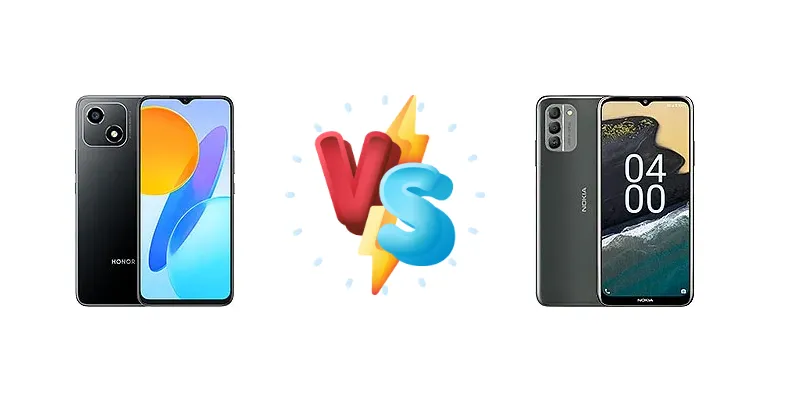
The Honor Play 30 and Nokia G400 occupy a similar price bracket, both aiming to deliver 5G connectivity and a functional smartphone experience without breaking the bank. Both devices utilize the Qualcomm Snapdragon 480+ 5G chipset, making a direct comparison of their implementations and supporting features crucial for discerning buyers.
🏆 Quick Verdict
For the average user prioritizing convenience, the Nokia G400 emerges as the better choice. While both phones share the same Snapdragon 480+ 5G chipset, the Nokia G400’s 20W charging with PD3.0 support significantly reduces downtime, offering a more fluid daily experience compared to the Honor Play 30’s slower 10W charging.
| Network |
|---|
| 2G bands | GSM 850 / 900 / 1800 / 1900 | GSM 850 / 900 / 1800 / 1900 |
| 3G bands | HSDPA 850 / 900 / 1900 / 2100 | HSDPA 850 / 1700(AWS) / 1900 |
| 4G bands | LTE | 2, 4, 5, 12, 13, 25, 26, 41, 66, 71 |
| 5G bands | SA/NSA | 2, 5, 25, 41, 66, 71, 77 SA/NSA |
| Speed | HSPA, LTE, 5G | HSPA, LTE, 5G |
| Technology | GSM / CDMA / HSPA / CDMA2000 / LTE / 5G | GSM / HSPA / LTE / 5G |
| | CDMA2000 1x | - |
| Launch |
|---|
| Announced | 2022, May 10 | 2022, January 05 |
| Status | Available. Released 2022, May 27 | Available. Released 2022, August 24 |
| Body |
|---|
| Build | - | Glass front (Gorilla Glass 3), aluminum frame |
| Dimensions | 163.7 x 75.1 x 8.7 mm (6.44 x 2.96 x 0.34 in) | 166.4 x 76.7 x 8.8 mm (6.55 x 3.02 x 0.35 in) |
| SIM | Nano-SIM + Nano-SIM | Nano-SIM |
| Weight | 194 g (6.84 oz) | 198 g (6.98 oz) |
| Display |
|---|
| Protection | Aluminosilicate glass | Corning Gorilla Glass 3 |
| Resolution | 720 x 1600 pixels, 20:9 ratio (~270 ppi density) | 1080 x 2408 pixels, 20:9 ratio (~401 ppi density) |
| Size | 6.5 inches, 102.0 cm2 (~83.0% screen-to-body ratio) | 6.58 inches, 104.3 cm2 (~81.7% screen-to-body ratio) |
| Type | TFT LCD, 90Hz | IPS LCD, 120Hz |
| Platform |
|---|
| CPU | Octa-core (2x2.2 GHz Kryo 460 & 6x1.9 GHz Kryo 460) | Octa-core (2x2.2 GHz Kryo 460 & 6x1.9 GHz Kryo 460) |
| Chipset | Qualcomm SM4350-AC Snapdragon 480+ 5G (8 nm) | Qualcomm SM4350-AC Snapdragon 480+ 5G (8 nm) |
| GPU | Adreno 619 | Adreno 619 |
| OS | Android 11, Magic UI 5.0 | Android 12 |
| Memory |
|---|
| Card slot | microSDXC (uses shared SIM slot) | microSDXC (dedicated slot) |
| Internal | 128GB 4GB RAM, 128GB 8GB RAM | 64GB 4GB RAM |
| Main Camera |
|---|
| Features | LED flash, HDR, panorama | LED flash, HDR, panorama |
| Single | 13 MP, f/1.8, (wide), AF | 16 MP, (wide) |
| Triple | - | 48 MP, f/1.8, (wide), PDAF
5 MP, f/2.2, 115˚ (ultrawide)
Auxiliary lens |
| Video | 1080p@30fps | 1080p@30/60fps |
| Selfie camera |
|---|
| Single | 5 MP, f/2.2, (wide) | 16 MP, (wide) |
| Video | 1080p@30fps | 1080p@30fps |
| Sound |
|---|
| 3.5mm jack | Yes | Yes |
| 35mm jack | Yes | Yes |
| Loudspeaker | Yes | Yes |
| | 24-bit/192kHz audio | - |
| Comms |
|---|
| Bluetooth | 5.1, A2DP, LE | 5.1, A2DP, LE, aptX HD, aptX Adaptive |
| NFC | No | Yes |
| Positioning | GPS, GLONASS, GALILEO, BDS | GPS, GALILEO |
| Radio | FM radio | FM radio |
| USB | USB Type-C 2.0 | USB Type-C 2.0, OTG |
| WLAN | Wi-Fi 802.11 a/b/g/n/ac, dual-band, Wi-Fi Direct, DLNA | Wi-Fi 802.11 b/g/n/ac |
| Features |
|---|
| Sensors | Accelerometer, proximity, compass | Fingerprint (side-mounted), accelerometer, gyro, proximity, compass, barometer |
| Battery |
|---|
| Charging | 10W wired | 20W wired, PD3.0 |
| Type | Li-Po 5000 mAh | Li-Po 5000 mAh |
| Misc |
|---|
| Colors | Black, Blue, Gold, Gradient | Meteor Grey |
| Models | VNE-AN00 | TA-1530, TA-1448, TA-1476, N1530DL |
| Price | About 150 EUR | About 70 EUR |
| SAR | - | 1.05 W/kg (head) 1.09 W/kg (body) |
Honor Play 30
- Potentially lower purchase price
- Shares the same Snapdragon 480+ 5G chipset as the Nokia G400
- Functional smartphone experience for basic tasks
- Slow 10W charging
- Limited charger compatibility
- Likely basic display and camera specifications
Nokia G400
- Faster 20W charging with PD3.0 support
- Wider charger compatibility
- Shares the same Snapdragon 480+ 5G chipset as the Honor Play 30
- Potentially higher purchase price
- Likely basic display and camera specifications
- May not offer significant performance gains over the Honor Play 30
Display Comparison
Neither Honor nor Nokia provide display specifications beyond the basic panel type. Given the price point, both likely utilize LCD panels. The absence of details like peak brightness (nits), color gamut coverage (DCI-P3), or refresh rate suggests a focus on cost optimization over display quality. Users should expect a standard viewing experience suitable for everyday tasks, but not ideal for HDR content or outdoor use. Bezels are likely to be noticeable on both devices, further indicating a budget-focused design.
Camera Comparison
Detailed camera specifications are absent from the provided data. Given the market segment, both phones likely feature a multi-camera setup with a primary sensor and supporting lenses (potentially including macro and depth sensors). Without knowing sensor sizes, apertures, or image processing algorithms, it’s difficult to assess camera quality. It’s reasonable to assume image quality will be adequate for social media sharing and casual photography, but not competitive with higher-end smartphones. The absence of Optical Image Stabilization (OIS) is also probable, impacting low-light performance.
Performance
Both the Honor Play 30 and Nokia G400 are powered by the Qualcomm SM4350-AC Snapdragon 480+ 5G (8 nm) chipset, featuring an octa-core CPU configuration with 2x2.2 GHz Kryo 460 cores and 6x1.9 GHz Kryo 460 cores. This means CPU performance will be virtually identical between the two. The real-world impact will depend on RAM configuration (not specified) and software optimization. Thermal management is also a key factor; the 8nm process node is relatively efficient, but sustained workloads could lead to throttling. The shared chipset means gaming performance will be comparable, though not suited for demanding titles at high settings.
Battery Life
Battery capacity is not specified for either device. However, the key differentiator is charging speed. The Honor Play 30 supports 10W wired charging, while the Nokia G400 boasts 20W wired charging with Power Delivery (PD) 3.0. This is a significant advantage for the Nokia G400. 20W charging will substantially reduce the time required to reach a full charge, offering greater convenience. PD3.0 also ensures compatibility with a wider range of chargers, including those used for laptops and tablets. Even with similar battery capacities, the Nokia G400’s faster charging will translate to less downtime.
Buying Guide
Buy the Honor Play 30 if you prioritize a potentially lower initial purchase price and are comfortable with slower charging speeds. You'll need to plan around overnight charging or accept longer periods tethered to a wall outlet. Buy the Nokia G400 if you value faster charging and the convenience of quickly topping up your battery throughout the day, even if it means a slightly higher upfront cost. The PD3.0 support also offers broader charger compatibility.
Frequently Asked Questions
❓ Will the Nokia G400’s 20W charging work with my existing USB-C charger?
Likely, yes. The Nokia G400 supports Power Delivery (PD) 3.0, a widely adopted standard. Most modern USB-C chargers are PD-compatible. However, to achieve the full 20W charging speed, ensure your charger specifically supports the PD protocol.
❓ How will the Snapdragon 480+ 5G handle popular games like PUBG Mobile or Call of Duty Mobile?
The Snapdragon 480+ 5G is capable of running PUBG Mobile and Call of Duty Mobile, but you’ll likely need to lower graphics settings to medium or low to maintain a stable frame rate. Don’t expect a flagship-level gaming experience; the chipset is geared towards providing a functional experience rather than pushing graphical boundaries.
❓ Is the lack of detailed camera specs a major concern?
Given the price point of both devices, it’s not surprising to see limited camera information. Expect adequate performance for casual photography and social media sharing, but don’t anticipate flagship-level image quality or advanced features like OIS. Focus on user reviews and sample photos to get a better understanding of real-world camera performance.