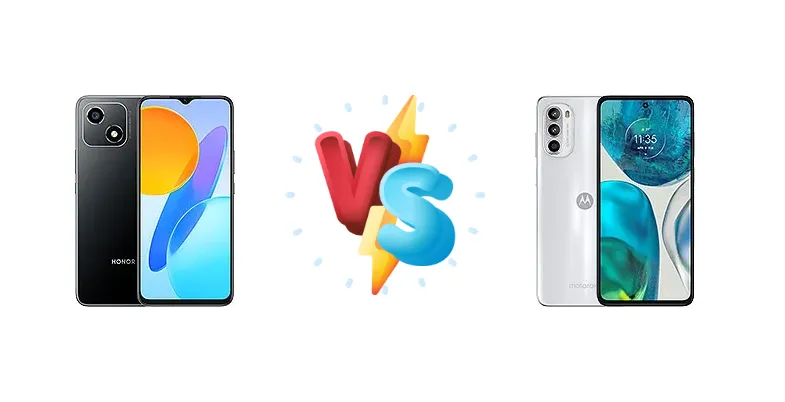
The Honor Play 30 and Motorola Moto G52 represent compelling options in the crowded budget smartphone market. While both aim to deliver essential features at an accessible price point, they diverge significantly in their core hardware. The Honor Play 30 prioritizes 5G connectivity with the Snapdragon 480+, while the Moto G52 focuses on efficiency and a smoother experience with the Snapdragon 680, albeit lacking 5G. This comparison will dissect these differences to determine which device best suits your needs.
🏆 Quick Verdict
For the average user prioritizing a consistently smoother experience and faster charging, the Motorola Moto G52 is the better choice. Its Snapdragon 680, built on a more efficient 6nm process, delivers noticeable performance gains over the Honor Play 30’s Snapdragon 480+, and the 30W charging significantly reduces downtime.
| Network |
|---|
| 2G bands | GSM 850 / 900 / 1800 / 1900 | GSM 850 / 900 / 1800 / 1900 |
| 3G bands | HSDPA 850 / 900 / 1900 / 2100 | HSDPA 850 / 900 / 1700(AWS) / 1900 / 2100 |
| 4G bands | LTE | LTE |
| 5G bands | SA/NSA | - |
| Speed | HSPA, LTE, 5G | HSPA, LTE |
| Technology | GSM / CDMA / HSPA / CDMA2000 / LTE / 5G | GSM / HSPA / LTE |
| | CDMA2000 1x | - |
| Launch |
|---|
| Announced | 2022, May 10 | 2022, April 12 |
| Status | Available. Released 2022, May 27 | Available. Released 2022, April 20 |
| Body |
|---|
| Dimensions | 163.7 x 75.1 x 8.7 mm (6.44 x 2.96 x 0.34 in) | 160.1 x 74.5 x 8 mm (6.30 x 2.93 x 0.31 in) |
| SIM | Nano-SIM + Nano-SIM | Nano-SIM + Nano-SIM |
| Weight | 194 g (6.84 oz) | 169 g (5.96 oz) |
| | - | Water-repellent design |
| Display |
|---|
| Protection | Aluminosilicate glass | - |
| Resolution | 720 x 1600 pixels, 20:9 ratio (~270 ppi density) | 1080 x 2400 pixels, 20:9 ratio (~402 ppi density) |
| Size | 6.5 inches, 102.0 cm2 (~83.0% screen-to-body ratio) | 6.6 inches, 103.6 cm2 (~86.9% screen-to-body ratio) |
| Type | TFT LCD, 90Hz | AMOLED, 90Hz |
| Platform |
|---|
| CPU | Octa-core (2x2.2 GHz Kryo 460 & 6x1.9 GHz Kryo 460) | Octa-core (4x2.4 GHz Kryo 265 Gold & 4x1.9 GHz Kryo 265 Silver) |
| Chipset | Qualcomm SM4350-AC Snapdragon 480+ 5G (8 nm) | Qualcomm SM6225 Snapdragon 680 4G (6 nm) |
| GPU | Adreno 619 | Adreno 610 |
| OS | Android 11, Magic UI 5.0 | Android 12, planned upgrade to Android 13 |
| Memory |
|---|
| Card slot | microSDXC (uses shared SIM slot) | microSDXC (uses shared SIM slot) |
| Internal | 128GB 4GB RAM, 128GB 8GB RAM | 64GB 4GB RAM, 128GB 4GB RAM, 128GB 6GB RAM, 256GB 6GB RAM |
| Main Camera |
|---|
| Features | LED flash, HDR, panorama | LED flash, HDR, panorama |
| Single | 13 MP, f/1.8, (wide), AF | - |
| Triple | - | 50 MP, f/1.8 (wide), 1/2.76", 0.64µm, PDAF
8 MP, f/2.2, 118˚ (ultrawide), 1/4.0", 1.12µm
2 MP (macro) |
| Video | 1080p@30fps | 1080p@30fps |
| Selfie camera |
|---|
| Single | 5 MP, f/2.2, (wide) | 16 MP, f/2.5, (wide), 1.0µm |
| Video | 1080p@30fps | 1080p@30fps |
| Sound |
|---|
| 3.5mm jack | Yes | Yes |
| 35mm jack | Yes | Yes |
| Loudspeaker | Yes | Yes, with stereo speakers |
| | 24-bit/192kHz audio | - |
| Comms |
|---|
| Bluetooth | 5.1, A2DP, LE | 5.0, A2DP, LE |
| NFC | No | Yes (market/region dependent) |
| Positioning | GPS, GLONASS, GALILEO, BDS | GPS, GLONASS, GALILEO |
| Radio | FM radio | Unspecified |
| USB | USB Type-C 2.0 | USB Type-C 2.0 |
| WLAN | Wi-Fi 802.11 a/b/g/n/ac, dual-band, Wi-Fi Direct, DLNA | Wi-Fi 802.11 a/b/g/n/ac, dual-band, Wi-Fi Direct |
| Features |
|---|
| Sensors | Accelerometer, proximity, compass | Fingerprint (side-mounted), accelerometer, gyro, proximity, compass |
| Battery |
|---|
| Charging | 10W wired | 30W wired |
| Type | Li-Po 5000 mAh | Li-Po 5000 mAh |
| Misc |
|---|
| Colors | Black, Blue, Gold, Gradient | Charcoal Gray, Porcelain White |
| Models | VNE-AN00 | XT2221-1, XT2221-2 |
| Price | About 150 EUR | About 470 EUR |
Honor Play 30
- 5G Connectivity
- Lower Price (potentially)
- Acceptable performance for basic tasks
- Slow 10W Charging
- Less Efficient Snapdragon 480+
- Potential for throttling under load
Motorola Moto G52
- Faster 30W Charging
- More Efficient Snapdragon 680
- Smoother User Experience
- Better Thermal Management
- Lacks 5G Connectivity
- Potentially Higher Price
- Camera performance may be similar to the Honor Play 30
Display Comparison
Neither device boasts a standout display. Details regarding panel type (IPS vs AMOLED) and resolution are missing, but both likely feature standard LCD panels for this price bracket. The key difference lies in charging; however, display quality is likely similar. Bezels are expected to be moderate on both, and color accuracy will likely be tuned for vibrant, rather than accurate, reproduction. Without further display specs, it's difficult to declare a clear winner.
Camera Comparison
Without detailed camera sensor information, a direct comparison is challenging. However, the market segment suggests both phones will feature modest camera setups. The absence of OIS on either device indicates reliance on software processing for stabilization. The Snapdragon 680’s ISP (Image Signal Processor) is likely more advanced than the 480+'s, potentially leading to better image quality in challenging lighting conditions. The focus should be on the main sensor resolution and aperture, as the often-included 2MP macro lenses offer limited practical value.
Performance
The Motorola Moto G52’s Snapdragon 680, fabricated on a 6nm process, holds a clear advantage over the Honor Play 30’s Snapdragon 480+ (8nm). The 6nm node translates to improved thermal efficiency, meaning the Moto G52 is less likely to throttle under sustained load. While both CPUs are octa-core, the Moto G52 utilizes a more powerful CPU cluster with 4x2.4 GHz Kryo 265 Gold cores compared to the Honor Play 30’s 2x2.2 GHz Kryo 460 cores. This difference will be noticeable in app launch times and multitasking. The Snapdragon 680 also benefits from a more modern CPU architecture, further enhancing its performance.
Battery Life
The Honor Play 30 is hampered by its slow 10W charging, meaning a full charge will take a considerable amount of time. The Motorola Moto G52’s 30W charging is a significant advantage, drastically reducing charging times. While battery capacity isn't specified, the Snapdragon 680’s superior efficiency means the Moto G52 will likely offer comparable or better battery life despite potentially having a smaller battery capacity. The faster charging speed is a crucial benefit for users who need to quickly top up their device.
Buying Guide
Buy the Honor Play 30 if your primary need is 5G connectivity on a tight budget and you're willing to accept slightly slower performance and slower charging. Buy the Motorola Moto G52 if you prioritize a more responsive user experience, faster charging speeds, and don't require 5G connectivity. The Moto G52 is ideal for everyday tasks, media consumption, and light gaming.
Frequently Asked Questions
❓ Will the Snapdragon 480+ in the Honor Play 30 struggle with demanding games like PUBG Mobile?
Yes, the Snapdragon 480+ is an entry-level 5G chipset. While it can run PUBG Mobile, you'll likely need to lower graphics settings to achieve a playable frame rate. The 8nm process and limited thermal headroom mean sustained gaming sessions could lead to noticeable throttling.
❓ How long does it realistically take to fully charge the Honor Play 30 with its 10W charger?
With a 10W charger, a full charge from 0% on the Honor Play 30 will likely take over 3 hours, potentially closer to 4. This is a significant drawback compared to the Moto G52's 30W charging.
❓ Does the Motorola Moto G52 support VoLTE and VoWiFi for improved call quality?
Support for VoLTE and VoWiFi varies by carrier and region. It's crucial to check with your mobile carrier to confirm compatibility with the Motorola Moto G52 before purchasing, as these features significantly enhance call quality and network connectivity.
❓ Is the lack of 5G on the Moto G52 a significant disadvantage for most users?
For many users, the lack of 5G isn't a dealbreaker. 5G coverage is still limited in many areas, and 4G LTE provides sufficient speeds for most everyday tasks. The Moto G52's superior performance and charging capabilities offer more tangible benefits for the average user.