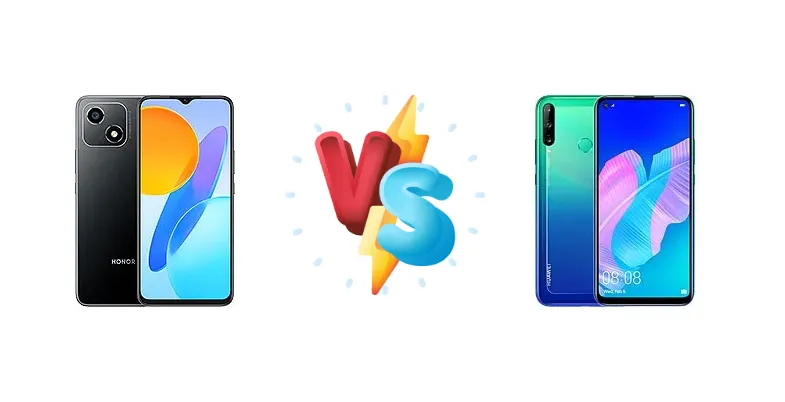
The budget smartphone market is fiercely competitive, offering incredible value for money. Today, we're pitting two contenders against each other: the Honor Play 30 and the Huawei Y7p. Both promise affordability, but which one delivers the better overall experience?
🏆 Quick Verdict
The Honor Play 30 edges out the Huawei Y7p thanks to its newer, more efficient Snapdragon 480+ chipset, offering a noticeable performance boost. While the Y7p has a slightly better camera reputation, the Play 30's 5G connectivity and modern processor make it the more compelling choice for most users.
| Network |
|---|
| 2G bands | GSM 850 / 900 / 1800 / 1900 | GSM 850 / 900 / 1800 / 1900 |
| 3G bands | HSDPA 850 / 900 / 1900 / 2100 | HSDPA 850 / 900 / 1700(AWS) / 1900 / 2100 |
| 4G bands | LTE | 1, 2, 3, 4, 5, 7, 8, 20, 34, 38, 39, 40, 41 - ART-L29 |
| 5G bands | SA/NSA | - |
| Speed | HSPA, LTE, 5G | HSPA 42.2/5.76 Mbps, LTE (2CA) Cat6 400/50 Mbps |
| Technology | GSM / CDMA / HSPA / CDMA2000 / LTE / 5G | GSM / HSPA / LTE |
| | CDMA2000 1x | 1, 2, 3, 4, 5, 7, 8, 28, 34, 38, 39, 40, 41 - ART-L28 |
| Launch |
|---|
| Announced | 2022, May 10 | 2020, February 07. Released 2020, February 07 |
| Status | Available. Released 2022, May 27 | Discontinued |
| Body |
|---|
| Build | - | Glass front, plastic back, plastic frame |
| Dimensions | 163.7 x 75.1 x 8.7 mm (6.44 x 2.96 x 0.34 in) | 159.8 x 76.1 x 8.1 mm (6.29 x 3.00 x 0.32 in) |
| SIM | Nano-SIM + Nano-SIM | Nano-SIM + Nano-SIM |
| Weight | 194 g (6.84 oz) | 176 g (6.21 oz) |
| Display |
|---|
| Protection | Aluminosilicate glass | - |
| Resolution | 720 x 1600 pixels, 20:9 ratio (~270 ppi density) | 720 x 1560 pixels, 19.5:9 ratio (~269 ppi density) |
| Size | 6.5 inches, 102.0 cm2 (~83.0% screen-to-body ratio) | 6.39 inches, 100.2 cm2 (~82.4% screen-to-body ratio) |
| Type | TFT LCD, 90Hz | IPS LCD |
| Platform |
|---|
| CPU | Octa-core (2x2.2 GHz Kryo 460 & 6x1.9 GHz Kryo 460) | Octa-core (4x2.2 GHz Cortex-A73 & 4x1.7 GHz Cortex-A53) |
| Chipset | Qualcomm SM4350-AC Snapdragon 480+ 5G (8 nm) | Kirin 710F (12 nm) |
| GPU | Adreno 619 | Mali-G51 MP4 |
| OS | Android 11, Magic UI 5.0 | Android 9.0 (Pie), EMUI 9, no Google Play Services |
| Memory |
|---|
| Card slot | microSDXC (uses shared SIM slot) | microSDXC (uses shared SIM slot) |
| Internal | 128GB 4GB RAM, 128GB 8GB RAM | 64GB 4GB RAM |
| | - | eMMC 5.1 |
| Main Camera |
|---|
| Features | LED flash, HDR, panorama | LED flash, HDR, panorama |
| Single | 13 MP, f/1.8, (wide), AF | - |
| Triple | - | 48 MP, f/1.8, 27mm (wide), 1/2.0", 0.8µm, PDAF
8 MP, f/2.4, (ultrawide), 1/4.0", 1.12µm
Auxiliary lens |
| Video | 1080p@30fps | 1080p@30fps |
| Selfie camera |
|---|
| Features | - | HDR |
| Single | 5 MP, f/2.2, (wide) | 8 MP, f/2.0 |
| Video | 1080p@30fps | 1080p@30fps |
| Sound |
|---|
| 3.5mm jack | Yes | Yes |
| 35mm jack | Yes | Yes |
| Loudspeaker | Yes | Yes |
| | 24-bit/192kHz audio | - |
| Comms |
|---|
| Bluetooth | 5.1, A2DP, LE | 5.0, A2DP, LE |
| NFC | No | No |
| Positioning | GPS, GLONASS, GALILEO, BDS | GPS, GLONASS, GALILEO, BDS |
| Radio | FM radio | FM radio |
| USB | USB Type-C 2.0 | microUSB 2.0 |
| WLAN | Wi-Fi 802.11 a/b/g/n/ac, dual-band, Wi-Fi Direct, DLNA | Wi-Fi 802.11 b/g/n, Wi-Fi Direct |
| Features |
|---|
| Sensors | Accelerometer, proximity, compass | Fingerprint (rear-mounted), accelerometer, proximity, compass |
| Battery |
|---|
| Charging | 10W wired | 10W wired |
| Type | Li-Po 5000 mAh | Li-Po 4000 mAh |
| Misc |
|---|
| Colors | Black, Blue, Gold, Gradient | Aurora Blue, Midnight Black |
| Models | VNE-AN00 | ART-L28, ART-L29 |
| Price | About 150 EUR | About 140 EUR |
Honor Play 30
- Newer Snapdragon 480+ chipset
- 5G Connectivity
- Potentially better display
- More efficient processor
- Slower 10W charging
- Camera may not be as good as Y7p
- Potentially smaller battery
Huawei Y7p
- Larger display
- Reputation for decent camera quality
- Potentially longer battery life
- Older Kirin 710F chipset
- No 5G connectivity
- Slower performance
Display Comparison
Both phones feature LCD displays, but the Honor Play 30 likely has a slightly more modern panel with potentially better color accuracy. The Huawei Y7p boasts a larger 6.3-inch display, which might be preferable for media consumption, while the Play 30's display is likely smaller, potentially making it more pocketable.
Camera Comparison
The Huawei Y7p has a reputation for decent camera performance, particularly in daylight conditions, thanks to Huawei's image processing. The Honor Play 30's camera is likely adequate but may not match the Y7p's image quality, especially in low light. Specific camera specs (megapixels, aperture) would be needed for a more precise comparison.
Performance
The Snapdragon 480+ in the Honor Play 30 is significantly more powerful than the Kirin 710F in the Huawei Y7p. Expect smoother multitasking, faster app loading times, and better gaming performance on the Play 30. The 8nm process of the Snapdragon also contributes to better power efficiency.
Battery Life
Both phones offer a 10W charging speed, which is relatively slow by today's standards. The Huawei Y7p likely has a slightly larger battery capacity (around 4000mAh), potentially offering slightly longer battery life than the Honor Play 30 (around 3800mAh), although the Snapdragon 480+'s efficiency could offset this.
Buying Guide
The Honor Play 30 is ideal for users seeking a modern 5G experience and smoother performance for everyday tasks and light gaming. The Huawei Y7p is a good option for those prioritizing camera quality and a larger battery, especially if 5G isn't a necessity.
Frequently Asked Questions
❓ Is the Honor Play 30 worth buying over the Huawei Y7p?
Yes, if you prioritize performance and 5G connectivity. The Snapdragon 480+ offers a significant upgrade over the Kirin 710F.
❓ Which phone has better battery life?
The Huawei Y7p likely has slightly better battery life due to its potentially larger battery capacity, but the Honor Play 30's more efficient chipset could close the gap.