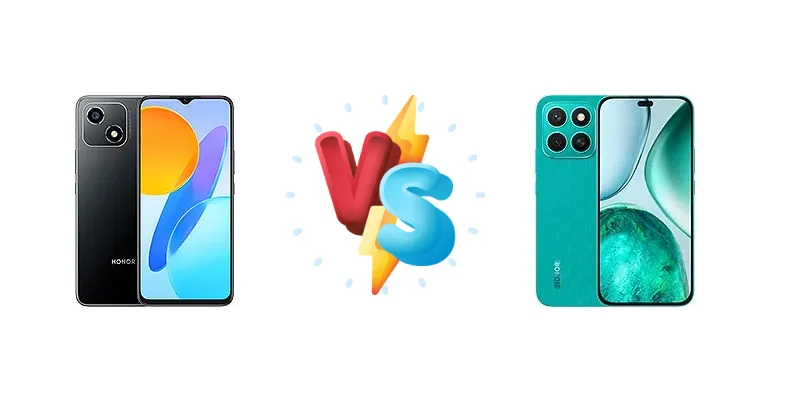
Honor's Play 30 and X8c represent compelling options in the crowded budget smartphone market. While both aim to deliver 5G connectivity at an accessible price point, they diverge significantly in their core hardware. The Play 30 leverages the older Snapdragon 480+ platform, while the X8c opts for the newer, more efficient Snapdragon 685. This comparison dissects these differences to determine which device offers the best overall experience.
🏆 Quick Verdict
For most users, the Honor X8c emerges as the superior choice. Its Snapdragon 685 chipset, built on a more efficient 6nm process, provides a noticeable performance uplift and improved power efficiency. Crucially, the 35W fast charging significantly reduces downtime compared to the Play 30’s sluggish 10W charging.
| Network |
|---|
| 2G bands | GSM 850 / 900 / 1800 / 1900 | GSM 850 / 900 / 1800 / 1900 |
| 3G bands | HSDPA 850 / 900 / 1900 / 2100 | HSDPA 850 / 900 / 1900 / 2100 |
| 4G bands | LTE | LTE |
| 5G bands | SA/NSA | - |
| Speed | HSPA, LTE, 5G | HSPA, LTE |
| Technology | GSM / CDMA / HSPA / CDMA2000 / LTE / 5G | GSM / HSPA / LTE |
| | CDMA2000 1x | - |
| Launch |
|---|
| Announced | 2022, May 10 | 2025, January 14 |
| Status | Available. Released 2022, May 27 | Available. Released 2025, January 20 |
| Body |
|---|
| Build | - | Glass front, plastic frame, plastic back or silicone polymer back (eco leather) |
| Dimensions | 163.7 x 75.1 x 8.7 mm (6.44 x 2.96 x 0.34 in) | 161.1 x 74.6 x 7.1 mm (6.34 x 2.94 x 0.28 in) |
| SIM | Nano-SIM + Nano-SIM | Nano-SIM + Nano-SIM |
| Weight | 194 g (6.84 oz) | 174 g (6.14 oz) |
| Display |
|---|
| Protection | Aluminosilicate glass | - |
| Resolution | 720 x 1600 pixels, 20:9 ratio (~270 ppi density) | 1080 x 2412 pixels, 20:9 ratio (~394 ppi density) |
| Size | 6.5 inches, 102.0 cm2 (~83.0% screen-to-body ratio) | 6.7 inches, 108.0 cm2 (~89.9% screen-to-body ratio) |
| Type | TFT LCD, 90Hz | AMOLED, 120Hz, 1200 nits (HBM), 2800 nits (peak) |
| Platform |
|---|
| CPU | Octa-core (2x2.2 GHz Kryo 460 & 6x1.9 GHz Kryo 460) | Octa-core (4x2.8 GHz Cortex-A73 & 4x1.9 GHz Cortex-A53) |
| Chipset | Qualcomm SM4350-AC Snapdragon 480+ 5G (8 nm) | Qualcomm SM6225 Snapdragon 685 (6 nm) |
| GPU | Adreno 619 | Adreno 610 |
| OS | Android 11, Magic UI 5.0 | Android 15, MagicOS 9 |
| Memory |
|---|
| Card slot | microSDXC (uses shared SIM slot) | No |
| Internal | 128GB 4GB RAM, 128GB 8GB RAM | 128GB 6GB RAM, 128GB 8GB RAM, 256GB 8GB RAM, 512GB 8GB RAM |
| Main Camera |
|---|
| Dual | - | 108 MP, f/1.8, 24mm (wide), 1/1.67", PDAF, OIS
5 MP, f/2.2, (ultrawide) |
| Features | LED flash, HDR, panorama | LED flash, HDR, panorama |
| Single | 13 MP, f/1.8, (wide), AF | - |
| Video | 1080p@30fps | 1080p@30fps, gyro-EIS |
| Selfie camera |
|---|
| Single | 5 MP, f/2.2, (wide) | 50 MP, f/2.1, (wide) |
| Video | 1080p@30fps | 1080p@30fps |
| Sound |
|---|
| 3.5mm jack | Yes | - |
| 35mm jack | Yes | No |
| Loudspeaker | Yes | Yes |
| | 24-bit/192kHz audio | - |
| Comms |
|---|
| Bluetooth | 5.1, A2DP, LE | 5.0/5.1, A2DP, LE |
| NFC | No | Yes (market/region dependent) |
| Positioning | GPS, GLONASS, GALILEO, BDS | GPS, GLONASS, GALILEO, BDS |
| Radio | FM radio | No |
| USB | USB Type-C 2.0 | USB Type-C 2.0, OTG |
| WLAN | Wi-Fi 802.11 a/b/g/n/ac, dual-band, Wi-Fi Direct, DLNA | Wi-Fi 802.11 a/b/g/n/ac, dual-band, Wi-Fi Direct |
| Features |
|---|
| Sensors | Accelerometer, proximity, compass | Fingerprint (under display, optical), accelerometer, gyro, compass, proximity (ultrasonic) |
| Battery |
|---|
| Charging | 10W wired | 35W wired |
| Type | Li-Po 5000 mAh | Li-Po 5000 mAh |
| Misc |
|---|
| Colors | Black, Blue, Gold, Gradient | Marrs Green, Midnight Black, Moonlight White, Cloud Purple |
| Models | VNE-AN00 | ABR-LX1, ABR-LX2, ABR-LX3 |
| Price | About 150 EUR | € 190.78 / $ 213.42 / £ 159.00 |
Honor Play 30
- Potentially lower price point
- 5G connectivity
- Functional for basic tasks
- Slow 10W charging
- Less powerful Snapdragon 480+ chipset
- Less efficient 8nm process
Honor X8c
- Faster Snapdragon 685 chipset
- More efficient 6nm process
- 35W fast charging
- Improved ISP for better camera performance
- Potentially higher price
- May not offer significant camera improvements over competitors
Display Comparison
Neither Honor provides detailed display specifications beyond resolution. However, the focus here isn't on display quality, but rather the underlying performance driving the UI. Both likely utilize LCD panels, common in this price bracket. The difference lies in how efficiently the chipset can render content on the display; the Snapdragon 685 in the X8c will deliver a smoother experience, especially during scrolling and animations.
Camera Comparison
Without detailed camera specs, a direct comparison is difficult. Both phones likely feature a multi-camera setup with a primary sensor and supporting lenses. However, image processing is heavily reliant on the ISP within the chipset. The Snapdragon 685’s ISP is more advanced, enabling better noise reduction, dynamic range, and overall image quality. The Play 30 will likely struggle in low-light conditions compared to the X8c. The presence of a 2MP macro camera on either device is largely inconsequential; image quality will be limited.
Performance
The core distinction lies in the chipsets. The Honor Play 30’s Snapdragon 480+ (8nm) features a Kryo 460-based octa-core CPU clocked up to 2.2 GHz. The X8c’s Snapdragon 685 (6nm) utilizes Cortex-A73 cores clocked higher at 2.8 GHz, alongside more efficient Cortex-A53 cores. The 6nm process of the 685 is a significant advantage, offering better thermal efficiency and sustained performance. While the 480+ has a slight clock speed advantage on its prime cores, the architectural improvements and process node of the 685 translate to a more responsive and capable device. The X8c will handle multitasking and demanding apps with greater ease.
Battery Life
Battery capacity isn't specified, but the real differentiator is charging speed. The Honor Play 30 is limited to a slow 10W wired charge, meaning a full charge will take well over two hours. The Honor X8c, with its 35W wired charging, can significantly reduce this downtime, potentially reaching a full charge in under an hour. This is a crucial advantage for users who rely heavily on their phones throughout the day. While a larger battery capacity is desirable, faster charging mitigates the impact of a smaller battery.
Buying Guide
Buy the Honor Play 30 if your primary concern is minimizing upfront cost and 5G connectivity is your sole requirement. It's a functional device for basic tasks. Buy the Honor X8c if you prioritize a smoother user experience, faster charging, and a more future-proof chipset, even if it means a slightly higher initial investment. The X8c is ideal for users who consume media, browse the web, and occasionally engage in light gaming.
Frequently Asked Questions
❓ Will the Snapdragon 685 in the X8c handle demanding games like PUBG Mobile?
While the Snapdragon 685 isn't a gaming powerhouse, it's capable of running PUBG Mobile at medium settings with reasonable frame rates. The 6nm process and improved CPU architecture provide a more stable gaming experience compared to the Play 30’s Snapdragon 480+.
❓ How much faster is the 35W charging on the X8c compared to the 10W charging on the Play 30?
The difference is substantial. 10W charging will take over 2 hours for a full charge, while 35W charging can potentially achieve a full charge in under an hour, depending on battery capacity. This is a significant convenience factor for daily use.
❓ Does the Snapdragon 685 offer any advantages in terms of software updates and longevity?
The Snapdragon 685 is a newer chipset, suggesting it will receive software updates and security patches for a longer period compared to the older Snapdragon 480+. This contributes to the overall longevity and security of the Honor X8c.