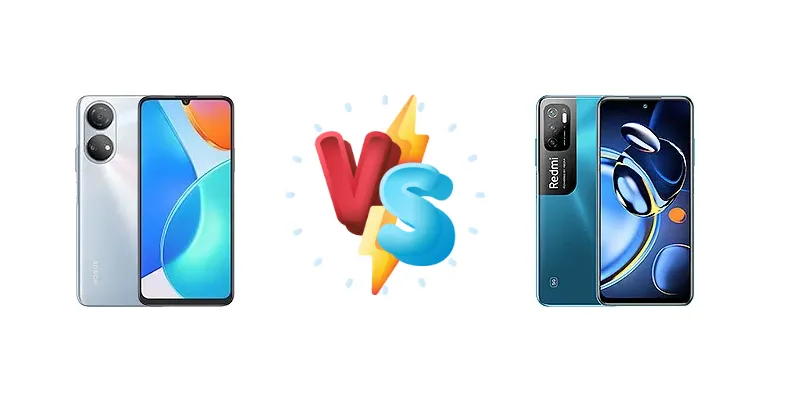
Both the Honor Play 30 Plus and the Xiaomi Redmi Note 11SE occupy the fiercely competitive sub-$200 5G smartphone segment. While both leverage the Mediatek Dimensity 700 chipset, key differences in charging speed and potentially software optimization create a distinct user experience. This comparison dissects these nuances to help you choose the right device.
🏆 Quick Verdict
For the average user prioritizing faster charging and potentially more efficient power management, the Honor Play 30 Plus emerges as the slightly better choice. Its 22.5W charging significantly outperforms the Redmi Note 11SE’s 18W, reducing downtime and offering a more convenient experience, despite both phones sharing the same core processing power.
| Network |
|---|
| 2G bands | GSM 850 / 900 / 1800 / 1900 | GSM 850 / 900 / 1800 / 1900 |
| 3G bands | HSDPA 850 / 900 / 2100 | HSDPA 850 / 900 / 1900 / 2100 |
| 4G bands | LTE | 1, 3, 5, 7, 8, 34, 38, 39, 40, 41 |
| 5G bands | SA/NSA | 1, 41, 78 SA/NSA |
| Speed | HSPA, LTE, 5G | HSPA, LTE, 5G |
| Technology | GSM / CDMA / HSPA / CDMA2000 / LTE / 5G | GSM / CDMA / HSPA / EVDO / LTE / 5G |
| | CDMA2000 1x | CDMA2000 1xEV-DO |
| Launch |
|---|
| Announced | 2021, December 16 | 2022, May 24 |
| Status | Available. Released 2022, January 02 | Available. Released 2022, May 31 |
| Body |
|---|
| Build | Glass front, plastic back, plastic frame | - |
| Dimensions | 167.6 x 77.2 x 8.6 mm (6.60 x 3.04 x 0.34 in) | 161.8 x 75.3 x 8.9 mm (6.37 x 2.96 x 0.35 in) |
| SIM | Nano-SIM + Nano-SIM | Nano-SIM + Nano-SIM |
| Weight | 198 g (6.98 oz) | 190 g (6.70 oz) |
| Display |
|---|
| Resolution | 720 x 1600 pixels, 20:9 ratio (~260 ppi density) | 1080 x 2400 pixels, 20:9 ratio (~405 ppi density) |
| Size | 6.74 inches, 109.7 cm2 (~84.8% screen-to-body ratio) | 6.5 inches, 102.0 cm2 (~83.7% screen-to-body ratio) |
| Type | IPS LCD, 90Hz | IPS LCD, 90Hz, 400 nits (typ) |
| Platform |
|---|
| CPU | Octa-core (2x2.2 GHz Cortex-A76 & 6x2.0 GHz Cortex-A55) | Octa-core (2x2.2 GHz Cortex-A76 & 6x2.0 GHz Cortex-A55) |
| Chipset | Mediatek Dimensity 700 (7 nm) | Mediatek Dimensity 700 (7 nm) |
| GPU | Mali-G57 MC2 | Mali-G57 MC2 |
| OS | Android 11, Magic UI 5.0 | Android 11, MIUI 12.5 |
| Memory |
|---|
| Card slot | microSDXC (uses shared SIM slot) | No |
| Internal | 128GB 4GB RAM, 128GB 6GB RAM, 128GB 8GB RAM | 128GB 4GB RAM, 128GB 8GB RAM |
| | eMMC 5.1 | UFS 2.2 |
| Main Camera |
|---|
| Dual | 13 MP, f/1.8, (wide), PDAF
Auxiliary lens | 48 MP, f/1.8, (wide), 1/2.0", 0.8µm, PDAF
2 MP (macro) |
| Features | LED flash, HDR, panorama | Dual-LED dual-tone flash, HDR, panorama |
| Single | 5 MP, f/2.2, (wide) | 8 MP, f/2.0, (wide), 1/4.0", 1.12µm |
| Video | 1080p@30fps | 1080p@30fps |
| Selfie camera |
|---|
| Single | 5 MP, f/2.2, (wide) | 8 MP, f/2.0, (wide), 1/4.0", 1.12µm |
| Video | - | 1080p@30fps |
| Sound |
|---|
| 3.5mm jack | Yes | Yes |
| 35mm jack | Yes | Yes |
| Loudspeaker | Yes | Yes |
| Comms |
|---|
| Bluetooth | 5.1, A2DP, LE | 5.1, A2DP, LE |
| Infrared port | - | Yes |
| NFC | No | Yes |
| Positioning | GPS, BDS | GPS, GLONASS, GALILEO, BDS |
| Radio | No | No |
| USB | USB Type-C 2.0, OTG | USB Type-C 2.0, OTG |
| WLAN | Wi-Fi 802.11 a/b/g/n/ac, dual-band, Wi-Fi Direct | Wi-Fi 802.11 a/b/g/n/ac, dual-band, Wi-Fi Direct |
| Features |
|---|
| Sensors | Fingerprint (side-mounted), accelerometer, proximity, compass | Fingerprint (side-mounted), accelerometer, gyro, proximity, compass |
| | - | 24-bit/192kHz audio |
| Battery |
|---|
| Charging | 22.5W wired | 18W wired |
| Type | Li-Po 5000 mAh | Li-Po 5000 mAh |
| Misc |
|---|
| Colors | Black, Blue, Silver, Gold | Blue, Black |
| Models | CMA-AN00 | - |
| Price | About 150 EUR | About 150 EUR |
Honor Play 30 Plus
- Faster 22.5W charging for quicker top-ups
- Potentially more efficient power management due to charging optimization
- Competitive price point within the budget 5G segment
- Software experience may be less refined than MIUI
- Camera performance details are unknown
Xiaomi Redmi Note 11SE
- MIUI software ecosystem with potential for customization
- Wider availability of accessories and community support
- Competitive price point within the budget 5G segment
- Slower 18W charging compared to the Honor Play 30 Plus
- Potential for bloatware in MIUI
Display Comparison
Neither Honor nor Xiaomi provide detailed display specifications beyond the basic panel type. Given the price point, both likely utilize LCD panels. The absence of high refresh rates (90Hz or 120Hz) is expected. The real-world difference in display quality will likely be minimal, focusing on color calibration and viewing angles, areas where brand-specific tuning will play a larger role. Bezels are expected to be comparable, prioritizing cost-effectiveness over ultra-slim designs.
Camera Comparison
Detailed camera specifications are unavailable. However, given the market segment, both phones likely feature a primary sensor paired with depth and macro lenses. The quality of the primary sensor and image processing algorithms will be the determining factors. Without knowing sensor sizes or apertures, it’s difficult to declare a clear winner. The 2MP macro lenses commonly found in this price range offer limited utility, and image quality will be significantly lower than the main sensor. Expect adequate performance in well-lit conditions, but struggles in low-light scenarios.
Performance
Both the Honor Play 30 Plus and the Xiaomi Redmi Note 11SE are powered by the Mediatek Dimensity 700 (7nm). This chipset features an octa-core configuration with 2x2.2 GHz Cortex-A76 and 6x2.0 GHz Cortex-A55 cores. Performance will be virtually identical for everyday tasks like browsing, social media, and light gaming. The Dimensity 700’s integrated 5G modem provides reliable connectivity. Thermal management will depend on the phone’s internal design and cooling solutions, but given the chipset’s efficiency, significant throttling isn’t anticipated under sustained loads. RAM configurations are likely similar, further minimizing performance disparities.
Battery Life
The Honor Play 30 Plus boasts 22.5W wired charging, while the Redmi Note 11SE is limited to 18W. This is the most significant hardware difference. While both phones likely feature 5000mAh batteries (a common capacity in this segment), the faster charging of the Honor Play 30 Plus translates to a quicker 0-100% charge time. This difference is substantial for users who need to quickly replenish their battery. The 4.5W difference in charging wattage may not seem large, but it accumulates over time, offering a more convenient user experience.
Buying Guide
Buy the Honor Play 30 Plus if you frequently find yourself needing to top up your phone quickly and value a faster charging experience. This is ideal for users who are constantly on the go. Buy the Xiaomi Redmi Note 11SE if you prioritize Xiaomi’s MIUI software ecosystem and are less concerned about charging speed, potentially benefiting from a more mature software experience and wider accessory availability.
Frequently Asked Questions
❓ Will the Dimensity 700 in either phone struggle with demanding games like PUBG Mobile?
The Dimensity 700 is capable of running PUBG Mobile, but you’ll likely need to lower graphics settings to medium or low to maintain a stable frame rate. Expect occasional frame drops during intense firefights. Neither phone is designed for high-end gaming.
❓ How does the software update policy differ between Honor and Xiaomi on these devices?
Historically, Xiaomi has offered more consistent software updates for its Redmi series compared to Honor. However, Honor is improving its software support. Expect at least one major Android update for both devices, but long-term support is uncertain. Xiaomi’s MIUI also offers more customization options.
❓ Is the 5G connectivity on both phones compatible with all 5G networks?
The Dimensity 700 supports a wide range of 5G bands, but compatibility depends on your carrier and region. Check your carrier’s website to ensure the phones support the specific 5G bands used in your area.