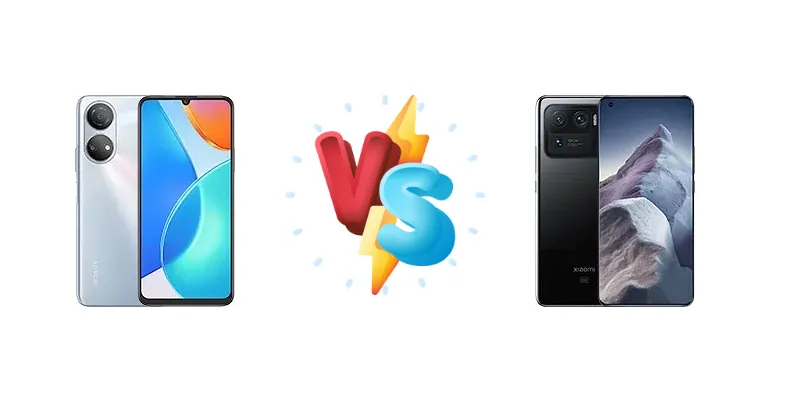
The smartphone market is brimming with options, but choosing the right one can be overwhelming. Today, we pit the budget-friendly Honor Play 30 Plus against the flagship Xiaomi Mi 11 Ultra to see which device reigns supreme. This comparison will help you decide which phone best suits your needs and budget.
🏆 Quick Verdict
The Xiaomi Mi 11 Ultra is the clear winner, boasting a superior chipset, stunning display, incredible camera system, and blazing-fast charging. However, the Honor Play 30 Plus offers a compelling value proposition for budget-conscious users seeking a reliable daily driver.
| Network |
|---|
| 2G bands | GSM 850 / 900 / 1800 / 1900 | GSM 850 / 900 / 1800 / 1900 |
| 3G bands | HSDPA 850 / 900 / 2100 | HSDPA 850 / 900 / 1700(AWS) / 1900 / 2100 |
| 4G bands | LTE | 1, 2, 3, 4, 5, 7, 8, 12, 17, 20, 28, 32, 38, 40, 41, 42, 66 - International |
| 5G bands | SA/NSA | 1, 3, 5, 7, 8, 20, 28, 38, 40, 41, 77, 78, 79 SA/NSA - International |
| Speed | HSPA, LTE, 5G | HSPA, LTE, 5G |
| Technology | GSM / CDMA / HSPA / CDMA2000 / LTE / 5G | GSM / CDMA / HSPA / EVDO / LTE / 5G |
| | CDMA2000 1x | 1, 3, 28, 41, 77, 78, 79 SA/NSA - China |
| Launch |
|---|
| Announced | 2021, December 16 | 2021, March 29 |
| Status | Available. Released 2022, January 02 | Available. Released 2021, April 02 |
| Body |
|---|
| Build | Glass front, plastic back, plastic frame | Glass front (Gorilla Glass Victus), ceramic back, aluminum frame |
| Dimensions | 167.6 x 77.2 x 8.6 mm (6.60 x 3.04 x 0.34 in) | 164.3 x 74.6 x 8.4 mm (6.47 x 2.94 x 0.33 in) |
| SIM | Nano-SIM + Nano-SIM | Nano-SIM + Nano-SIM |
| Weight | 198 g (6.98 oz) | 234 g (8.25 oz) |
| | - | IP68 dust/water resistant (up to 1.5m for 30 min) |
| Display |
|---|
| Protection | - | Corning Gorilla Glass Victus |
| Resolution | 720 x 1600 pixels, 20:9 ratio (~260 ppi density) | 1440 x 3200 pixels, 20:9 ratio (~515 ppi density) |
| Size | 6.74 inches, 109.7 cm2 (~84.8% screen-to-body ratio) | 6.81 inches, 112.0 cm2 (~91.4% screen-to-body ratio) |
| Type | IPS LCD, 90Hz | AMOLED, 1B colors, 120Hz, HDR10+, Dolby Vision, 900 nits (HBM), 1700 nits (peak) |
| Platform |
|---|
| CPU | Octa-core (2x2.2 GHz Cortex-A76 & 6x2.0 GHz Cortex-A55) | Octa-core (1x2.84 GHz Cortex-X1 & 3x2.42 GHz Cortex-A78 & 4x1.80 GHz Cortex-A55) |
| Chipset | Mediatek Dimensity 700 (7 nm) | Qualcomm SM8350 Snapdragon 888 5G (5 nm) |
| GPU | Mali-G57 MC2 | Adreno 660 |
| OS | Android 11, Magic UI 5.0 | Android 11, upgradable to Android 13, MIUI 14 |
| Memory |
|---|
| Card slot | microSDXC (uses shared SIM slot) | No |
| Internal | 128GB 4GB RAM, 128GB 6GB RAM, 128GB 8GB RAM | 256GB 8GB RAM, 256GB 12GB RAM, 512GB 12GB RAM |
| | eMMC 5.1 | UFS 3.1 |
| Main Camera |
|---|
| Dual | 13 MP, f/1.8, (wide), PDAF
Auxiliary lens | - |
| Features | LED flash, HDR, panorama | Laser AF, color spectrum sensor, Dual-LED flash, HDR, panorama, 1.1” AMOLED selfie display |
| Single | 5 MP, f/2.2, (wide) | 20 MP, f/2.2, 27mm (wide), 1/3.4", 0.8µm |
| Triple | - | 50 MP, f/2.0, 24mm (wide), 1/1.12", 1.4µm, dual pixel PDAF, OIS
48 MP, f/4.1, 120mm (periscope telephoto), 1/2.0", 0.8µm, PDAF, OIS, 5x optical zoom
48 MP, f/2.2, 12mm, 128˚ (ultrawide), 1/2.0", 0.8µm, PDAF |
| Video | 1080p@30fps | 8K@24fps, 4K@30/60fps, 1080p@30/60/120/240/960/1920fps, gyro-EIS, HDR10+ rec. |
| Selfie camera |
|---|
| Features | - | HDR, panorama |
| Single | 5 MP, f/2.2, (wide) | 20 MP, f/2.2, 27mm (wide), 1/3.4", 0.8µm |
| Video | - | 1080p@30/60fps, 720p@120fps, gyro-EIS |
| Sound |
|---|
| 3.5mm jack | Yes | No |
| 35mm jack | Yes | No |
| Loudspeaker | Yes | Yes, with stereo speakers |
| | - | 24-bit/192kHz audio
Tuned by Harman Kardon |
| Comms |
|---|
| Bluetooth | 5.1, A2DP, LE | 5.2, A2DP, LE, aptX HD, aptX Adaptive |
| Infrared port | - | Yes |
| NFC | No | Yes |
| Positioning | GPS, BDS | GPS (L1+L5), GLONASS (L1), BDS (B1I+B1c+B2a), GALILEO (E1+E5a), QZSS (L1+L5), NavIC (L5) |
| Radio | No | No |
| USB | USB Type-C 2.0, OTG | USB Type-C 2.0, OTG |
| WLAN | Wi-Fi 802.11 a/b/g/n/ac, dual-band, Wi-Fi Direct | Wi-Fi 802.11 a/b/g/n/ac/6e, dual-band, Wi-Fi Direct, DLNA |
| Features |
|---|
| Sensors | Fingerprint (side-mounted), accelerometer, proximity, compass | Fingerprint (under display, optical), accelerometer, gyro, compass |
| | - | Virtual proximity sensing |
| Battery |
|---|
| Charging | 22.5W wired | 67W wired, PD3.0, QC4, 100% in 36 min
67W wireless, 100% in 39 min
10W reverse wireless |
| Type | Li-Po 5000 mAh | Li-Po 5000 mAh |
| Misc |
|---|
| Colors | Black, Blue, Silver, Gold | Ceramic White (Cosmic White), Ceramic Black (Cosmic Black) |
| Models | CMA-AN00 | M2102K1G, M2102K1C |
| Price | About 150 EUR | About 1500 EUR |
| SAR | - | 1.08 W/kg (head) 0.81 W/kg (body) |
| SAR EU | - | 0.55 W/kg (head) 0.99 W/kg (body) |
| Tests |
|---|
| Battery life | - |
Endurance rating 95h
|
| Camera | - |
Photo / Video |
| Display | - |
Contrast ratio: Infinite (nominal) |
| Loudspeaker | - |
-24.3 LUFS (Very good)
|
| Performance | - |
AnTuTu: 688720 (v8)
GeekBench: 3191 (v5.1)
GFXBench: 33fps (ES 3.1 onscreen) |
Honor Play 30 Plus
- Affordable
- Decent battery life
- Reliable for basic tasks
- Good value for money
- Underpowered chipset
- Mediocre camera
- Slow charging
- Basic display
Xiaomi Mi 11 Ultra
- Flagship performance
- Exceptional camera
- Stunning display
- Fast charging (wired & wireless)
- Premium design
- Expensive
- Large and heavy
- Potential for overheating under heavy load
Display Comparison
The Xiaomi Mi 11 Ultra's display is a significant advantage. Its 943 nits max brightness and infinite contrast ratio provide a vibrant and immersive viewing experience. The Honor Play 30 Plus likely has a decent display, but it won't match the Mi 11 Ultra's quality. Expect better color accuracy and outdoor visibility on the Xiaomi.
Camera Comparison
The Mi 11 Ultra's camera system is legendary, featuring a massive 108MP main sensor and impressive zoom capabilities. It excels in both photo and video quality. The Honor Play 30 Plus will offer a functional camera, but it won't compete with the Mi 11 Ultra's versatility and image quality.
Performance
The Snapdragon 888 in the Mi 11 Ultra obliterates the Dimensity 700 in the Honor Play 30 Plus. Expect significantly faster app loading times, smoother multitasking, and better gaming performance on the Xiaomi. The Dimensity 700 is adequate for everyday tasks, but struggles with demanding applications.
Battery Life
Both phones boast impressive endurance ratings (95h). However, the Mi 11 Ultra's 67W wired and wireless charging capabilities provide significantly faster charging speeds compared to the Honor Play 30 Plus's 22.5W wired charging.
Buying Guide
The Honor Play 30 Plus is ideal for students, casual users, or anyone on a tight budget who prioritizes affordability and basic functionality. The Xiaomi Mi 11 Ultra is perfect for photography enthusiasts, power users, and those who demand the best possible performance and features, regardless of price.
Frequently Asked Questions
❓ Is the Honor Play 30 Plus good for gaming?
While it can handle some games, the Honor Play 30 Plus's chipset isn't ideal for demanding titles. Expect lower frame rates and potential lag.
❓ How does the Xiaomi Mi 11 Ultra's camera compare to other flagships?
The Mi 11 Ultra's camera is consistently ranked among the best in the industry, offering exceptional detail, dynamic range, and zoom capabilities.
❓ What is the difference in charging speed between the two phones?
The Xiaomi Mi 11 Ultra charges significantly faster with its 67W wired and wireless charging, while the Honor Play 30 Plus is limited to 22.5W wired charging.