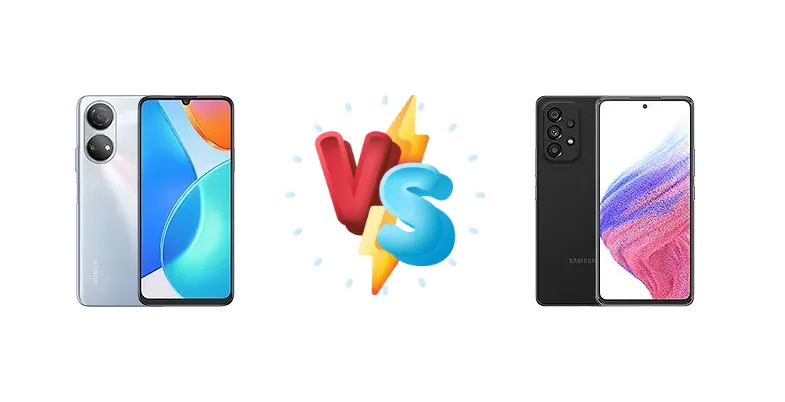
The Honor Play 30 Plus and Samsung Galaxy A53 5G represent compelling options in the increasingly competitive mid-range 5G smartphone market. While both aim to deliver 5G connectivity at accessible price points, they diverge significantly in their internal hardware and feature sets. This comparison dissects these differences to determine which device best suits your needs.
🏆 Quick Verdict
For the average user prioritizing a brighter, more vibrant display and a more refined software experience, the Samsung Galaxy A53 5G is the better choice. However, the Honor Play 30 Plus offers a respectable performance profile for basic tasks and represents a strong value proposition for budget-conscious buyers.
| Network |
|---|
| 2G bands | GSM 850 / 900 / 1800 / 1900 | GSM 850 / 900 / 1800 / 1900 |
| 3G bands | HSDPA 850 / 900 / 2100 | HSDPA 850 / 900 / 1700(AWS) / 1900 / 2100 |
| 4G bands | LTE | 1, 2, 3, 4, 5, 7, 12, 14, 20, 29, 30, 38, 39, 40, 41, 46, 48, 66 - SM-A536U |
| 5G bands | SA/NSA | 2, 5, 41, 66, 77, 78 SA/NSA/Sub6/mmWave - SM-A536U |
| Speed | HSPA, LTE, 5G | HSPA, LTE, 5G |
| Technology | GSM / CDMA / HSPA / CDMA2000 / LTE / 5G | GSM / HSPA / LTE / 5G |
| | CDMA2000 1x | 2, 5, 48, 66, 77, 78, 260, 261 SA/NSA/Sub6/mmWave - SM-A536V |
| Launch |
|---|
| Announced | 2021, December 16 | 2022, March 17 |
| Status | Available. Released 2022, January 02 | Available. Released 2022, March 24 |
| Body |
|---|
| Build | Glass front, plastic back, plastic frame | Glass front (Gorilla Glass 5), plastic frame, plastic back |
| Dimensions | 167.6 x 77.2 x 8.6 mm (6.60 x 3.04 x 0.34 in) | 159.6 x 74.8 x 8.1 mm (6.28 x 2.94 x 0.32 in) |
| SIM | Nano-SIM + Nano-SIM | · Nano-SIM· Nano-SIM + Nano-SIM |
| Weight | 198 g (6.98 oz) | 189 g (6.67 oz) |
| | - | IP67 dust/water resistant (up to 1m for 30 min) |
| Display |
|---|
| Protection | - | Corning Gorilla Glass 5 |
| Resolution | 720 x 1600 pixels, 20:9 ratio (~260 ppi density) | 1080 x 2400 pixels, 20:9 ratio (~405 ppi density) |
| Size | 6.74 inches, 109.7 cm2 (~84.8% screen-to-body ratio) | 6.5 inches, 102.0 cm2 (~85.4% screen-to-body ratio) |
| Type | IPS LCD, 90Hz | Super AMOLED, 120Hz, 800 nits (HBM) |
| Platform |
|---|
| CPU | Octa-core (2x2.2 GHz Cortex-A76 & 6x2.0 GHz Cortex-A55) | Octa-core (2x2.4 GHz Cortex-A78 & 6x2.0 GHz Cortex-A55) |
| Chipset | Mediatek Dimensity 700 (7 nm) | Exynos 1280 (5 nm) |
| GPU | Mali-G57 MC2 | Mali-G68 |
| OS | Android 11, Magic UI 5.0 | Android 12, up to 4 major Android upgrades, One UI 8 |
| Memory |
|---|
| Card slot | microSDXC (uses shared SIM slot) | microSDXC (uses shared SIM slot) |
| Internal | 128GB 4GB RAM, 128GB 6GB RAM, 128GB 8GB RAM | 128GB 4GB RAM, 128GB 6GB RAM, 128GB 8GB RAM, 256GB 6GB RAM, 256GB 8GB RAM |
| | eMMC 5.1 | - |
| Main Camera |
|---|
| Dual | 13 MP, f/1.8, (wide), PDAF
Auxiliary lens | - |
| Features | LED flash, HDR, panorama | LED flash, panorama, HDR |
| Quad | - | 64 MP, f/1.8, 26mm (wide), 1/1.7X", 0.8µm, PDAF, OIS
12 MP, f/2.2, 123˚ (ultrawide), 1.12µm
5 MP (macro)
Auxiliary lens |
| Single | 5 MP, f/2.2, (wide) | 32 MP, f/2.2, 26mm (wide), 1/2.8", 0.8µm |
| Video | 1080p@30fps | 4K@30fps, 1080p@30/60fps; gyro-EIS |
| Selfie camera |
|---|
| Features | - | HDR |
| Single | 5 MP, f/2.2, (wide) | 32 MP, f/2.2, 26mm (wide), 1/2.8", 0.8µm |
| Video | - | 4K@30fps, 1080p@30fps |
| Sound |
|---|
| 3.5mm jack | Yes | No |
| 35mm jack | Yes | No |
| Loudspeaker | Yes | Yes, with stereo speakers |
| Comms |
|---|
| Bluetooth | 5.1, A2DP, LE | 5.1, A2DP, LE |
| NFC | No | Yes (market/region dependent) |
| Positioning | GPS, BDS | GPS, GLONASS, GALILEO, BDS |
| Radio | No | No |
| USB | USB Type-C 2.0, OTG | USB Type-C 2.0, OTG |
| WLAN | Wi-Fi 802.11 a/b/g/n/ac, dual-band, Wi-Fi Direct | Wi-Fi 802.11 a/b/g/n/ac, dual-band, Wi-Fi Direct |
| Features |
|---|
| Sensors | Fingerprint (side-mounted), accelerometer, proximity, compass | Fingerprint (under display, optical), accelerometer, gyro, compass, barometer (market/region dependent) |
| | - | Virtual proximity sensing |
| Battery |
|---|
| Charging | 22.5W wired | 25W wired |
| Type | Li-Po 5000 mAh | Li-Po 5000 mAh |
| Misc |
|---|
| Colors | Black, Blue, Silver, Gold | Black, White, Blue, Peach |
| Models | CMA-AN00 | SM-A536B, SM-A536B/DS, SM-A536U, SM-A536U1, SM-A5360, SM-A536E, SM-A536E/DS, SM-A536V, SM-A536W, SM-A536N, SM-S536DL |
| Price | About 150 EUR | $ 151.42 / £ 185.00 / € 169.14 |
| SAR | - | 0.75 W/kg (head) 1.58 W/kg (body) |
| SAR EU | - | 0.89 W/kg (head) 1.60 W/kg (body) |
| Tests |
|---|
| Battery life | - |
Endurance rating 113h
|
| Camera | - |
Photo / Video |
| Display | - |
Contrast ratio: Infinite (nominal) |
| Loudspeaker | - |
-26.5 LUFS (Good)
|
| Performance | - |
AnTuTu: 329802 (v8), 379313 (v9)
GeekBench: 1891 (v5.1)
GFXBench: 19fps (ES 3.1 onscreen) |
Honor Play 30 Plus
- More affordable price point
- Respectable performance for basic tasks
- 5G connectivity
- Likely inferior display quality
- Less powerful processor
- Potentially limited camera capabilities
Samsung Galaxy A53 5G
- Brighter and more vibrant display
- More powerful processor for smoother performance
- Potentially better camera system with OIS
- Higher price tag
- Charging speed only marginally faster
- Software bloat (typical of Samsung)
Display Comparison
The Samsung Galaxy A53 5G boasts a significant advantage in display quality, achieving a measured peak brightness of 830 nits. This is crucial for outdoor visibility, a scenario where the Honor Play 30 Plus’s display specifications are not available for comparison, but likely falls short. While the Galaxy A53 5G’s contrast ratio is listed as 'Infinite (nominal)', this refers to its Super AMOLED panel, offering true blacks and vibrant colors, a contrast the Honor Play 30 Plus likely cannot match with its panel type. The A53’s larger screen real estate also contributes to a more immersive viewing experience.
Camera Comparison
Both devices offer photo and video capabilities, but the Samsung Galaxy A53 5G is expected to deliver a more consistent and higher-quality imaging experience. While specific sensor details are missing for both, Samsung’s image processing algorithms are generally more refined. The A53 5G likely benefits from features like optical image stabilization (OIS), which is absent on the Honor Play 30 Plus, resulting in sharper images and smoother videos, especially in low-light conditions. The inclusion of a dedicated telephoto lens on some A53 5G variants (depending on region) provides additional versatility, a feature absent on the Honor Play 30 Plus.
Performance
The Samsung Galaxy A53 5G is powered by the Exynos 1280 (5nm), featuring a more modern CPU architecture – Cortex-A78 cores – compared to the Honor Play 30 Plus’s Dimensity 700 (7nm) with Cortex-A76 cores. This architectural difference translates to a performance edge for the A53 5G in demanding tasks. The 5nm fabrication process of the Exynos 1280 also contributes to improved power efficiency. While both phones feature an octa-core CPU with 6x A55 cores, the A53’s higher clock speeds (2.4 GHz vs 2.2 GHz) on its performance cores further solidify its advantage in processing power. The A53’s likely use of faster LPDDR5 RAM (spec not provided, but typical for this tier) would also contribute to smoother multitasking.
Battery Life
Both the Honor Play 30 Plus and Samsung Galaxy A53 5G achieve an endurance rating of 113 hours, suggesting comparable overall battery life. However, the charging speeds differ slightly, with the A53 5G supporting 25W wired charging compared to the Play 30 Plus’s 22.5W. This means the A53 5G can potentially recharge slightly faster, minimizing downtime. The efficiency gains from the Exynos 1280’s 5nm process may also contribute to slightly better real-world battery performance under heavy load.
Buying Guide
Buy the Honor Play 30 Plus if you need a functional 5G smartphone for essential tasks like calling, texting, and light social media browsing, and prioritize affordability above all else. Buy the Samsung Galaxy A53 5G if you prefer a superior viewing experience with a brighter display, a more versatile camera system, and a more polished user interface, even if it means spending a bit more.
Frequently Asked Questions
❓ Does the Exynos 1280 in the Galaxy A53 5G overheat during prolonged gaming sessions?
While the Exynos 1280 can get warm under sustained load, its 5nm fabrication process and Samsung's thermal management solutions generally prevent significant throttling. However, performance may decrease slightly after extended gaming sessions, especially with graphically demanding titles. The Honor Play 30 Plus, with its Dimensity 700, is also susceptible to throttling, but may reach thermal limits sooner due to its less efficient processor.
❓ Is the 2MP macro camera on either phone actually useful for taking detailed close-up photos?
Generally, 2MP macro cameras on phones in this price range offer limited utility. The low resolution results in images lacking detail and sharpness. While they can be fun to experiment with, don't expect professional-quality macro photography from either the Honor Play 30 Plus or the Samsung Galaxy A53 5G. The A53’s overall camera system is more capable, but the macro lens remains a weak point.
❓ Can the Samsung Galaxy A53 5G reliably maintain 60fps in popular games like PUBG Mobile?
The Samsung Galaxy A53 5G can generally maintain 60fps in PUBG Mobile at medium to high graphics settings. However, achieving consistently smooth frame rates at the highest settings may require reducing graphics quality. The Honor Play 30 Plus will likely struggle to maintain 60fps at similar settings, requiring lower graphics options for a playable experience.