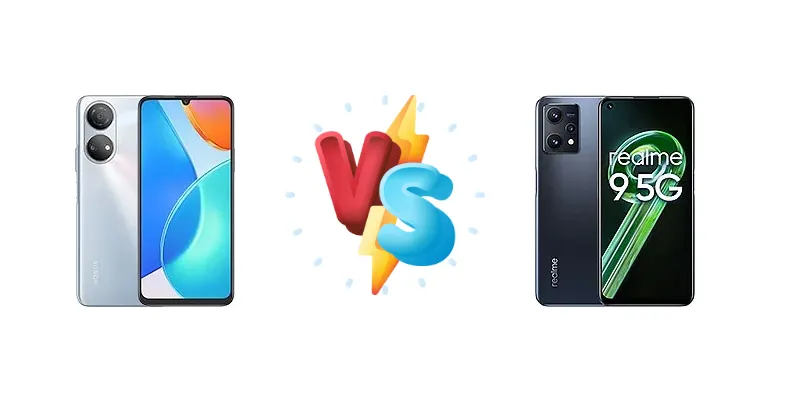
The Honor Play 30 Plus and Realme 9 5G represent compelling options in the increasingly competitive budget 5G smartphone market. Both aim to deliver 5G connectivity without breaking the bank, but they achieve this through different approaches to chipset selection and feature prioritization. This comparison dissects their core specifications to determine which device offers the best value for your money.
🏆 Quick Verdict
For the average user prioritizing sustained performance and efficiency, the Realme 9 5G is the better choice. Its Snapdragon 695, built on a 6nm process, offers a slight edge in power efficiency and potentially better thermal management compared to the Honor Play 30 Plus’s Dimensity 700. However, the Honor Play 30 Plus offers a slightly faster charging speed.
| Network |
|---|
| 2G bands | GSM 850 / 900 / 1800 / 1900 | GSM 850 / 900 / 1800 / 1900 |
| 3G bands | HSDPA 850 / 900 / 2100 | HSDPA 800 / 850 / 900 / 1700(AWS) / 1900 / 2100 |
| 4G bands | LTE | 1, 2, 3, 4, 5, 7, 8, 12, 13, 17, 18, 19, 20, 26, 28, 38, 39, 40, 41, 66 |
| 5G bands | SA/NSA | 1, 3, 5, 7, 8, 20, 28, 38, 40, 41, 66, 77, 78 SA/NSA |
| Speed | HSPA, LTE, 5G | HSPA, LTE, 5G |
| Technology | GSM / CDMA / HSPA / CDMA2000 / LTE / 5G | GSM / HSPA / LTE / 5G |
| | CDMA2000 1x | - |
| Launch |
|---|
| Announced | 2021, December 16 | 2022, May 12 |
| Status | Available. Released 2022, January 02 | Available. Released 2022, June 09 |
| Body |
|---|
| Build | Glass front, plastic back, plastic frame | - |
| Dimensions | 167.6 x 77.2 x 8.6 mm (6.60 x 3.04 x 0.34 in) | 164.3 x 75.6 x 8.5 mm (6.47 x 2.98 x 0.33 in) |
| SIM | Nano-SIM + Nano-SIM | Nano-SIM + Nano-SIM |
| Weight | 198 g (6.98 oz) | 191 g (6.74 oz) |
| Display |
|---|
| Resolution | 720 x 1600 pixels, 20:9 ratio (~260 ppi density) | 1080 x 2412 pixels, 20:9 ratio (~400 ppi density) |
| Size | 6.74 inches, 109.7 cm2 (~84.8% screen-to-body ratio) | 6.6 inches, 104.8 cm2 (~84.4% screen-to-body ratio) |
| Type | IPS LCD, 90Hz | IPS LCD, 120Hz, 600 nits (peak) |
| Platform |
|---|
| CPU | Octa-core (2x2.2 GHz Cortex-A76 & 6x2.0 GHz Cortex-A55) | Octa-core (2x2.2 GHz Kryo 660 Gold & 6x1.7 GHz Kryo 660 Silver) |
| Chipset | Mediatek Dimensity 700 (7 nm) | Qualcomm SM6375 Snapdragon 695 5G (6 nm) |
| GPU | Mali-G57 MC2 | Adreno 619 |
| OS | Android 11, Magic UI 5.0 | Android 12, Realme UI 3.0 |
| Memory |
|---|
| Card slot | microSDXC (uses shared SIM slot) | microSDXC (uses shared SIM slot) |
| Internal | 128GB 4GB RAM, 128GB 6GB RAM, 128GB 8GB RAM | 64GB 4GB RAM, 128GB 4GB RAM, 128GB 8GB RAM |
| | eMMC 5.1 | - |
| Main Camera |
|---|
| Dual | 13 MP, f/1.8, (wide), PDAF
Auxiliary lens | - |
| Features | LED flash, HDR, panorama | LED flash, HDR, panorama |
| Single | 5 MP, f/2.2, (wide) | - |
| Triple | - | 50 MP, f/1.8, 27mm (wide), 1/2.76", 0.64µm, PDAF
2 MP (macro)
Auxiliary lens |
| Video | 1080p@30fps | 1080p@30fps |
| Selfie camera |
|---|
| Features | - | HDR, panorama |
| Single | 5 MP, f/2.2, (wide) | 16 MP, f/2.1, 26mm (wide), 1/3.09", 1.0µm |
| Video | - | 1080p@30fps |
| Sound |
|---|
| 3.5mm jack | Yes | Yes |
| 35mm jack | Yes | Yes |
| Loudspeaker | Yes | Yes |
| Comms |
|---|
| Bluetooth | 5.1, A2DP, LE | 5.1, A2DP, LE, aptX HD |
| NFC | No | No |
| Positioning | GPS, BDS | GPS, GLONASS, BDS |
| Radio | No | No |
| USB | USB Type-C 2.0, OTG | USB Type-C 2.0, OTG |
| WLAN | Wi-Fi 802.11 a/b/g/n/ac, dual-band, Wi-Fi Direct | Wi-Fi 802.11 a/b/g/n/ac, dual-band |
| Features |
|---|
| Sensors | Fingerprint (side-mounted), accelerometer, proximity, compass | Fingerprint (side-mounted), accelerometer, gyro, proximity, compass |
| Battery |
|---|
| Charging | 22.5W wired | 18W wired |
| Type | Li-Po 5000 mAh | 5000 mAh |
| Misc |
|---|
| Colors | Black, Blue, Silver, Gold | Meteor Black, Stargaze White |
| Models | CMA-AN00 | RMX3474 |
| Price | About 150 EUR | About 190 EUR |
Honor Play 30 Plus
- Faster 22.5W wired charging
- Potentially lower price point
- Honor's typically clean software experience
- Less efficient Dimensity 700 chipset
- Potentially more thermal throttling under load
- Likely less refined image processing
Realme 9 5G
- More efficient Snapdragon 695 chipset
- Better multitasking and sustained performance
- Qualcomm's optimized ISP for image processing
- Slower 18W wired charging
- Realme UI can be feature-rich but bloated
- Potentially slightly higher price
Display Comparison
Neither device boasts a standout display. Given the limited data, we can assume both utilize LCD panels common in this price bracket. The focus here isn't on visual fidelity, but rather functionality. Bezels are likely comparable, and color accuracy will be standard for budget phones. Without specific display specs, the difference will be minimal for most users.
Camera Comparison
Without detailed camera specifications, a direct comparison is difficult. However, it’s safe to assume both phones feature a primary camera and supporting lenses for depth or macro photography. The image processing algorithms will likely differ, with Realme often leaning towards more vibrant, saturated images, while Honor tends towards a more natural look. The absence of OIS on either device suggests low-light performance will be limited. Focusing on the chipset's ISP capabilities, the Snapdragon 695's Spectra 340 ISP offers potentially faster image processing and better noise reduction.
Performance
The core battleground is the chipset. The Realme 9 5G’s Qualcomm Snapdragon 695 (6nm) has a clear architectural advantage over the Honor Play 30 Plus’s MediaTek Dimensity 700 (7nm). The smaller 6nm node generally translates to improved power efficiency and reduced heat generation. While both CPUs feature a 2x2.2 GHz core configuration, the Snapdragon 695’s Kryo 660 Gold cores are built on a more modern architecture than the Cortex-A76 cores in the Dimensity 700. This means the Realme 9 5G will likely handle sustained workloads and multitasking more effectively. The Dimensity 700 is still capable, but the Snapdragon 695 offers a more future-proof platform.
Battery Life
The Honor Play 30 Plus features 22.5W wired charging, a slight advantage over the Realme 9 5G’s 18W charging. This means the Honor Play 30 Plus will likely charge from 0-100% faster, assuming similar battery capacities (which are not specified). However, the Snapdragon 695’s superior power efficiency could offset the slower charging speed, resulting in comparable real-world battery life. The Realme 9 5G may last longer on a single charge during heavy use due to its more efficient processor.
Buying Guide
Buy the Honor Play 30 Plus if you prioritize faster wired charging and are primarily focused on basic smartphone tasks like calling, texting, and light social media use. Buy the Realme 9 5G if you value a more efficient processor for smoother multitasking, slightly better gaming performance, and potentially longer battery life during intensive use. The Realme 9 5G is the better all-rounder.
Frequently Asked Questions
❓ Will the Snapdragon 695 in the Realme 9 5G handle demanding games like PUBG Mobile smoothly?
The Snapdragon 695 is capable of running PUBG Mobile, but you'll likely need to stick to medium graphics settings for a consistently smooth experience. While not a gaming powerhouse, it offers a noticeable improvement over the Dimensity 700 in sustained performance, reducing the likelihood of frame drops during longer gaming sessions.
❓ How significant is the difference in charging speed between the 22.5W Honor Play 30 Plus and the 18W Realme 9 5G?
The 4.5W difference in charging wattage translates to roughly 15-20 minutes faster charging times for the Honor Play 30 Plus, assuming similar battery capacities. While noticeable, it's not a massive difference. The Realme 9 5G's more efficient processor may compensate for the slower charging by providing longer battery life overall.
❓ Does the Realme 9 5G support carrier aggregation for faster 5G speeds?
The Snapdragon 695 supports carrier aggregation, which allows it to combine multiple 5G channels for faster download and upload speeds. This is a significant advantage in areas with strong 5G coverage, providing a more reliable and responsive 5G experience compared to devices with limited carrier aggregation support.