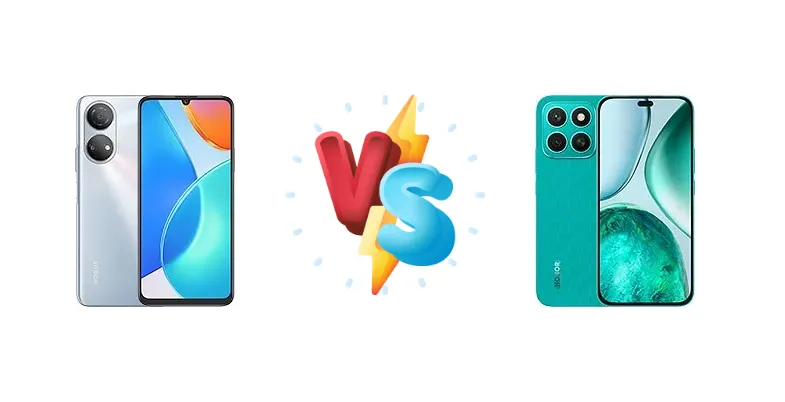
Honor's Play 30 Plus and X8c represent compelling options in the ultra-budget smartphone space, but cater to slightly different priorities. The Play 30 Plus leverages MediaTek's Dimensity 700, a 7nm chip, while the X8c opts for Qualcomm's 6nm Snapdragon 685. This comparison dives deep into the architectural differences and real-world implications of these chipsets, alongside battery, charging, and overall value.
🏆 Quick Verdict
For most users, the Honor X8c emerges as the better choice. Its Snapdragon 685, built on a more efficient 6nm process, offers a noticeable performance advantage in sustained tasks and better power management. The significantly faster 35W charging also provides a crucial convenience factor, offsetting the Play 30 Plus's slightly lower price.
| Network |
|---|
| 2G bands | GSM 850 / 900 / 1800 / 1900 | GSM 850 / 900 / 1800 / 1900 |
| 3G bands | HSDPA 850 / 900 / 2100 | HSDPA 850 / 900 / 1900 / 2100 |
| 4G bands | LTE | LTE |
| 5G bands | SA/NSA | - |
| Speed | HSPA, LTE, 5G | HSPA, LTE |
| Technology | GSM / CDMA / HSPA / CDMA2000 / LTE / 5G | GSM / HSPA / LTE |
| | CDMA2000 1x | - |
| Launch |
|---|
| Announced | 2021, December 16 | 2025, January 14 |
| Status | Available. Released 2022, January 02 | Available. Released 2025, January 20 |
| Body |
|---|
| Build | Glass front, plastic back, plastic frame | Glass front, plastic frame, plastic back or silicone polymer back (eco leather) |
| Dimensions | 167.6 x 77.2 x 8.6 mm (6.60 x 3.04 x 0.34 in) | 161.1 x 74.6 x 7.1 mm (6.34 x 2.94 x 0.28 in) |
| SIM | Nano-SIM + Nano-SIM | Nano-SIM + Nano-SIM |
| Weight | 198 g (6.98 oz) | 174 g (6.14 oz) |
| Display |
|---|
| Resolution | 720 x 1600 pixels, 20:9 ratio (~260 ppi density) | 1080 x 2412 pixels, 20:9 ratio (~394 ppi density) |
| Size | 6.74 inches, 109.7 cm2 (~84.8% screen-to-body ratio) | 6.7 inches, 108.0 cm2 (~89.9% screen-to-body ratio) |
| Type | IPS LCD, 90Hz | AMOLED, 120Hz, 1200 nits (HBM), 2800 nits (peak) |
| Platform |
|---|
| CPU | Octa-core (2x2.2 GHz Cortex-A76 & 6x2.0 GHz Cortex-A55) | Octa-core (4x2.8 GHz Cortex-A73 & 4x1.9 GHz Cortex-A53) |
| Chipset | Mediatek Dimensity 700 (7 nm) | Qualcomm SM6225 Snapdragon 685 (6 nm) |
| GPU | Mali-G57 MC2 | Adreno 610 |
| OS | Android 11, Magic UI 5.0 | Android 15, MagicOS 9 |
| Memory |
|---|
| Card slot | microSDXC (uses shared SIM slot) | No |
| Internal | 128GB 4GB RAM, 128GB 6GB RAM, 128GB 8GB RAM | 128GB 6GB RAM, 128GB 8GB RAM, 256GB 8GB RAM, 512GB 8GB RAM |
| | eMMC 5.1 | - |
| Main Camera |
|---|
| Dual | 13 MP, f/1.8, (wide), PDAF
Auxiliary lens | 108 MP, f/1.8, 24mm (wide), 1/1.67", PDAF, OIS
5 MP, f/2.2, (ultrawide) |
| Features | LED flash, HDR, panorama | LED flash, HDR, panorama |
| Single | 5 MP, f/2.2, (wide) | - |
| Video | 1080p@30fps | 1080p@30fps, gyro-EIS |
| Selfie camera |
|---|
| Single | 5 MP, f/2.2, (wide) | 50 MP, f/2.1, (wide) |
| Video | - | 1080p@30fps |
| Sound |
|---|
| 3.5mm jack | Yes | - |
| 35mm jack | Yes | No |
| Loudspeaker | Yes | Yes |
| Comms |
|---|
| Bluetooth | 5.1, A2DP, LE | 5.0/5.1, A2DP, LE |
| NFC | No | Yes (market/region dependent) |
| Positioning | GPS, BDS | GPS, GLONASS, GALILEO, BDS |
| Radio | No | No |
| USB | USB Type-C 2.0, OTG | USB Type-C 2.0, OTG |
| WLAN | Wi-Fi 802.11 a/b/g/n/ac, dual-band, Wi-Fi Direct | Wi-Fi 802.11 a/b/g/n/ac, dual-band, Wi-Fi Direct |
| Features |
|---|
| Sensors | Fingerprint (side-mounted), accelerometer, proximity, compass | Fingerprint (under display, optical), accelerometer, gyro, compass, proximity (ultrasonic) |
| Battery |
|---|
| Charging | 22.5W wired | 35W wired |
| Type | Li-Po 5000 mAh | Li-Po 5000 mAh |
| Misc |
|---|
| Colors | Black, Blue, Silver, Gold | Marrs Green, Midnight Black, Moonlight White, Cloud Purple |
| Models | CMA-AN00 | ABR-LX1, ABR-LX2, ABR-LX3 |
| Price | About 150 EUR | € 190.78 / $ 213.42 / £ 159.00 |
Honor Play 30 Plus
- Potentially lower price point
- Sufficient for basic tasks
- MediaTek Dimensity 700 is a proven performer for its class
- Slower charging speed (22.5W)
- Less efficient 7nm chipset
- Likely lower sustained performance
Honor X8c
- More efficient 6nm Snapdragon 685
- Faster 35W charging
- Superior multi-core performance
- Potentially slightly higher price
- Cortex-A73 cores are older architecture than A76
- May not offer a dramatically better camera experience
Display Comparison
Neither Honor provides display specifications beyond resolution. However, the choice of chipsets hints at display capabilities. The Snapdragon 685 often pairs with higher refresh rate panels, though not guaranteed here. The 6nm process allows for more efficient display driving. The Play 30 Plus, with the older 7nm Dimensity 700, may have a slightly less vibrant or responsive display experience, though this is speculative without further data.
Camera Comparison
Without detailed camera specs, a direct comparison is difficult. However, the chipset plays a role in image signal processing (ISP) capabilities. Qualcomm's Snapdragon ISPs generally offer more advanced features and better noise reduction. It's likely the X8c will produce slightly better image quality, particularly in low-light conditions, due to the more modern ISP. The presence of a dedicated ISP on the Snapdragon 685 allows for faster image processing and potentially better video recording capabilities.
Performance
The core difference lies in the chipsets. The Mediatek Dimensity 700 utilizes two Cortex-A76 cores clocked at 2.2 GHz, paired with six Cortex-A55 cores at 2.0 GHz. The Honor X8c’s Snapdragon 685 features four Cortex-A73 cores at 2.8 GHz and four Cortex-A53 cores at 1.9 GHz. While the Snapdragon 685 has a lower clock speed on its prime cores, the architectural improvements of the Cortex-A73, combined with the 6nm fabrication process, result in superior single-core and multi-core performance. This translates to snappier app launches and smoother multitasking. The 6nm process also contributes to better thermal efficiency, reducing the likelihood of performance throttling during extended use.
Battery Life
Both phones likely feature similar battery capacities, given their market segment. However, the X8c’s 35W wired charging is a significant advantage over the Play 30 Plus’s 22.5W charging. This means the X8c can replenish its battery much faster, reducing downtime. While a larger battery capacity is ideal, the faster charging speed of the X8c effectively mitigates any potential difference in battery life, offering a more convenient user experience.
Buying Guide
Buy the Honor Play 30 Plus if your primary need is basic smartphone functionality – calls, texts, and light social media – and you're on an extremely tight budget. Its Dimensity 700 is sufficient for these tasks. Buy the Honor X8c if you prioritize smoother multitasking, occasional gaming, and faster charging, even if it means spending a little more. The Snapdragon 685 provides a more future-proof experience and reduces frustration with lag.
Frequently Asked Questions
❓ Will the Snapdragon 685 in the X8c handle demanding games like PUBG Mobile?
The Snapdragon 685 can run PUBG Mobile, but likely at medium settings to maintain a stable frame rate. The Dimensity 700 in the Play 30 Plus will also run it, but may experience more frequent frame drops and require lower settings. The X8c's better thermal management will also contribute to more consistent performance during longer gaming sessions.
❓ How much faster is the 35W charging on the X8c compared to the 22.5W on the Play 30 Plus?
The 35W charging on the X8c will significantly reduce charging times. Expect a 0-100% charge in approximately 60-75 minutes, compared to potentially 90-120 minutes on the Play 30 Plus. This difference is particularly noticeable for users who frequently need to top up their battery quickly.
❓ Is the 6nm process of the Snapdragon 685 a significant advantage over the 7nm Dimensity 700?
Yes, the 6nm process is more efficient, meaning the Snapdragon 685 consumes less power for the same level of performance. This translates to better battery life and reduced heat generation, leading to more sustained performance without throttling. While the difference may not be dramatic in everyday use, it's a key advantage for demanding tasks.