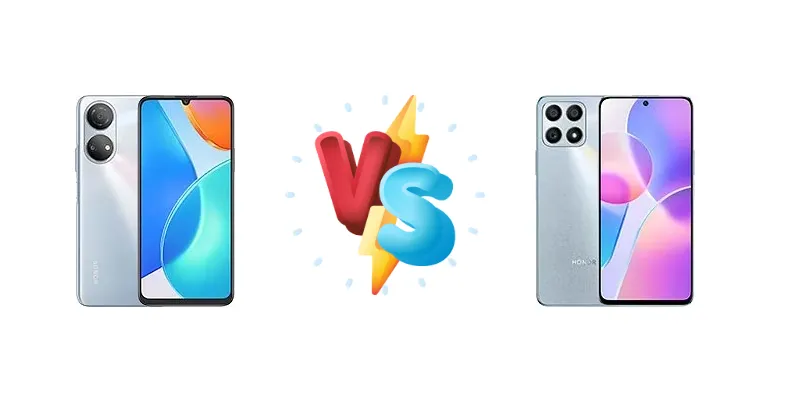
Honor's Play and X series consistently deliver compelling value in the budget smartphone space. The Play 30 Plus and X30i represent two distinct approaches to affordability, both powered by Mediatek Dimensity chips. This comparison dissects their key differences, focusing on performance, battery life, and overall user experience to determine which device offers the most bang for your buck.
🏆 Quick Verdict
For most users, the Honor X30i emerges as the better choice. Its Dimensity 810, built on a more efficient 6nm process, provides a noticeable performance uplift over the Play 30 Plus’s Dimensity 700. While both share the same 22.5W charging, the X30i’s improved chipset translates to smoother multitasking and a more responsive experience.
| Network |
|---|
| 2G bands | GSM 850 / 900 / 1800 / 1900 | GSM 850 / 900 / 1800 / 1900 |
| 3G bands | HSDPA 850 / 900 / 2100 | HSDPA 850 / 900 / 1700(AWS) / 1900 / 2100 |
| 4G bands | LTE | LTE |
| 5G bands | SA/NSA | SA/NSA |
| Speed | HSPA, LTE, 5G | HSPA, LTE, 5G |
| Technology | GSM / CDMA / HSPA / CDMA2000 / LTE / 5G | GSM / CDMA / HSPA / CDMA2000 / LTE / 5G |
| | CDMA2000 1x | CDMA2000 1x |
| Launch |
|---|
| Announced | 2021, December 16 | 2021, October 28 |
| Status | Available. Released 2022, January 02 | Available. Released 2021, November 02 |
| Body |
|---|
| Build | Glass front, plastic back, plastic frame | Glass front, plastic frame, plastic back |
| Dimensions | 167.6 x 77.2 x 8.6 mm (6.60 x 3.04 x 0.34 in) | 163.4 x 74.7 x 7.5 mm (6.43 x 2.94 x 0.30 in) |
| SIM | Nano-SIM + Nano-SIM | Nano-SIM + Nano-SIM |
| Weight | 198 g (6.98 oz) | 175 g (6.17 oz) |
| Display |
|---|
| Resolution | 720 x 1600 pixels, 20:9 ratio (~260 ppi density) | 1080 x 2388 pixels (~391 ppi density) |
| Size | 6.74 inches, 109.7 cm2 (~84.8% screen-to-body ratio) | 6.7 inches, 108.7 cm2 (~89.1% screen-to-body ratio) |
| Type | IPS LCD, 90Hz | IPS LCD, 90Hz |
| Platform |
|---|
| CPU | Octa-core (2x2.2 GHz Cortex-A76 & 6x2.0 GHz Cortex-A55) | Octa-core (2x2.4 GHz Cortex-A76 & 6x2.0 GHz Cortex-A55) |
| Chipset | Mediatek Dimensity 700 (7 nm) | Mediatek Dimensity 810 (6 nm) |
| GPU | Mali-G57 MC2 | Mali-G57 MC2 |
| OS | Android 11, Magic UI 5.0 | Android 11, Magic UI 5.0 |
| Memory |
|---|
| Card slot | microSDXC (uses shared SIM slot) | No |
| Internal | 128GB 4GB RAM, 128GB 6GB RAM, 128GB 8GB RAM | 128GB 6GB RAM, 128GB 8GB RAM, 256GB 8GB RAM |
| | eMMC 5.1 | - |
| Main Camera |
|---|
| Dual | 13 MP, f/1.8, (wide), PDAF
Auxiliary lens | - |
| Features | LED flash, HDR, panorama | LED flash, panorama, HDR |
| Single | 5 MP, f/2.2, (wide) | 8 MP, f/2.0 |
| Triple | - | 48 MP, f/1.8, 26mm (wide), PDAF
2 MP (macro)
Auxiliary lens |
| Video | 1080p@30fps | 1080p@30fps |
| Selfie camera |
|---|
| Single | 5 MP, f/2.2, (wide) | 8 MP, f/2.0 |
| Video | - | 1080p@30fps |
| Sound |
|---|
| 3.5mm jack | Yes | Yes |
| 35mm jack | Yes | Yes |
| Loudspeaker | Yes | Yes, with dual speakers |
| Comms |
|---|
| Bluetooth | 5.1, A2DP, LE | 5.1, A2DP, LE |
| NFC | No | No |
| Positioning | GPS, BDS | GPS, GLONASS, BDS |
| Radio | No | No |
| USB | USB Type-C 2.0, OTG | USB Type-C 2.0, OTG |
| WLAN | Wi-Fi 802.11 a/b/g/n/ac, dual-band, Wi-Fi Direct | Wi-Fi 802.11 a/b/g/n/ac, dual-band, Wi-Fi Direct |
| Features |
|---|
| Sensors | Fingerprint (side-mounted), accelerometer, proximity, compass | Fingerprint (side-mounted), accelerometer, compass |
| Battery |
|---|
| Charging | 22.5W wired | 22.5W wired |
| Type | Li-Po 5000 mAh | Li-Po 4000 mAh |
| Misc |
|---|
| Colors | Black, Blue, Silver, Gold | Black, Blue, Silver, Rose Gold |
| Models | CMA-AN00 | TFY-AN00 |
| Price | About 150 EUR | About 190 EUR |
Honor Play 30 Plus
- Potentially lower price point
- Sufficient for basic smartphone tasks
- Reliable Mediatek Dimensity 700 chipset
- Less powerful chipset compared to X30i
- May struggle with demanding games
- Potentially shorter battery life
Honor X30i
- More powerful Mediatek Dimensity 810 chipset
- Improved power efficiency for longer battery life
- Smoother multitasking and gaming experience
- Potentially higher price
- May not offer a significant camera upgrade
- Still relies on LCD panel technology
Display Comparison
Both devices likely feature LCD panels, a common trait in this price bracket. However, detailed display specs like resolution and peak brightness are missing. The X30i’s chipset, being newer, *could* indicate slightly better image processing capabilities, potentially leading to more vibrant colors. Bezels are likely similar, focusing on maximizing screen real estate within the budget constraints. Without specific data, it's difficult to definitively declare a winner; both will likely offer adequate, but not exceptional, viewing experiences.
Camera Comparison
Without detailed camera sensor information, a direct comparison is challenging. It’s safe to assume both phones feature a multi-camera setup, likely with a primary sensor and depth/macro lenses. Given the price point, image quality will heavily rely on software processing. The Dimensity 810’s improved ISP (Image Signal Processor) in the X30i *could* contribute to better dynamic range and noise reduction, but this is speculative. The presence of a 2MP macro lens on either device is largely a marketing feature with limited practical utility; focusing on the primary sensor’s quality is more important.
Performance
The core difference lies in the chipsets. The Honor X30i’s Mediatek Dimensity 810 (6nm) is a clear upgrade over the Play 30 Plus’s Dimensity 700 (7nm). The 6nm process inherently offers better power efficiency, translating to less heat generation and potentially sustained performance during demanding tasks. While both CPUs share the same Cortex-A76 and A55 core configuration, the X30i’s higher clock speeds (2.4 GHz vs 2.2 GHz) on the A76 cores provide a measurable performance boost. This benefits gaming, app loading times, and overall system responsiveness. The X30i will handle graphically intensive games with fewer stutters and maintain smoother frame rates.
Battery Life
Both phones share the same 22.5W wired charging, suggesting similar charging speeds – approximately 1.5 to 2 hours for a full charge. Battery capacity is not specified, but the Dimensity 810’s superior power efficiency in the X30i will likely result in longer battery life during typical usage. The 6nm process allows the X30i to accomplish the same tasks using less power, extending the time between charges. Users prioritizing all-day battery life will likely find the X30i more reliable.
Buying Guide
Buy the Honor Play 30 Plus if you prioritize a slightly lower initial cost and are primarily focused on basic smartphone tasks like calling, texting, and light social media use. Buy the Honor X30i if you value a more fluid user experience, enjoy occasional gaming, or frequently multitask between applications – the Dimensity 810 offers a tangible performance advantage worth the potential price difference.
Frequently Asked Questions
❓ Will the Honor X30i handle popular games like PUBG Mobile smoothly?
The Dimensity 810 in the X30i is capable of running PUBG Mobile at medium to high settings with reasonable frame rates. While it won't deliver a flagship gaming experience, it offers a significantly smoother experience than the Play 30 Plus, minimizing lag and stuttering during gameplay.
❓ Is the 22.5W charging fast enough for quick top-ups?
22.5W charging is considered moderate for today's standards. Both phones will take approximately 1.5 to 2 hours for a full charge. However, it's sufficient for quickly topping up the battery when needed, providing several hours of usage with a short charging session.
❓ How much of a real-world performance difference will I notice between the Dimensity 700 and 810?
You'll notice a tangible difference in everyday tasks. The X30i will feel snappier when opening apps, multitasking, and browsing the web. The Dimensity 810's improved CPU and GPU performance translates to a more responsive and fluid user experience, especially noticeable when switching between applications.
❓ Are there any significant differences in software features between the two devices?
Both devices likely run Honor's Magic UI based on Android. Software features are likely very similar, with any differences stemming from minor optimizations related to the different chipsets. Expect a similar user interface and pre-installed apps on both phones.