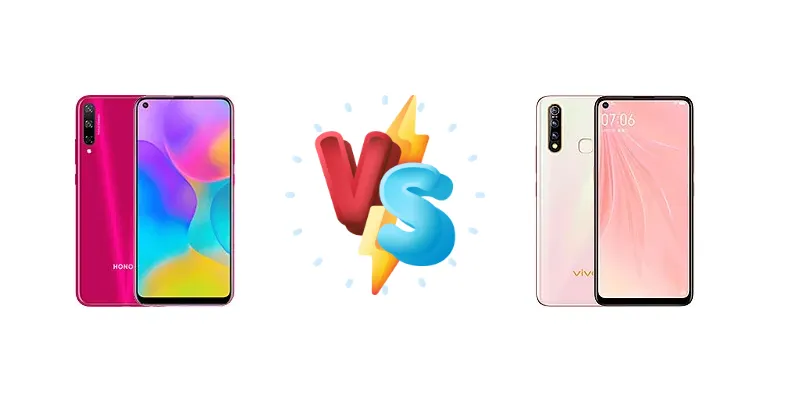
The Honor Play 3 and vivo Z5x (2020) represent compelling options in the crowded budget smartphone market. Both aim to deliver a solid experience without breaking the bank, but they take different approaches. The Honor Play 3 relies on Huawei’s Kirin 710F, while the vivo Z5x (2020) opts for Qualcomm’s Snapdragon 712. This comparison will dissect the key differences to determine which device offers the most bang for your buck.
🏆 Quick Verdict
For the average user prioritizing consistent performance and faster charging, the vivo Z5x (2020) is the better choice. Its Snapdragon 712, built on a more efficient 10nm process, provides a noticeable edge in both everyday tasks and gaming, and the 18W charging significantly reduces downtime compared to the Honor Play 3’s 10W charging.
| Network |
|---|
| 2G bands | GSM 850 / 900 / 1800 / 1900 | GSM 850 / 900 / 1800 / 1900 |
| 3G bands | HSDPA 850 / 900 / 1900 / 2100 | HSDPA 850 / 900 / 2100 |
| 4G bands | 1, 3, 5, 7, 8, 34, 38, 39, 40, 41 | 1, 3, 4, 5, 8, 34, 38, 39, 40, 41 |
| Speed | HSPA 42.2/5.76 Mbps, LTE (2CA) Cat6 400/50 Mbps | HSPA, LTE |
| Technology | GSM / CDMA / HSPA / LTE | GSM / CDMA / HSPA / LTE |
| | CDMA 800 & TD-SCDMA | CDMA 800 & TD-SCDMA |
| Launch |
|---|
| Announced | 2019, September. Released 2019, September | 2020, June 09. Released 2020, June 09 |
| Status | Discontinued | Discontinued |
| Body |
|---|
| Build | Glass front, plastic back, plastic frame | Glass front, plastic back, plastic frame |
| Dimensions | 159.8 x 76.1 x 8.1 mm (6.29 x 3.00 x 0.32 in) | 162.4 x 77.3 x 8.9 mm (6.39 x 3.04 x 0.35 in) |
| SIM | Nano-SIM + Nano-SIM | Nano-SIM + Nano-SIM |
| Weight | 176 g (6.21 oz) | 204.1 g (7.20 oz) |
| | IP5X (dust), IPX4 (water) resistance | - |
| Display |
|---|
| Resolution | 720 x 1560 pixels, 19.5:9 ratio (~269 ppi density) | 1080 x 2340 pixels, 19.5:9 ratio (~395 ppi density) |
| Size | 6.39 inches, 100.2 cm2 (~82.4% screen-to-body ratio) | 6.53 inches, 104.7 cm2 (~83.4% screen-to-body ratio) |
| Type | IPS LCD | IPS LCD |
| Platform |
|---|
| CPU | Octa-core (4x2.2 GHz Cortex-A73 & 4x1.7 GHz Cortex-A53) | Octa-core (2x2.3 GHz Kryo 360 Gold & 6x1.7 GHz Kryo 360 Silver) |
| Chipset | Kirin 710F (12 nm) | Qualcomm SDM712 Snapdragon 712 (10 nm) |
| GPU | Mali-G51 MP4 | Adreno 616 |
| OS | Android 9.0 (Pie), EMUI 9.1 | Android 9.0 (Pie), upgradable to Android 10, Funtouch 10 |
| Memory |
|---|
| Card slot | microSDXC (uses shared SIM slot) | microSDXC (dedicated slot) |
| Internal | 64GB 4GB RAM, 64GB 6GB RAM, 128GB 4GB RAM | 64GB 4GB RAM, 64GB 6GB RAM, 128GB 8GB RAM |
| Main Camera |
|---|
| Features | LED flash, HDR, panorama | LED flash, HDR, panorama |
| Triple | 48 MP, f/1.8, 27mm (wide), 1/2.0", 0.8µm, PDAF
8 MP, f/2.4, 13mm (ultrawide), 1/4.0", 1.12µm
Auxiliary lens | 16 MP, f/1.8, (wide), 1/2.8", 1.12µm, AF
8 MP, f/2.2, 16mm (ultrawide), 1/4.0", 1.12µm
Auxiliary lens |
| Video | 1080p@30fps | 1080p@30fps |
| Selfie camera |
|---|
| Features | HDR | - |
| Single | 8 MP, f/2.0 | 16 MP, f/2.0, 26mm (wide), 1/3.06", 1.0µm |
| Video | 1080p@30fps | 1080p@30fps |
| Sound |
|---|
| 3.5mm jack | Yes | Yes |
| 35mm jack | Yes | Yes |
| Loudspeaker | Yes | Yes |
| Comms |
|---|
| Bluetooth | 5.0, A2DP, LE | 5.0, A2DP, LE |
| NFC | No | No |
| Positioning | GPS, GLONASS, BDS | GPS, GLONASS, BDS |
| Radio | FM radio | No |
| USB | microUSB 2.0, OTG | microUSB 2.0, OTG |
| WLAN | Wi-Fi 802.11 b/g/n, Wi-Fi Direct | Wi-Fi 802.11 a/b/g/n/ac, dual-band, Wi-Fi Direct |
| Features |
|---|
| Sensors | Accelerometer, proximity, compass | Fingerprint (rear-mounted), accelerometer, gyro, proximity, compass |
| Battery |
|---|
| Charging | 10W wired | 18W wired |
| Type | Li-Po 4000 mAh, non-removable | 5000 mAh |
| Misc |
|---|
| Colors | Magic Night Black, Aurora Blue, Charm Red | Black, Blue, White, Dark Blue |
| Models | ASK-AL00x | - |
| Price | About 130 EUR | About 160 EUR |
Honor Play 3
- Potentially lower price point.
- Familiar EMUI software (depending on region).
- May offer a slightly longer battery life due to potentially larger capacity (speculation).
- Less powerful Kirin 710F chipset.
- Slower 10W charging.
- 12nm process node leads to potential thermal throttling.
vivo Z5x (2020)
- More powerful Snapdragon 712 chipset.
- Faster 18W charging.
- 10nm process node for improved efficiency.
- May be slightly more expensive.
- Funtouch OS may not appeal to all users.
- Potentially smaller battery capacity (speculation).
Display Comparison
Neither device boasts a standout display. Given the context data focuses on internal components, we can infer both likely utilize LCD panels common in this price bracket. The absence of information regarding refresh rates suggests both are likely 60Hz. Bezels are expected to be noticeable on both, typical of budget devices. Color accuracy will likely be adequate but not exceptional, geared towards vibrant rather than color-accurate visuals.
Camera Comparison
Without detailed camera specifications, a direct comparison is difficult. However, it’s safe to assume both phones feature multi-camera setups geared towards versatility rather than exceptional image quality. The market segment suggests both will include a primary sensor, an ultrawide, and potentially a depth sensor. The absence of OIS on either device indicates reliance on software processing for stabilization. Image processing styles will likely differ – Honor typically leans towards vibrant colors, while vivo often aims for a more natural look. The usefulness of any 2MP macro lens included on either device is questionable, offering limited detail and often serving as a marketing feature rather than a practical tool.
Performance
The core difference lies in the chipsets. The vivo Z5x (2020)’s Snapdragon 712 (10nm) offers a clear advantage over the Honor Play 3’s Kirin 710F (12nm). The 10nm process node allows for greater transistor density and improved thermal efficiency, meaning the Snapdragon 712 can sustain peak performance for longer periods without throttling. While both CPUs feature octa-core configurations, the Snapdragon 712’s Kryo 360 Gold cores, clocked at 2.3 GHz, provide a performance boost over the Kirin 710F’s Cortex-A73 cores at 2.2 GHz. This translates to snappier app launches, smoother multitasking, and a more enjoyable gaming experience on the vivo Z5x (2020).
Battery Life
While the exact battery capacities are unknown, the charging speeds reveal a significant difference. The vivo Z5x (2020)’s 18W wired charging is considerably faster than the Honor Play 3’s 10W charging. This means the vivo Z5x (2020) can replenish its battery much more quickly, reducing downtime. Even if the Honor Play 3 has a slightly larger battery capacity, the slower charging speed will likely negate that advantage for users who frequently top up their phones throughout the day.
Buying Guide
Buy the Honor Play 3 if you prioritize a potentially lower price point and are a very casual smartphone user who primarily focuses on basic tasks like calls, texts, and light social media. Buy the vivo Z5x (2020) if you prefer a smoother, more responsive experience, enjoy mobile gaming, and value faster charging speeds to minimize interruptions.
Frequently Asked Questions
❓ Will the Snapdragon 712 in the vivo Z5x (2020) handle demanding games like PUBG Mobile smoothly?
Yes, the Snapdragon 712 is capable of running PUBG Mobile at medium to high settings with stable frame rates. The Adreno 616 GPU provides sufficient graphical power for a smooth gaming experience, and the 10nm process helps prevent overheating during extended gaming sessions.
❓ How long will it take to fully charge the Honor Play 3 with its 10W charging?
Given the 10W charging speed, a full charge from 0% to 100% on the Honor Play 3 will likely take around 2.5 to 3.5 hours, depending on the battery capacity. This is significantly slower than the vivo Z5x (2020)'s 18W charging.
❓ Is the software experience significantly different between Honor's EMUI and vivo's Funtouch OS?
Yes, EMUI and Funtouch OS offer distinct user experiences. EMUI is known for its customization options and feature-rich interface, while Funtouch OS historically prioritized simplicity and speed. Recent versions of Funtouch OS have become more refined, but user preference will ultimately determine which interface is more appealing.