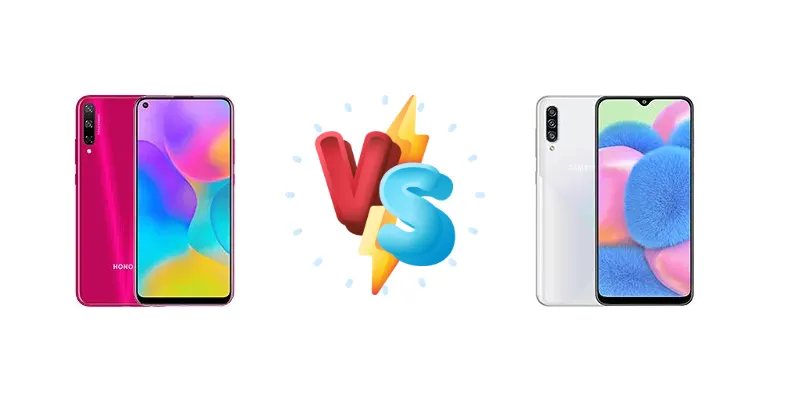
The Honor Play 3 and Samsung Galaxy A30s represent compelling options in the sub-$200 smartphone market. While both aim to deliver essential features at an accessible price, they diverge in their core hardware choices. This comparison dissects the differences between the Kirin 710F-powered Honor and the Exynos 7904-equipped Samsung, focusing on performance, battery life, and overall value.
🏆 Quick Verdict
For the average user prioritizing consistent performance and slightly faster charging, the Samsung Galaxy A30s emerges as the better choice. Its Exynos 7904, built on a smaller 14nm process, offers a marginal performance edge and the 15W charging is a welcome improvement over the Honor Play 3’s 10W.
| Network |
|---|
| 2G bands | GSM 850 / 900 / 1800 / 1900 | GSM 850 / 900 / 1800 / 1900 |
| 3G bands | HSDPA 850 / 900 / 1900 / 2100 | HSDPA 850 / 900 / 1700(AWS) / 1900 / 2100 |
| 4G bands | 1, 3, 5, 7, 8, 34, 38, 39, 40, 41 | 1, 2, 3, 4, 5, 7, 8, 12, 13, 17, 20, 28, 38, 40, 41, 66 |
| Speed | HSPA 42.2/5.76 Mbps, LTE (2CA) Cat6 400/50 Mbps | HSPA, LTE |
| Technology | GSM / CDMA / HSPA / LTE | GSM / HSPA / LTE |
| | CDMA 800 & TD-SCDMA | - |
| Launch |
|---|
| Announced | 2019, September. Released 2019, September | 2019, August 22. Released 2019, September 11 |
| Status | Discontinued | Discontinued |
| Body |
|---|
| Build | Glass front, plastic back, plastic frame | Glass front, plastic back, plastic frame |
| Dimensions | 159.8 x 76.1 x 8.1 mm (6.29 x 3.00 x 0.32 in) | 158.5 x 74.7 x 7.8 mm (6.24 x 2.94 x 0.31 in) |
| SIM | Nano-SIM + Nano-SIM | · Nano-SIM· Nano-SIM + Nano-SIM |
| Weight | 176 g (6.21 oz) | 169 g (5.96 oz) |
| | IP5X (dust), IPX4 (water) resistance | - |
| Display |
|---|
| Protection | - | Asahi Dragontrail Glass |
| Resolution | 720 x 1560 pixels, 19.5:9 ratio (~269 ppi density) | 720 x 1560 pixels, 19.5:9 ratio (~268 ppi density) |
| Size | 6.39 inches, 100.2 cm2 (~82.4% screen-to-body ratio) | 6.4 inches, 100.5 cm2 (~84.9% screen-to-body ratio) |
| Type | IPS LCD | Super AMOLED |
| Platform |
|---|
| CPU | Octa-core (4x2.2 GHz Cortex-A73 & 4x1.7 GHz Cortex-A53) | Octa-core (2x1.8 GHz Cortex-A73 & 6x1.6 GHz Cortex-A53) |
| Chipset | Kirin 710F (12 nm) | Exynos 7904 (14 nm) |
| GPU | Mali-G51 MP4 | Mali-G71 MP2 |
| OS | Android 9.0 (Pie), EMUI 9.1 | Android 9.0 (Pie), upgradable to Android 11, One UI 3.1 |
| Memory |
|---|
| Card slot | microSDXC (uses shared SIM slot) | microSDXC (dedicated slot) |
| Internal | 64GB 4GB RAM, 64GB 6GB RAM, 128GB 4GB RAM | 32GB 3GB RAM, 64GB 4GB RAM, 128GB 4GB RAM |
| | - | eMMC 5.1 |
| Main Camera |
|---|
| Features | LED flash, HDR, panorama | LED flash, panorama, HDR |
| Single | - | 13 MP, AF |
| Triple | 48 MP, f/1.8, 27mm (wide), 1/2.0", 0.8µm, PDAF
8 MP, f/2.4, 13mm (ultrawide), 1/4.0", 1.12µm
Auxiliary lens | 25 MP, f/1.7, 27mm (wide), PDAF
8 MP, f/2.2, 13mm (ultrawide), 1/4.0", 1.12µm
Auxiliary lens |
| Video | 1080p@30fps | 1080p@30fps |
| Selfie camera |
|---|
| Features | HDR | - |
| Single | 8 MP, f/2.0 | 16 MP, f/2.0, 26mm (wide), 1/3.06", 1.0µm |
| Video | 1080p@30fps | 1080p@30fps |
| Sound |
|---|
| 3.5mm jack | Yes | Yes |
| 35mm jack | Yes | Yes |
| Loudspeaker | Yes | Yes |
| Comms |
|---|
| Bluetooth | 5.0, A2DP, LE | 5.0, A2DP, LE |
| Infrared port | - | Yes |
| NFC | No | Yes (market/region dependent) |
| Positioning | GPS, GLONASS, BDS | GPS, GLONASS, GALILEO, BDS |
| Radio | FM radio | FM radio |
| USB | microUSB 2.0, OTG | USB Type-C 2.0, OTG |
| WLAN | Wi-Fi 802.11 b/g/n, Wi-Fi Direct | Wi-Fi 802.11 a/b/g/n/ac, dual-band, Wi-Fi Direct |
| Features |
|---|
| Sensors | Accelerometer, proximity, compass | Fingerprint (under display, optical), accelerometer, gyro, proximity, compass |
| Battery |
|---|
| Charging | 10W wired | 15W wired |
| Type | Li-Po 4000 mAh, non-removable | Li-Po 4000 mAh, non-removable |
| Misc |
|---|
| Colors | Magic Night Black, Aurora Blue, Charm Red | Prism Crush Black, Prism Crush White, Prism Crush Green, Prism Crush Violet2 |
| Models | ASK-AL00x | SM-A307F, SM-A307FN, SM-A307G, SM-A307GN, SM-A307GT |
| Price | About 130 EUR | About 260 EUR |
| SAR | - | 0.87 W/kg (head) 0.43 W/kg (body) |
| SAR EU | - | 1.05 W/kg (head) 1.54 W/kg (body) |
| Pricing |
|---|
| 128GB 4GB RAM | - | $ 194.02 |
| 64GB 4GB RAM | - | $ 269.99 |
| RENEWED | - | £ 120.00 |
Honor Play 3
- Potentially more efficient chipset (12nm)
- Honor’s UI may appeal to some users
- Competitive price point
- Slower 10W charging
- Likely less refined camera software
- Performance may lag behind the A30s in demanding tasks
Samsung Galaxy A30s
- Faster 15W charging
- Exynos 7904 offers a slight performance edge
- Samsung’s established camera software
- Built on a larger 14nm process
- May be slightly more expensive depending on retailer
- Samsung’s UI can be bloated for some users
Display Comparison
Neither device boasts a standout display. Both likely utilize LCD panels, common in this price bracket. The absence of detailed display specs necessitates relying on brand tendencies; Samsung generally offers slightly more color-accurate displays. However, the real difference lies elsewhere. The A30s’s display is likely optimized for Samsung’s image processing, while the Honor Play 3’s will lean towards Honor’s color science. Bezels are expected to be comparable, and neither phone features high refresh rates or advanced panel technologies like LTPO.
Camera Comparison
Camera performance is difficult to assess without detailed sensor information. Both phones likely feature a primary camera alongside depth and macro sensors (the latter often being of limited utility). The A30s’s image processing benefits from Samsung’s established algorithms, potentially delivering more pleasing results in various lighting conditions. The Honor Play 3’s camera will rely on Honor’s software optimizations. Given the price point, expect similar levels of detail and dynamic range, with the A30s potentially having a slight advantage in software-driven enhancements.
Performance
The core of the difference lies in the chipsets. The Samsung Galaxy A30s’s Exynos 7904 (14nm) features a dual-core Cortex-A73 setup paired with six Cortex-A53 cores, while the Honor Play 3 utilizes the Kirin 710F (12nm) with a quad-core Cortex-A73 and quad-core Cortex-A53 configuration. While core counts aren’t everything, the 14nm process of the Exynos generally translates to slightly better sustained performance under load, despite the Kirin having a more efficient node. The A30s’s CPU configuration suggests a slight advantage in multi-threaded tasks. Both phones utilize 4GB of RAM, limiting multitasking capabilities, but the Exynos’s architecture provides a small edge.
Battery Life
Battery capacity isn’t specified for the Honor Play 3, but it’s likely in the 4000-5000mAh range, similar to the Samsung Galaxy A30s. However, the charging speeds are a clear differentiator. The A30s supports 15W wired charging, significantly faster than the Honor Play 3’s 10W. This translates to a noticeably quicker top-up time, a crucial advantage for users who frequently need to recharge their devices. While a larger battery capacity is beneficial, faster charging can mitigate the impact of a slightly smaller cell.
Buying Guide
Buy the Honor Play 3 if you prioritize a potentially more efficient chipset in everyday tasks and are comfortable with slower charging speeds. It’s a solid option for basic smartphone use. Buy the Samsung Galaxy A30s if you value a slight performance boost for multitasking and light gaming, and appreciate the convenience of faster 15W charging, especially given the competitive pricing of the 128GB variant.
Frequently Asked Questions
❓ Does the Exynos 7904 in the Galaxy A30s tend to overheat during prolonged gaming sessions?
The Exynos 7904 is a relatively efficient chip, and overheating isn't a widespread issue. However, given the phone's plastic build and limited thermal dissipation, extended gaming at high settings may lead to some throttling to maintain safe temperatures. It's unlikely to be a severe problem for casual gaming, but hardcore gamers should manage expectations.
❓ Is the 2MP macro camera on either phone actually useful for taking detailed close-up photos?
Generally, 2MP macro cameras on budget phones are of limited utility. The low resolution results in images lacking detail and sharpness. They can be fun for experimentation, but don't expect professional-quality macro photography. The primary camera on either phone will likely produce better results even when digitally zoomed in.
❓ Can the Samsung Galaxy A30s reliably run PUBG Mobile at 60fps?
The Exynos 7904 can run PUBG Mobile, but achieving a consistent 60fps experience will depend on the graphics settings. Lowering the settings to balanced or even low is recommended for smoother gameplay. Expect some frame drops during intense action sequences, especially on the default settings.
❓ Which phone is better for watching videos and streaming content?
Both phones are adequate for video consumption, but the Samsung Galaxy A30s likely offers a slightly better experience due to Samsung’s display calibration and image processing. While neither has a high-resolution display, Samsung’s software optimizations can enhance color accuracy and contrast.