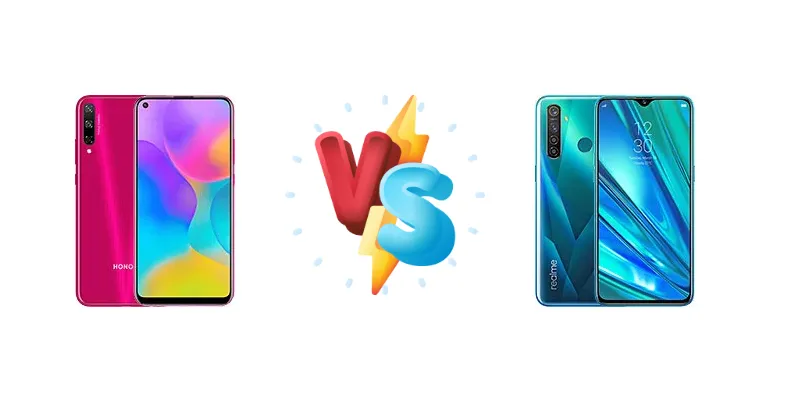
The Honor Play 3 and Realme 5 Pro represent compelling options in the crowded budget smartphone market. Both aim to deliver a solid experience without breaking the bank, but they take different approaches. The Realme 5 Pro, leveraging Qualcomm's Snapdragon 712, focuses on performance and faster charging, while the Honor Play 3 relies on Huawei's Kirin 710F and a more conservative power profile. This comparison dives deep into the specifics to determine which device offers the best value.
🏆 Quick Verdict
For most users, the Realme 5 Pro is the better choice. Its Snapdragon 712 chipset, built on a more efficient 10nm process, provides a noticeable performance advantage, and the 20W fast charging significantly reduces downtime. While both phones offer similar endurance ratings, the Realme 5 Pro’s charging speed is a key differentiator.
| Network |
|---|
| 2G bands | GSM 850 / 900 / 1800 / 1900 | GSM 850 / 900 / 1800 / 1900 |
| 3G bands | HSDPA 850 / 900 / 1900 / 2100 | HSDPA 850 / 900 / 2100 |
| 4G bands | 1, 3, 5, 7, 8, 34, 38, 39, 40, 41 | 1, 3, 5, 8, 38, 40, 41 - India |
| Speed | HSPA 42.2/5.76 Mbps, LTE (2CA) Cat6 400/50 Mbps | HSPA, LTE |
| Technology | GSM / CDMA / HSPA / LTE | GSM / HSPA / LTE |
| | CDMA 800 & TD-SCDMA | 1, 3, 5, 7, 8, 20, 28, 38, 40, 41 - EMEA |
| Launch |
|---|
| Announced | 2019, September. Released 2019, September | 2019, August 20. Released 2019, September |
| Status | Discontinued | Discontinued |
| Body |
|---|
| Build | Glass front, plastic back, plastic frame | Glass front (Gorilla Glass 3+), plastic back, plastic frame |
| Dimensions | 159.8 x 76.1 x 8.1 mm (6.29 x 3.00 x 0.32 in) | 157 x 74.2 x 8.9 mm (6.18 x 2.92 x 0.35 in) |
| SIM | Nano-SIM + Nano-SIM | Nano-SIM + Nano-SIM |
| Weight | 176 g (6.21 oz) | 184 g (6.49 oz) |
| | IP5X (dust), IPX4 (water) resistance | Weather-sealed ports & loudspeaker |
| Display |
|---|
| Protection | - | Corning Gorilla Glass 3+ |
| Resolution | 720 x 1560 pixels, 19.5:9 ratio (~269 ppi density) | 1080 x 2340 pixels, 19.5:9 ratio (~409 ppi density) |
| Size | 6.39 inches, 100.2 cm2 (~82.4% screen-to-body ratio) | 6.3 inches, 97.4 cm2 (~83.6% screen-to-body ratio) |
| Type | IPS LCD | IPS LCD, 450 nits (typ) |
| Platform |
|---|
| CPU | Octa-core (4x2.2 GHz Cortex-A73 & 4x1.7 GHz Cortex-A53) | Octa-core (2x2.3 GHz Kryo 360 Gold & 6x1.7 GHz Kryo 360 Silver) |
| Chipset | Kirin 710F (12 nm) | Qualcomm SDM712 Snapdragon 712 (10 nm) |
| GPU | Mali-G51 MP4 | Adreno 616 |
| OS | Android 9.0 (Pie), EMUI 9.1 | Android 9.0 (Pie), upgradable to Android 11, Realme UI 2.0 |
| Memory |
|---|
| Card slot | microSDXC (uses shared SIM slot) | microSDXC (dedicated slot) |
| Internal | 64GB 4GB RAM, 64GB 6GB RAM, 128GB 4GB RAM | 64GB 4GB RAM, 64GB 6GB RAM, 128GB 4GB RAM, 128GB 8GB RAM |
| | - | UFS 2.1 |
| Main Camera |
|---|
| Features | LED flash, HDR, panorama | LED flash, HDR, panorama |
| Quad | - | 48 MP, f/1.8, (wide), 1/2.0", 0.8µm, PDAF
8 MP, f/2.2, 13mm (ultrawide)
2 MP (macro)
Auxiliary lens |
| Triple | 48 MP, f/1.8, 27mm (wide), 1/2.0", 0.8µm, PDAF
8 MP, f/2.4, 13mm (ultrawide), 1/4.0", 1.12µm
Auxiliary lens | - |
| Video | 1080p@30fps | 4K@30fps, 1080p@30/60/120fps, 720p@960fps, gyro-EIS |
| Selfie camera |
|---|
| Features | HDR | HDR, panorama |
| Single | 8 MP, f/2.0 | 16 MP, f/2.0, 25mm (wide), 1/3.06", 1.0µm |
| Video | 1080p@30fps | 1080p@30fps |
| Sound |
|---|
| 3.5mm jack | Yes | Yes |
| 35mm jack | Yes | Yes |
| Loudspeaker | Yes | Yes |
| Comms |
|---|
| Bluetooth | 5.0, A2DP, LE | 5.0, A2DP, LE |
| NFC | No | No |
| Positioning | GPS, GLONASS, BDS | GPS, GLONASS, GALILEO, BDS |
| Radio | FM radio | FM radio |
| USB | microUSB 2.0, OTG | USB Type-C 2.0, OTG |
| WLAN | Wi-Fi 802.11 b/g/n, Wi-Fi Direct | Wi-Fi 802.11 a/b/g/n/ac, dual-band, Wi-Fi Direct |
| Features |
|---|
| Sensors | Accelerometer, proximity, compass | Fingerprint (rear-mounted), accelerometer, gyro, proximity, compass |
| Battery |
|---|
| Charging | 10W wired | 20W wired, 50% in 30 min |
| Type | Li-Po 4000 mAh, non-removable | 4035 mAh, non-removable |
| Misc |
|---|
| Colors | Magic Night Black, Aurora Blue, Charm Red | Crystal Green, Crystal Blue, Chroma White |
| Models | ASK-AL00x | RMX1971, RMX1973 |
| Price | About 130 EUR | About 430 EUR |
| Tests |
|---|
| Audio quality | - |
Noise -93.3dB / Crosstalk -92.0dB |
| Battery life | - | Endurance rating 100h |
| Camera | - |
Photo / Video |
| Display | - |
Contrast ratio: 1875:1 (nominal) |
| Loudspeaker | - |
Voice 66dB / Noise 72dB / Ring 85dB |
| Performance | - |
AnTuTu: 182765 (v7)
GeekBench: 6106 (v4.4)
GFXBench: 12fps (ES 3.1 onscreen) |
Honor Play 3
- Potentially more stable software (region dependent)
- May offer a slightly lower price point
- Comparable battery endurance
- Slower 10W charging
- Less powerful Kirin 710F chipset
- Limited performance headroom for demanding tasks
Realme 5 Pro
- Faster 20W charging with 30-minute 50% boost
- More efficient Snapdragon 712 chipset
- Better performance for gaming and multitasking
- Higher peak display brightness
- Software updates may be less consistent
- Potentially slightly higher price
Display Comparison
Both the Honor Play 3 and Realme 5 Pro feature displays with a 1875:1 contrast ratio, suggesting similar visual pop. However, the Realme 5 Pro boasts a measured peak brightness of 512 nits, which is a tangible advantage in outdoor visibility compared to the Honor Play 3, where brightness data is unavailable. While both likely utilize IPS LCD panels, the Realme 5 Pro’s higher brightness makes it more usable in direct sunlight.
Camera Comparison
Both devices are advertised with 'Photo / Video' capabilities, but detailed sensor information is lacking. Without specifics, it’s difficult to make a definitive judgment. However, the Realme 5 Pro’s brand positioning often emphasizes camera performance, suggesting a potentially more refined image processing pipeline. The absence of details on OIS or sensor size on either device suggests a focus on affordability over advanced camera features. It's likely both rely on software algorithms to enhance image quality.
Performance
The core difference lies in the chipsets. The Realme 5 Pro’s Qualcomm Snapdragon 712 (10nm) utilizes Kryo 360 Gold and Silver cores, clocked up to 2.3 GHz, offering a performance edge over the Honor Play 3’s Kirin 710F (12nm). The 10nm process of the Snapdragon 712 translates to better thermal efficiency, potentially reducing throttling during sustained workloads like gaming. The Kirin 710F’s Cortex-A73 cores, while capable, are less efficient. While both have octa-core CPUs, the architectural differences favor the Snapdragon 712.
Battery Life
Both phones achieve an endurance rating of 100 hours, indicating comparable battery life under similar usage scenarios. However, the Realme 5 Pro’s 20W wired charging is a significant advantage, allowing it to reach 50% charge in just 30 minutes. The Honor Play 3 is limited to 10W charging, resulting in a considerably longer charging time. This difference in charging speed dramatically impacts the user experience, especially for those who need to quickly top up their battery.
Buying Guide
Buy the Honor Play 3 if you prioritize a potentially more stable software experience (depending on region and updates) and are comfortable with slower charging speeds. Buy the Realme 5 Pro if you value performance for gaming and multitasking, and appreciate the convenience of significantly faster 20W charging. The Realme 5 Pro is the better option for users who frequently use their phone for demanding tasks.
Frequently Asked Questions
❓ Does the Snapdragon 712 in the Realme 5 Pro get hot during prolonged gaming sessions?
The Snapdragon 712, built on a 10nm process, is relatively efficient. While it will warm up during extended gaming, the thermal management is generally good, and throttling is less likely compared to the Kirin 710F due to the more efficient manufacturing process. Expect playable frame rates for most popular titles.
❓ Is the 10W charging on the Honor Play 3 noticeably slow in everyday use?
Yes, 10W charging is significantly slower than the 20W charging on the Realme 5 Pro. A full charge will take considerably longer, potentially requiring overnight charging. This is a major drawback for users who need to quickly top up their battery throughout the day.
❓ How does the software experience differ between Realme UI and EMUI (or whatever Honor is using)?
Realme UI is generally considered to be lighter and closer to stock Android, while Honor's software (depending on the region and model) can be more heavily customized. Realme UI often receives faster updates, but this can vary. User preference plays a large role here.