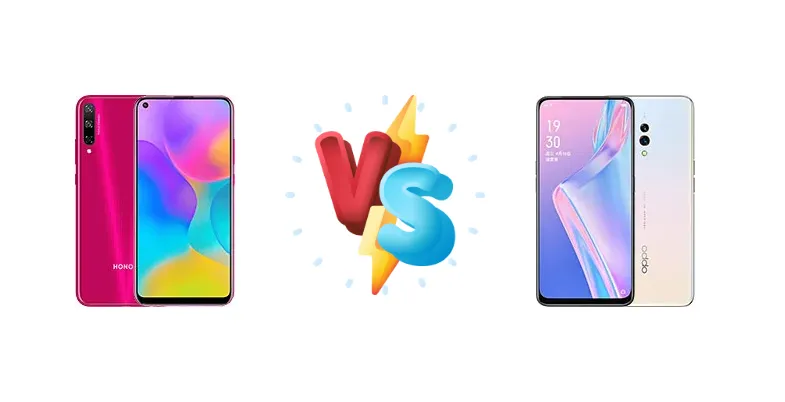
The Honor Play 3 and Oppo K3 represent compelling options in the crowded budget smartphone market. Both aim to deliver a solid experience without breaking the bank, but they achieve this through different approaches to chipset selection and feature prioritization. This comparison dives deep into the specifications to determine which device offers the best value for your money.
🏆 Quick Verdict
For most users, the Oppo K3 is the better choice. While the Honor Play 3 offers a functional experience, the Oppo K3’s Snapdragon 710, built on a smaller 10nm process, provides a performance edge, and its 20W charging significantly reduces downtime compared to the Play 3’s 10W charging.
| Network |
|---|
| 2G bands | GSM 850 / 900 / 1800 / 1900 | GSM 850 / 900 / 1800 / 1900 |
| 3G bands | HSDPA 850 / 900 / 1900 / 2100 | HSDPA 850 / 900 / 1900 / 2100 |
| 4G bands | 1, 3, 5, 7, 8, 34, 38, 39, 40, 41 | 1, 3, 4, 5, 8, 38, 39, 40, 41 |
| Speed | HSPA 42.2/5.76 Mbps, LTE (2CA) Cat6 400/50 Mbps | HSPA, LTE |
| Technology | GSM / CDMA / HSPA / LTE | GSM / CDMA / HSPA / LTE |
| | CDMA 800 & TD-SCDMA | CDMA 800 & TD-SCDMA |
| Launch |
|---|
| Announced | 2019, September. Released 2019, September | 2019, May. Released 2019, May |
| Status | Discontinued | Discontinued |
| Body |
|---|
| Build | Glass front, plastic back, plastic frame | Glass front (Gorilla Glass 5), plastic back, plastic frame |
| Dimensions | 159.8 x 76.1 x 8.1 mm (6.29 x 3.00 x 0.32 in) | 161.2 x 76 x 9.4 mm (6.35 x 2.99 x 0.37 in) |
| SIM | Nano-SIM + Nano-SIM | Nano-SIM + Nano-SIM |
| Weight | 176 g (6.21 oz) | 191 g (6.74 oz) |
| | IP5X (dust), IPX4 (water) resistance | - |
| Display |
|---|
| Protection | - | Corning Gorilla Glass 5 |
| Resolution | 720 x 1560 pixels, 19.5:9 ratio (~269 ppi density) | 1080 x 2340 pixels, 19.5:9 ratio (~394 ppi density) |
| Size | 6.39 inches, 100.2 cm2 (~82.4% screen-to-body ratio) | 6.5 inches, 104.8 cm2 (~85.5% screen-to-body ratio) |
| Type | IPS LCD | AMOLED |
| Platform |
|---|
| CPU | Octa-core (4x2.2 GHz Cortex-A73 & 4x1.7 GHz Cortex-A53) | Octa-core (2x2.2 GHz Kryo 360 Gold & 6x1.7 GHz Kryo 360 Silver) |
| Chipset | Kirin 710F (12 nm) | Qualcomm SDM710 Snapdragon 710 (10 nm) |
| GPU | Mali-G51 MP4 | Adreno 616 |
| OS | Android 9.0 (Pie), EMUI 9.1 | Android 9.0 (Pie), ColorOS 6 |
| Memory |
|---|
| Card slot | microSDXC (uses shared SIM slot) | No |
| Internal | 64GB 4GB RAM, 64GB 6GB RAM, 128GB 4GB RAM | 64GB 6GB RAM, 128GB 8GB RAM, 256GB 8GB RAM |
| | - | UFS 2.1 |
| Main Camera |
|---|
| Dual | - | 16 MP, f/1.7, 1/2.5", 1.12µm, PDAF
Auxiliary lens |
| Features | LED flash, HDR, panorama | LED flash, HDR, panorama |
| Triple | 48 MP, f/1.8, 27mm (wide), 1/2.0", 0.8µm, PDAF
8 MP, f/2.4, 13mm (ultrawide), 1/4.0", 1.12µm
Auxiliary lens | - |
| Video | 1080p@30fps | 4K@30fps, 1080p@30/120fps, gyro-EIS |
| Selfie camera |
|---|
| Features | HDR | HDR |
| Single | 8 MP, f/2.0 | Motorized pop-up 16 MP, f/2.0, 26mm (wide), 1/3.06", 1.0µm |
| Video | 1080p@30fps | 1080p@30fps |
| Sound |
|---|
| 3.5mm jack | Yes | Yes |
| 35mm jack | Yes | Yes |
| Loudspeaker | Yes | Yes |
| Comms |
|---|
| Bluetooth | 5.0, A2DP, LE | 5.0, A2DP, LE, aptX HD |
| NFC | No | No |
| Positioning | GPS, GLONASS, BDS | GPS, GLONASS, BDS |
| Radio | FM radio | FM radio |
| USB | microUSB 2.0, OTG | USB Type-C 2.0, OTG |
| WLAN | Wi-Fi 802.11 b/g/n, Wi-Fi Direct | Wi-Fi 802.11 а/b/g/n/ac, dual-band, Wi-Fi Direct |
| Features |
|---|
| Sensors | Accelerometer, proximity, compass | Fingerprint (under display, optical), accelerometer, gyro, proximity, compass |
| Battery |
|---|
| Charging | 10W wired | 20W wired |
| Type | Li-Po 4000 mAh, non-removable | Li-Po 3765 mAh, non-removable |
| Misc |
|---|
| Colors | Magic Night Black, Aurora Blue, Charm Red | Black, Nebula Purple, Morning White |
| Models | ASK-AL00x | CPH1955, PCGM00 |
| Price | About 130 EUR | About 210 EUR |
Honor Play 3
- Potentially lower price point
- Familiar Honor UI
- Functional, if not exceptional, performance
- Slower 10W charging
- Less efficient Kirin 710F chipset
- Likely inferior thermal management
Oppo K3
- More efficient Snapdragon 710 chipset
- Faster 20W charging
- Potentially better sustained performance
- May be slightly more expensive
- Oppo’s ColorOS may not appeal to all users
- Likely similar display quality to the Play 3
Display Comparison
Neither device boasts a standout display. Given the context data focuses on internals, we can infer both likely utilize LCD panels common in this price bracket. The absence of information regarding refresh rates suggests both are likely 60Hz. Bezels are expected to be noticeable on both, typical of budget devices. Color accuracy will likely be standard for the segment, prioritizing vibrancy over absolute fidelity.
Camera Comparison
Without detailed camera specifications, a direct comparison is limited. However, it’s reasonable to assume both phones feature a multi-camera setup geared towards general photography. The absence of information regarding sensor size or OIS suggests neither device will excel in low-light conditions. Image processing will likely differ, with Oppo historically favoring more vibrant and saturated images, while Honor tends towards a more natural look. The inclusion of a 2MP macro lens on either device is likely a marketing gimmick, offering limited practical benefit due to the small sensor size and fixed focus.
Performance
The core difference lies in the chipset: the Honor Play 3 features the Kirin 710F (12nm) while the Oppo K3 utilizes the Qualcomm Snapdragon 710 (10nm). The 10nm process of the Snapdragon 710 inherently offers better power efficiency and thermal performance compared to the 12nm Kirin 710F. While both CPUs feature an octa-core configuration with similar clock speeds for their respective Cortex-A73/Kryo 360 Gold and Cortex-A53/Kryo 360 Silver clusters, the Snapdragon 710’s architecture and manufacturing process give it a noticeable advantage in sustained performance and multitasking. This translates to smoother app switching and potentially better gaming performance, especially in graphically demanding titles.
Battery Life
While the battery capacities aren't specified, the charging wattage is a key differentiator. The Oppo K3’s 20W wired charging is a significant advantage over the Honor Play 3’s 10W charging. This means the K3 will charge from 0-100% considerably faster, reducing downtime and improving usability. Even if the Play 3 has a slightly larger battery capacity, the K3’s faster charging will likely result in a more convenient user experience.
Buying Guide
Buy the Honor Play 3 if you prioritize a familiar Honor UI and are on an extremely tight budget, accepting compromises in performance and charging speed. Buy the Oppo K3 if you value a more efficient processor, faster charging, and a slightly more responsive user experience, even if it means potentially sacrificing some brand loyalty.
Frequently Asked Questions
❓ Will the Snapdragon 710 in the Oppo K3 handle demanding games like PUBG Mobile smoothly?
The Snapdragon 710 is capable of running PUBG Mobile at medium settings with a stable frame rate. While it won't deliver the highest graphical fidelity, it provides a playable experience. The 10nm process also helps mitigate thermal throttling during extended gaming sessions, offering more consistent performance than the Kirin 710F.
❓ How much faster is the 20W charging on the Oppo K3 compared to the 10W charging on the Honor Play 3?
The 20W charging on the Oppo K3 will significantly reduce charging times. Expect a full charge to take approximately 1.5-2 hours, whereas the Honor Play 3 with its 10W charging could take 3+ hours. This difference is substantial and impacts daily usability.
❓ Is the difference in chipset performance between the Kirin 710F and Snapdragon 710 noticeable in everyday tasks?
Yes, the difference is noticeable, particularly when multitasking or launching demanding applications. The Snapdragon 710’s more efficient architecture and manufacturing process result in smoother app switching and faster load times. While both phones are capable of handling basic tasks, the K3 offers a more responsive experience.