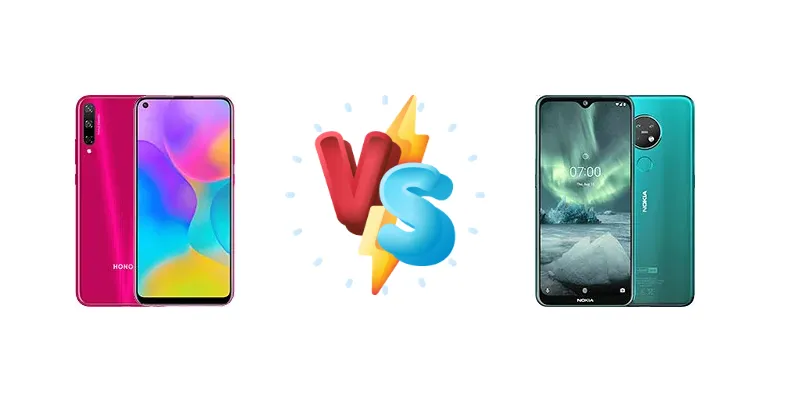
The Honor Play 3 and Nokia 7.2 represent compelling options in the sub-$200 smartphone market. While both aim to deliver essential features at an accessible price, they take different approaches to achieving this. The Honor Play 3 leverages Huawei’s Kirin chipset, while the Nokia 7.2 opts for a Qualcomm Snapdragon. This comparison dissects their key differences to help you determine which device best suits your needs.
🏆 Quick Verdict
For the average user prioritizing consistent performance and a slightly brighter display, the Nokia 7.2 emerges as the better choice. While both phones share 10W charging and similar battery endurance ratings, the Snapdragon 660 offers a more mature and stable software experience, offsetting the Kirin 710F’s theoretical CPU advantages.
| Network |
|---|
| 2G bands | GSM 850 / 900 / 1800 / 1900 | GSM 850 / 900 / 1800 / 1900 |
| 3G bands | HSDPA 850 / 900 / 1900 / 2100 | HSDPA 850 / 900 / 2100 - ROW |
| 4G bands | 1, 3, 5, 7, 8, 34, 38, 39, 40, 41 | 1, 3, 5, 7, 8, 20, 28, 38, 40, 41 - ROW |
| Speed | HSPA 42.2/5.76 Mbps, LTE (2CA) Cat6 400/50 Mbps | HSPA 42.2/5.76 Mbps, LTE (2CA) Cat6 300/50 Mbps or LTE Cat4 150/50 Mbps |
| Technology | GSM / CDMA / HSPA / LTE | GSM / HSPA / LTE |
| | CDMA 800 & TD-SCDMA | 1, 3, 5, 8, 40, 41 - IN |
| Launch |
|---|
| Announced | 2019, September. Released 2019, September | 2019, September 05. Released 2019, September 23 |
| Status | Discontinued | Discontinued |
| Body |
|---|
| Build | Glass front, plastic back, plastic frame | Glass front (Gorilla Glass 3), glass back (Gorilla Glass 3), plastic frame |
| Dimensions | 159.8 x 76.1 x 8.1 mm (6.29 x 3.00 x 0.32 in) | 159.9 x 75.2 x 8.3 mm (6.30 x 2.96 x 0.33 in) |
| SIM | Nano-SIM + Nano-SIM | · Nano-SIM· Nano-SIM + Nano-SIM |
| Weight | 176 g (6.21 oz) | 180 g (6.35 oz) |
| | IP5X (dust), IPX4 (water) resistance | - |
| Display |
|---|
| Protection | - | Corning Gorilla Glass 3 |
| Resolution | 720 x 1560 pixels, 19.5:9 ratio (~269 ppi density) | 1080 x 2280 pixels, 19:9 ratio (~400 ppi density) |
| Size | 6.39 inches, 100.2 cm2 (~82.4% screen-to-body ratio) | 6.3 inches, 99.1 cm2 (~82.4% screen-to-body ratio) |
| Type | IPS LCD | IPS LCD, HDR10 |
| Platform |
|---|
| CPU | Octa-core (4x2.2 GHz Cortex-A73 & 4x1.7 GHz Cortex-A53) | Octa-core (4x2.2 GHz Kryo 260 Gold & 4x1.8 GHz Kryo 260 Silver) |
| Chipset | Kirin 710F (12 nm) | Qualcomm SDM660 Snapdragon 660 (14 nm) |
| GPU | Mali-G51 MP4 | Adreno 512 |
| OS | Android 9.0 (Pie), EMUI 9.1 | Android 9.0 (Pie), upgradable to Android 11, Android One |
| Memory |
|---|
| Card slot | microSDXC (uses shared SIM slot) | microSDXC (dedicated slot) |
| Internal | 64GB 4GB RAM, 64GB 6GB RAM, 128GB 4GB RAM | 64GB 4GB RAM, 64GB 6GB RAM, 128GB 4GB RAM, 128GB 6GB RAM |
| | - | eMMC 5.1 |
| Main Camera |
|---|
| Features | LED flash, HDR, panorama | Zeiss optics, LED flash, panorama, HDR |
| Triple | 48 MP, f/1.8, 27mm (wide), 1/2.0", 0.8µm, PDAF
8 MP, f/2.4, 13mm (ultrawide), 1/4.0", 1.12µm
Auxiliary lens | 48 MP, f/1.8, (wide), 1/2.0", 0.8µm, PDAF
8 MP, f/2.2, 13mm (ultrawide), 1/4.0", 1.12µm
Auxiliary lens |
| Video | 1080p@30fps | 4K@30fps, 1080p@30fps (gyro-EIS) |
| Selfie camera |
|---|
| Features | HDR | Zeiss optics, HDR |
| Single | 8 MP, f/2.0 | 20 MP, f/2.0, (wide), 1/3", 0.9µm |
| Video | 1080p@30fps | 1080p@30fps |
| Sound |
|---|
| 3.5mm jack | Yes | Yes |
| 35mm jack | Yes | Yes |
| Loudspeaker | Yes | Yes |
| Comms |
|---|
| Bluetooth | 5.0, A2DP, LE | 5.0, A2DP, EDR, LE, aptX |
| NFC | No | Yes (excl. India) |
| Positioning | GPS, GLONASS, BDS | GPS, GLONASS, GALILEO, BDS |
| Radio | FM radio | FM radio |
| USB | microUSB 2.0, OTG | USB Type-C 2.0, OTG |
| WLAN | Wi-Fi 802.11 b/g/n, Wi-Fi Direct | Wi-Fi 802.11 b/g/n/ac, dual-band, Wi-Fi Direct |
| Features |
|---|
| Sensors | Accelerometer, proximity, compass | Fingerprint (rear-mounted), accelerometer, gyro, proximity, compass |
| Battery |
|---|
| Charging | 10W wired | 10W wired |
| Type | Li-Po 4000 mAh, non-removable | Li-Po 3500 mAh, non-removable |
| Misc |
|---|
| Colors | Magic Night Black, Aurora Blue, Charm Red | Cyan Green, Charcoal, Ice |
| Models | ASK-AL00x | TA-1193, TA-1178, TA-1196, TA-1181 |
| Price | About 130 EUR | About 240 EUR |
| SAR | - | 1.15 W/kg (head) 0.90 W/kg (body) |
| SAR EU | - | 0.99 W/kg (head) 1.44 W/kg (body) |
| Tests |
|---|
| Audio quality | - |
Noise -93.0dB / Crosstalk -93.4dB |
| Battery life | - |
Endurance rating 69h
|
| Camera | - |
Photo / Video |
| Display | - |
Contrast ratio: 1342:1 (nominal) |
| Loudspeaker | - |
-29.6 LUFS (Average)
|
| Performance | - |
AnTuTu: 139495 (v7), 164484 (v8)
GeekBench: 5440 (v4.4), 1398 (v5.1)
GFXBench: 8.1fps (ES 3.1 onscreen) |
Honor Play 3
- Potentially faster CPU for basic tasks
- Huawei’s EMUI offers unique features
- Competitive price point
- Software optimization can be inconsistent
- GPU performance lags behind Snapdragon 660
- Limited long-term software support
Nokia 7.2
- More refined Android experience
- Brighter and more vibrant display
- Qualcomm’s established ISP for better image processing
- 14nm process is less efficient than newer nodes
- 10W charging is slow
- May be slightly more expensive than the Honor Play 3
Display Comparison
The Nokia 7.2 boasts a noticeably superior display experience, achieving a measured peak brightness of 585 nits compared to an unspecified value for the Honor Play 3. The 1342:1 contrast ratio, consistent across both devices, indicates good black levels, but the Nokia’s higher brightness translates to better visibility in outdoor conditions. While both likely utilize IPS LCD panels, the Nokia’s calibration and brightness level provide a more vibrant and usable viewing experience.
Camera Comparison
Both devices are listed as having Photo/Video capabilities, but detailed sensor information is absent. Given the price point, expectations should be tempered. The Nokia 7.2 likely benefits from Qualcomm’s image signal processor (ISP) within the Snapdragon 660, potentially offering better dynamic range and noise reduction. The absence of specific sensor details makes a definitive comparison impossible, but the Nokia’s ISP advantage is a reasonable assumption. Avoid relying on any potential 2MP macro lenses on either device; their image quality will be limited.
Performance
Both the Honor Play 3’s Kirin 710F and the Nokia 7.2’s Snapdragon 660 feature octa-core CPUs with similar peak clock speeds (2.2 GHz). However, the architectural differences are crucial. The Snapdragon 660, built on a 14nm process, benefits from Qualcomm’s established optimization and Kryo CPU cores, offering a more consistent performance profile. The Kirin 710F, fabricated on a 12nm node, may show theoretical gains in power efficiency, but real-world performance is often hampered by software optimization. The Snapdragon 660’s Adreno 512 GPU is also generally considered more capable than the Mali-G51 MP4 in the Kirin 710F, providing a smoother gaming experience.
Battery Life
Both the Honor Play 3 and Nokia 7.2 share an endurance rating of 69 hours, suggesting comparable battery life under similar usage scenarios. However, the 10W wired charging on both devices is slow by modern standards, requiring over two hours for a full charge. The Snapdragon 660’s generally more efficient power management may contribute to slightly longer real-world usage on the Nokia 7.2, but the difference is unlikely to be substantial.
Buying Guide
Buy the Honor Play 3 if you prioritize a potentially faster CPU for basic multitasking and are comfortable with Huawei’s EMUI software ecosystem. Buy the Nokia 7.2 if you value a more refined Android experience, a brighter and more contrast-rich display for media consumption, and a generally more reliable long-term software support commitment.
Frequently Asked Questions
❓ Is the Snapdragon 660 in the Nokia 7.2 still capable of running modern apps and games?
Yes, the Snapdragon 660 remains a capable chipset for everyday tasks and many popular games. While it won't deliver flagship-level performance, it provides a smooth and responsive experience for most users. Expect to play games like PUBG Mobile at medium settings without significant issues.
❓ How does Huawei’s EMUI software on the Honor Play 3 compare to the stock Android experience on the Nokia 7.2?
EMUI is a heavily customized version of Android, offering a different user interface and a suite of additional features. While some users appreciate these additions, others prefer the cleaner, more stock-like experience of the Nokia 7.2. EMUI also tends to include more pre-installed apps (bloatware).
❓ Given the slow 10W charging, how long does it realistically take to fully charge either phone?
With 10W charging, expect a full charge to take approximately 2.5 to 3 hours from 0%. This is significantly slower than phones with fast charging capabilities, so overnight charging is recommended.